
Bitcoin's Sharp Downturn and Market Implications: Systemic Risks and Investor Psychology in a Shifting Crypto Landscape


 Aime Summary
Systemic Risks: From MicroStrategy to Macro Vulnerabilities
The most immediate flashpoint of systemic risk lies in MicroStrategy (MSTR), the largest corporate holder of Bitcoin. With Bitcoin's price hovering near $80,000, fears have intensified that MSTRMSTR-- could be excluded from major equity indices like MSCIMSCI-- due to its heavy exposure to crypto. Such an exclusion could trigger up to $8.8 billion in outflows, depending on how index providers respond. This reclassification risk has already exacerbated crypto market volatility, with Bitcoin's price swings compounding liquidity challenges for leveraged investors and decentralized platforms.
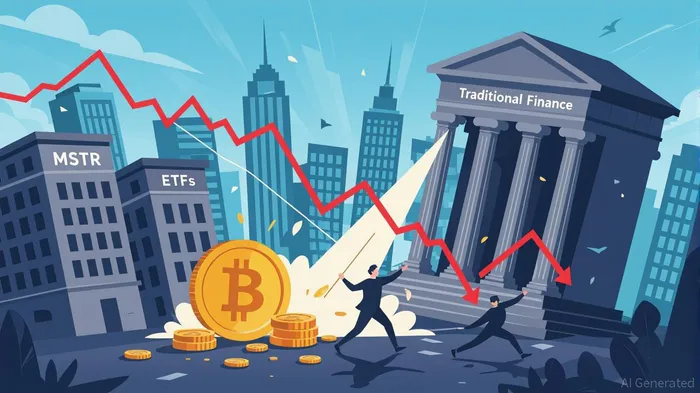 Beyond MSTR, the 2025 crash has exposed vulnerabilities tied to leveraged trading and macroeconomic conditions. A 6% drop in Bitcoin's value in November alone triggered $1.27 billion in leveraged liquidations, compounding stress in decentralized finance protocols like EulerEUL-- and BalancerBAL--. Meanwhile, the Federal Reserve's restrictive monetary policy and persistent 3% inflation have tightened global liquidity, further pressuring risk assets. The collapse of the U.S. government shutdown in October 2025 also created uncertainty, with ETF outflows and thin altcoin liquidity exacerbating the downturn.
Regulatory frameworks are now playing a critical role in shaping these risks. The European Union's Markets in Crypto-Assets Regulation (MiCAR) has begun categorizing crypto assets, distinguishing stablecoins from volatile tokens like Bitcoin. While MiCAR aims to enhance investor protection, it also signals a growing regulatory expectation for compliance and risk management-a shift that could redefine how crypto-heavy firms like MSTR are perceived in traditional benchmarks.
Investor Psychology: From Panic to Prudence
The psychological toll of Bitcoin's 30% slump is evident in investor behavior. Retail investors have sold approximately $4 billion worth of Bitcoin and EthereumETH-- spot ETFs in November, signaling a retreat to traditional assets like gold and Treasuries. Global stock ETFs, by contrast, have attracted a net inflow of $96 billion, reflecting a broader flight to perceived safety.
Economist Rashad Ahmed notes that Bitcoin's financialization-through ETFs, derivatives, and stablecoins-has made it more entangled with traditional markets, increasing its potential to influence or "infect" broader financial systems. While Bitcoin remains too small to trigger a full-scale crisis, its growing integration means it could behave like other risk assets during downturns. Ahmed advises investors to limit Bitcoin allocations to 1–5% of portfolios, warning that higher exposure amplifies vulnerability to its volatility.
The paradox of institutional involvement further complicates investor psychology. Companies like MSTR, which borrow to purchase Bitcoin, introduce leverage that can amplify losses during downturns. Michael Saylor's assertion that MSTR is an "operating company" with a $500 million software business has not fully assuaged concerns, as the firm's balance sheet remains heavily tied to crypto's performance.
Risk Management Strategies: Navigating the New Normal
For investors, the 2025 crash underscores the need for disciplined risk management. Diversification remains a cornerstone strategyMSTR--. Allocating across large-cap cryptocurrencies (Bitcoin, Ethereum), mid-cap tokens (Polygon, Arbitrum), and stablecoins (USDC, USDT) can mitigate exposure to individual asset failures. Morgan Stanley recommends limiting crypto exposure to 2–4% in aggressive portfolios and zero in conservative ones, emphasizing regular rebalancing to maintain risk targets.
Hedging techniques are equally critical. Maintaining 5–15% of a portfolio in stablecoins provides liquidity during downturns, while automated tools like stop-loss orders enforce discipline in selling assets at predetermined levels. Dollar-cost averaging (DCA)-investing fixed amounts regularly regardless of market conditions-also helps avoid emotional decision-making.
Regulatory clarity and macroeconomic monitoring are additional priorities. As MiCAR and similar frameworks evolve, investors must stay informed about how crypto assets are categorized and regulated. Tracking macroeconomic indicators like GDP per capita, internet penetration, and inflation rates can also provide early signals about adoption trends and market stability.
Conclusion: A Tipping Point for Crypto Markets
Bitcoin's 2025 downturn is more than a price correction-it is a stress test for the crypto ecosystem's resilience. While systemic risks remain manageable for now, the interplay of leverage, regulatory scrutiny, and macroeconomic volatility suggests that the asset class is entering a new phase of integration with traditional finance. For investors, the path forward demands a balance of caution and adaptability, leveraging diversification, hedging, and disciplined strategies to navigate the uncertainties ahead.
[2] Crypto regulation and enforcement: Key risks, trends, and ... [https://www.hoganlovells.com/en/publications/crypto-regulation-and-enforcement-key-risks-trends-and-compliance-priorities]
[3] Strategy's (MSTR) Michael Saylor Dismisses Index Concerns: 'Our Conviction in Bitcoin is Unwavering' [https://bitcoinmagazine.com/news/strategys-mstr-responds-to-concerns]
[5] The Financialization of Bitcoin Will Drive Its Undoing [https://www.bloomberg.com/news/newsletters/2025-11-19/bitcoin-is-becoming-a-bigger-systemic-risk-every-day]
[8] Economic Risk and Cryptocurrency: What Drives Global Digital Asset Adoption? [https://www.mdpi.com/1911-8074/18/8/453]
[10] Top Strategies for Managing Crypto Risk in 2025 [https://www.tokenmetrics.com/blog/top-strategies-for-managing-crypto-risk-in-2025-stay-profitable-in-a-volatile-market?0fad35da_page=14&74e29fd5_page=144]

Delivering real-time insights and analysis on emerging financial trends and market movements.
Latest Articles
Stay ahead of the market.
Get curated U.S. market news, insights and key dates delivered to your inbox.
AInvest
PRO
AInvest
PRO



Comments
No comments yet