
Bitcoin's Sharp Decline in Late 2025: Navigating Macro Risks and Regulatory Uncertainty


 Aime Summary
Macroeconomic Risks: Fed Uncertainty and Investor Flight
The Federal Reserve's indecisiveness over rate cuts in late 2025 emerged as a critical macroeconomic trigger. Policymakers were deeply divided between addressing inflation risks and a weakening labor market, creating a "tossup" scenario for a December rate cut. This uncertainty rippled through financial markets, with Bitcoin ETFs in the U.S. recording over $1.8 billion in net outflows since the Fed's October meeting, reflecting investor caution.
Compounding these issues was a U.S. government shutdown that delayed critical economic data releases, further muddying the outlook. Analysts noted that the shutdown "dampened momentum" for Bitcoin, limiting its ability to participate in broader equity market gains. The shutdown also disrupted operations at key regulatory bodies like the SEC and CFTC, which were already grappling with legacy investigations into crypto fraud, such as the Celsius Network case.
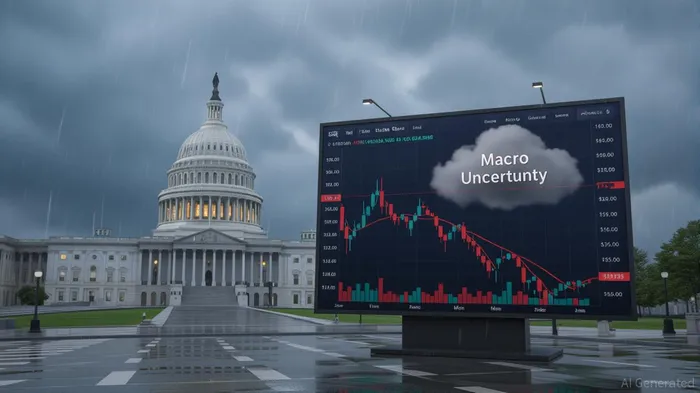
Regulatory Uncertainty: A Lingering Shadow
While no direct regulatory actions targeted Bitcoin in late 2025, the broader regulatory environment remained a drag. The SEC and CFTC's ongoing focus on past market manipulation cases-such as the guilty plea by Celsius Network's former CEO-highlighted persistent enforcement risks. Meanwhile, the government shutdown delayed clarity on new policy frameworks, leaving investors in limbo.
Canaan Inc., a major Bitcoin miner, reported operational updates during this period, including a hashrate increase to 8.25 EH/s by November 2025. While these developments signaled sector resilience, they did not offset the broader market pessimism driven by regulatory ambiguity.
Market Reactions and the Path Forward
The decline in Bitcoin's price was mirrored across major altcoins like EthereumETH-- (ETH) and SolanaSOL-- (SOL), indicating a systemic pullback rather than isolated volatility. Institutional players, however, remained cautiously optimistic. MicroStrategy's continued accumulation of Bitcoin-valued at over $71 billion in its portfolio-reinforced the asset's long-term appeal as a store of value.
For investors, the key takeaway is the interplay between macroeconomic fragility and regulatory ambiguity. While Bitcoin's fundamentals-such as reduced volatility and institutional adoption-remain strong, short-term risks persist. The Fed's eventual rate decision and regulatory clarity in early 2026 will likely dictate the next phase of Bitcoin's price action.
Conclusion
Bitcoin's late-2025 decline serves as a stark reminder of the market's sensitivity to macroeconomic and regulatory shifts. While bullish long-term narratives endure, investors must remain vigilant against near-term headwinds. As Saylor noted, Bitcoin's journey to $150,000-and beyond-will require navigating a landscape where policy uncertainty and economic volatility remain ever-present challenges.

Blending traditional trading wisdom with cutting-edge cryptocurrency insights.
Latest Articles
Stay ahead of the market.
Get curated U.S. market news, insights and key dates delivered to your inbox.






Comments
No comments yet