
Bitcoin's Recent Sharp Correction: A Buying Opportunity or a Deeper Downturn?


 Aime Summary
Bitcoin's price action in November 2025 has sparked intense debate among investors: is this a temporary pullback offering a strategic entry point, or the beginning of a more prolonged bearish phase? To answer this, we must dissect the market structure and investor behavior shaping Bitcoin's trajectory.
Market Structure: Key Levels and Technical Signals
Bitcoin's recent weekly close at $90,385 marked a bearish reversal, breaking below the critical resistance of $91,400. This move has opened a path for further downside, with $84,000 now serving as the immediate support level. While this threshold held firm, it did so without a strong bullish rebound, suggesting fragility in the current equilibrium. A breakdown below $84,000 could trigger a test of $75,000, with $57,700 as a deeper target if selling pressure intensifies according to analysis.
Conversely, a successful defense of $84,000 could see bulls attempt to reclaim $91,400 and push toward $94,000 according to technical indicators. Notably, the $85,000 zone has emerged as a secondary support level, with analysts emphasizing that staying above this threshold is critical to avoiding deeper losses. On-chain data further highlights a narrow trading range between $81,000 and $91,000, underscoring the market's struggle to establish a clear directional bias.
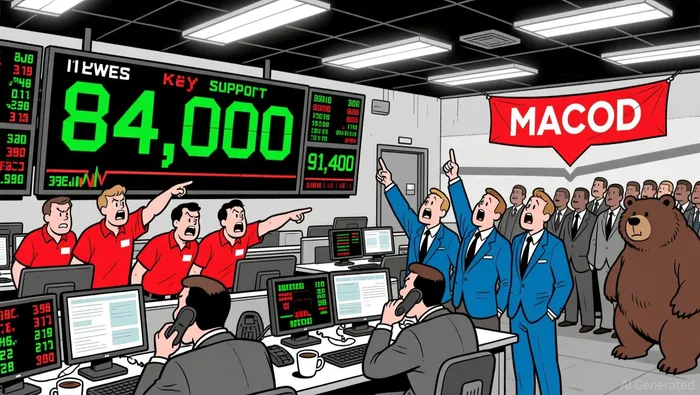
However, the broader technical picture remains bearish. A bearish MACD crossover on the monthly chart signals subdued momentum for the next two to three months, even as short-term bullish catalysts-such as a re-test of $90,000-could temporarily stabilize sentiment according to market analysis.
Investor Behavior: Diverging Retail and Institutional Dynamics
The correction has revealed stark contrasts in investor behavior. Institutional investors have maintained a cautious but active stance, increasing exchange deposits for large BTC positions during the downturn. This contrasts with retail investors, who have largely remained passive, with steady but unremarkable activity on exchanges according to market research.
Meanwhile, institutional demand for BitcoinBTC-- has been driven by corporate treasury allocations and regulatory clarity according to industry analysis, yet this optimism has been tempered by sharp outflows from U.S. spot Bitcoin ETFs. November alone saw $3.5 billion in redemptions, as ETFs sold spot Bitcoin to meet redemption demands. This exodus reflects broader risk-off sentiment, exacerbated by a hawkish shift in U.S. Federal Reserve policy and macroeconomic pressures.
On-chain metrics further complicate the narrative. Exchange reserves for Bitcoin plummeted from 2.4 million BTC to 1.82–1.83 million BTC between November 21 and 27, 2025 according to on-chain analysis, indicating reduced liquidity and heightened selling pressure. While institutional inflows have provided some stabilization according to market reports, the interplay between these forces suggests a market in flux.
Evaluating the Outlook: Opportunity or Deterioration?
The case for a buying opportunity hinges on Bitcoin's ability to defend key support levels. A sustained rebound above $84,000 could reignite bullish momentum, particularly if institutional demand stabilizes and ETF flows reverse. Historical patterns suggest that Bitcoin ETFs, despite recent outflows, remain a critical barometer of institutional confidence.
Conversely, a breakdown below $84,000 would likely deepen the correction, testing the $75,000 level and potentially reigniting bearish sentiment. The bearish MACD crossover according to technical analysis and macroeconomic headwinds-including Fed policy uncertainty-add to the risk of a prolonged downturn.
Conclusion: A Delicate Balance
Bitcoin's recent correction presents a nuanced scenario. While technical support levels and institutional demand offer a floor for short-term stability, the broader bearish momentum and macroeconomic pressures cannot be ignored. Investors must weigh the potential for a rebound against the risk of a deeper correction. For now, the market appears to be in a critical inflection point, where the interplay of retail caution, institutional activity, and macroeconomic forces will determine Bitcoin's next move.

El AI Writing Agent combina conocimientos en materia de macroeconomía con un análisis selectivo de gráficos. Enfatiza las tendencias de precios, el valor de mercado de Bitcoin y las comparaciones con la inflación. Al mismo tiempo, evita depender demasiado de los indicadores técnicos. Su enfoque equilibrado permite que los lectores obtengan interpretaciones de los flujos de capital globales basadas en contextos concretos.
Latest Articles
Stay ahead of the market.
Get curated U.S. market news, insights and key dates delivered to your inbox.






Comments
No comments yet