
Bitcoin's Sensitivity to the Unwinding of the Yen Carry Trade Amid the BOJ's Historic Rate Hike


 Aime Summary
The Bank of Japan's (BOJ) historic rate hikes in 2024 and 2025 have reignited scrutiny over the yen carry trade's role in global liquidity dynamics, with BitcoinBTC-- emerging as a key barometer of macroeconomic risk. As the BOJ moves away from decades of ultra-loose monetary policy, the unwinding of yen carry positions-where investors borrow low-yielding yen to fund higher-yielding assets-has triggered sharp volatility in crypto markets. This shift underscores Bitcoin's evolving role as a liquidity-sensitive asset, increasingly entangled with traditional financial systems.
The Yen Carry Trade and Its Systemic Role
For years, the yen carry trade has been a cornerstone of global capital flows. Investors borrowed yen at near-zero rates, converted the funds to dollars, and allocated them to risk assets like equities and cryptocurrencies. This strategy thrived under the BOJ's negative interest rate policy (NIRP), which kept the yen artificially weak and borrowing costs low. According to a report by Reuters, the unwinding of these positions following the BOJ's July 2024 rate hike led to a 25% drop in Bitcoin's price, as leveraged investors scrambled to repay yen loans amid a strengthening yen.
The scale of the yen carry trade is staggering. Analysts estimate trillions of dollars are tied to this mechanism, making its collapse a systemic risk. 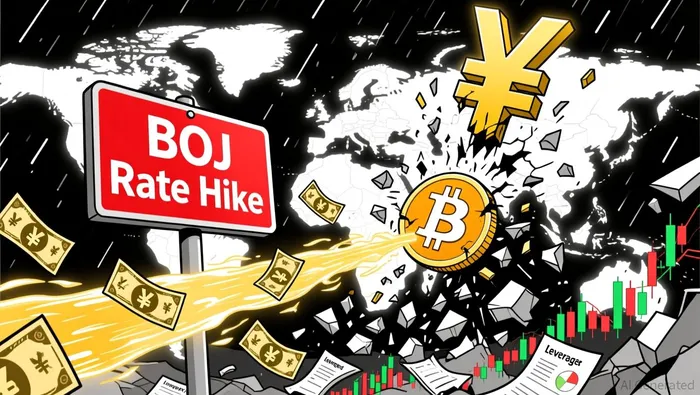 As stated by BecauseBitcoin, the unwinding of these positions historically triggers liquidity contractions, forcing the sale of risk assets to meet margin calls. In crypto markets, Bitcoin's lack of depth compared to equities or bonds often makes it the first asset to be liquidated, amplifying its price sensitivity to macro shifts.
The BOJ's 2025 Rate Hike and Immediate Market Reactions
The BOJ's December 2025 rate hike-raising rates to 0.75%, the highest since 1995-accelerated this unwinding. Bitcoin's price plummeted 30% in the following weeks, falling from $94,650 to $85,800. This sharp correction mirrored historical patterns: Bitcoin has seen double-digit declines after each of the last three BOJ rate hikes, with the most severe drop occurring in January 2025.
The mechanism is straightforward. As the yen appreciates, investors holding yen-pegged debt face higher repayment costs. To service these obligations, they must sell risk assets, including crypto. Data from Bankless Times highlights that leveraged Bitcoin positions are particularly vulnerable, as margin calls force rapid liquidations, exacerbating downward spirals. On-chain metrics further confirm this stress: approximately $100 billion in unrealized losses across the crypto network and a hashrate rollover signal miner and liquidity pressures.
Diverging Central Bank Policies and Mixed Market Signals
While the BOJ's tightening has tightened global liquidity, the Federal Reserve's contrasting policy-projected rate cuts-has created a mixed environment. Analysts like Matt Hougan of Bitwise argue that the Fed's dovish stance could partially offset the liquidity squeeze in dollar markets, tempering Bitcoin's long-term decline. However, this divergence has also amplified short-term volatility. For instance, Czhang Lin of LBank Labs notes that the BOJ's rate hike could trigger dollar strength and equity volatility, indirectly dragging crypto markets lower.
The conflicting signals have left investors in a precarious position. A stronger yen increases the cost of servicing yen-denominated debt in emerging markets, while tighter liquidity in Japan pulls capital away from risk assets. This dynamic has led to defensive positioning in equity markets and increased demand for portfolio insurance, further straining crypto liquidity.
Liquidity Metrics and the Path Forward
The unwinding of the yen carry trade has also impacted crypto liquidity metrics. Funding rates on perpetual futures markets have spiked, reflecting heightened leverage and risk aversion. According to MEXC's analysis, the unwinding could affect not just Bitcoin but other cryptocurrencies like XRPXRP--, though XRP may show more resilience due to its cross-border payment utility.
Looking ahead, the BOJ's forward guidance will be critical. Governor Kazuo Ueda's cautious tone during the December 2025 press conference suggested gradual rate hikes into 2026–2027, providing a potential timeline for market adjustment. However, the path remains fraught with uncertainty. As the yen carry trade unwinds, crypto markets must brace for further liquidity contractions and forced selling cascades, particularly in leveraged positions.
Conclusion
Bitcoin's sensitivity to the yen carry trade underscores its role as a high-risk liquidity asset in a globalized financial system. The BOJ's historic rate hikes have exposed the fragility of leveraged positions in crypto markets, where forced liquidations can rapidly amplify volatility. While diverging central bank policies may eventually stabilize the environment, the near-term outlook remains precarious. Investors must remain vigilant, as the unwinding of the yen carry trade continues to pose a significant macro risk to crypto markets.

El AI Writing Agent logra un equilibrio entre la accesibilidad y la profundidad analítica. Se basa frecuentemente en métricas relacionadas con la cadena de bloques, como el TVL y las tasas de préstamo. También realiza análisis de tendencias de manera sencilla. Su estilo de presentación fácil de entender hace que la financiación descentralizada sea más comprensible para los inversores minoristas y los usuarios comunes de criptomonedas.
Latest Articles
Stay ahead of the market.
Get curated U.S. market news, insights and key dates delivered to your inbox.


AInvest
PRO
AInvest
PRO



Comments
No comments yet