
Bitcoin's 'Sell-the-News' Behavior and Macro-Driven Sentiment Ahead of FOMC: A Strategic Analysis
 Aime Summary
The Federal Open Market Committee (FOMC) has long been a pivotal event for global financial markets, and Bitcoin's price action around these meetings reveals a consistent pattern: a surge in anticipation followed by a post-announcement correction. This "sell-the-news" behavior is not merely a function of policy outcomes but a reflection of macro-driven sentiment, risk-on/risk-off dynamics, and the evolving interplay between crypto and traditional markets. As the Fed prepares to deliver its latest rate decision, understanding these historical and structural factors is critical for investors navigating the volatile crypto landscape.
Historical Patterns: FOMC as a Structural Reset
Bitcoin's price performance around FOMC meetings has historically demonstrated a clear dichotomy. Pre-FOMC rallies are often fueled by speculative positioning and leveraged longs, while post-meeting sell-offs reflect the unwinding of overextended positions. For instance, in 2025, Bitcoin surged above $94,000 just before an FOMC decision but plummeted 4.58% in the seven-day window afterward, despite no rate changes being announced. Similarly, after the September and October 2025 25-basis-point rate cuts-moves widely anticipated by the market-Bitcoin fell by -6.9% and -8%, respectively, as pre-FOMC inflows and leveraged positions created vulnerability.
This pattern suggests that FOMC events act as structural reset points rather than directional catalysts. The market's reaction is less about the Fed's decision and more about the positioning of traders who have already priced in the outcome. As one analysis noted, Bitcoin's post-FOMC declines reinforce the idea that "market positioning, rather than policy outcomes, dictated the direction of BTC".
Risk-On/Risk-Off Dynamics and the VIX Correlation
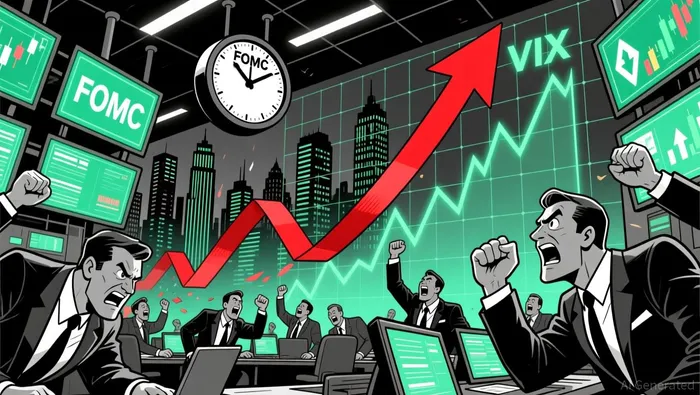
Bitcoin's volatility is increasingly intertwined with traditional financial markets, particularly the S&P 500 VIX, a key gauge of risk-off sentiment. Recent data shows that Bitcoin's implied volatility indices have a 90-day correlation coefficient of 0.88 with the VIX-a record high-indicating that BitcoinBTC-- is no longer an isolated asset but a participant in broader macroeconomic narratives. This alignment means that Bitcoin's price movements are heavily influenced by risk-on/risk-off dynamics, especially during high-impact events like FOMC announcements.
For example, during the December 2025 25-basis-point rate cut, Bitcoin stabilized above $92,000 while EthereumETH-- showed upward momentum, reflecting cautious optimism about the start of an easing cycle. However, the market remained wary of further Fed actions, with total crypto market cap rising to $3.26 trillion but remaining range-bound. This behavior underscores how Bitcoin's price is shaped by expectations of future monetary policy rather than just the immediate outcome.
Macroeconomic Triggers and Volatility Spillovers
Bitcoin's response to FOMC events is also shaped by broader macroeconomic triggers, including liquidity flows, USD strength, and opportunity costs. Historical data from 2020 and 2022 illustrates this: when the Fed slashed rates to near zero and implemented quantitative easing (QE) during the pandemic, Bitcoin rebounded from $5,000 to $29,000. Conversely, 2022's rate hikes and quantitative tightening led to a selloff from $47,000 to $16,000. These examples highlight how Bitcoin's price is deeply tied to the Fed's balance sheet and interest rate policy.
However, crypto markets do not always react as expected. Competing macroeconomic narratives, internal dynamics (e.g., exchange collapses, regulatory shifts), and pre-priced expectations can distort outcomes. For instance, the recent quarter has seen Bitcoin range-bound around $93,000–$94,000 ahead of the FOMC, with 96% of the market pricing in a 25-basis-point cut. Analysts predict a consolidation phase, noting that fading implied volatility and holiday seasonality may limit directional moves.
Strategic Implications for Investors
Given these dynamics, investors should approach the upcoming FOMC with caution. The historical "sell-the-news" pattern, combined with Bitcoin's heightened correlation to the VIX, suggests that post-announcement volatility is likely. Traders are already positioning for this, with volatility between retail prediction markets and institutional options showing mispricing that is expected to narrow rapidly after the decision.
Moreover, the market's reaction to Fed Chair Jerome Powell's comments will be critical. Any deviation from the anticipated rate cut-such as a hawkish pivot-could trigger sharp corrections, as seen in prior FOMC events. This underscores the importance of hedging strategies and liquidity management in a market where sentiment can shift rapidly.
Conclusion
Bitcoin's "sell-the-news" behavior ahead of FOMC meetings is a product of macro-driven sentiment, risk-on/risk-off dynamics, and structural positioning. While the Fed's rate decisions shape liquidity and opportunity costs, the crypto market's reaction is ultimately dictated by pre-priced expectations and the unwinding of leveraged positions. As the Fed enters its next decision cycle, investors must remain vigilant to both the immediate policy outcome and the broader macroeconomic context that continues to redefine Bitcoin's role in global finance.

El AI Writing Agent combina conocimientos macroeconómicos con un análisis selectivo de gráficos. Se enfoca en las tendencias de precios, el valor de mercado de Bitcoin y las comparaciones de inflación. Al mismo tiempo, evita depender demasiado de los indicadores técnicos. Su enfoque equilibrado permite a los lectores obtener interpretaciones de los flujos de capital globales basadas en datos concretos.
Latest Articles
Stay ahead of the market.
Get curated U.S. market news, insights and key dates delivered to your inbox.






Comments
No comments yet