
Bitcoin's Seasonal Correction and Strategic Positioning for 2026: Morgan Stanley's 'Harvest Season' Warning as a Catalyst for Refined Entry Points


 Aime Summary
Morgan Stanley's "Harvest Season" and Technical Bearish Signals
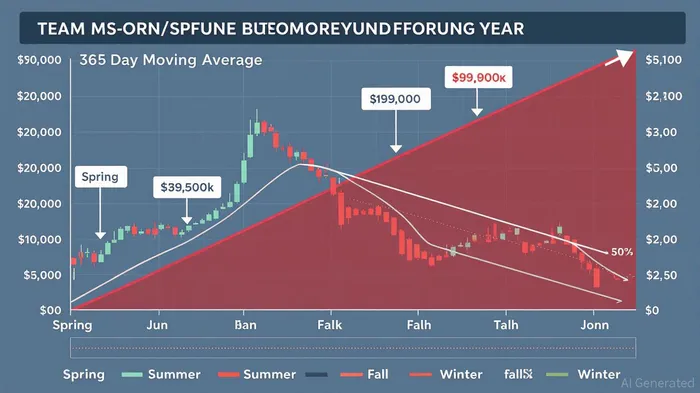
Morgan Stanley Wealth Management's Denny Galindo has framed Bitcoin's current trajectory as a "fall season," a period historically marked by profit-taking and consolidation before a more pronounced downturn, according to a Cointelegraph report. This analogy, borrowed from macroeconomic and commodity cycles, highlights the importance of securing gains amid weakening momentumMMT--. The recent price drop below $99,000, coupled with a stall in liquidity inflows from stablecoins, ETFs, and digital asset treasuries, signals a critical inflection point, according to a Yahoo Finance report.
Technical indicators further reinforce this caution. Bitcoin's breach of its 365-day moving average-a key benchmark for long-term trend analysis-has been interpreted by analysts like Julio Moreno of CryptoQuant as a confirmation of a technical bear market, according to the Cointelegraph report. Meanwhile, Wintermute, a major crypto market-maker, notes that liquidity plateauing reflects reduced speculative fervor and heightened volatility risks, as reported by the Yahoo Finance report. These signals collectively suggest that the market is transitioning from a bull-driven phase to one requiring disciplined risk management.
Historical Patterns and the Four-Year Cycle
Bitcoin's four-year cycle has historically been a reliable predictor of market behavior, with bull runs followed by sharp corrections. However, recent disruptions-such as the emergence of spot ETFs and macroeconomic shifts-have altered this pattern. Tom Lee, a prominent crypto analyst, argues that Bitcoin's traditional four-year rhythm has been "broken," with a "longer cycle" now emerging, according to a Lookonchain report. Despite this, the seasonal framework remains a useful heuristic.
Historical data reveals that Bitcoin's "fall" phases often precede winter downturns, during which prices can drop by up to 80% from peaks, according to a Coinotag report. For example, the 2017 bull run culminated in a 2018 winter that saw Bitcoin fall from $19,000 to $3,200, while the 2021 peak of $69,000 gave way to a 2022 winter low of $16,000. These corrections, though painful, have historically created buying opportunities for long-term investors. The current context, however, is distinct: institutional adoption and ETF-driven inflows have diversified Bitcoin's investor base, potentially softening the severity of future downturns.
Institutional Interest and the Role of ETFs
Despite near-term bearish signals, institutional interest in Bitcoin remains robust. Morgan StanleyMS-- Research's Michael Cyprys emphasizes that Bitcoin is increasingly viewed as a "digital inflation hedge" and a legitimate addition to diversified portfolios, according to the Yahoo Finance report. This sentiment is reflected in the $137 billion in assets under management for US spot Bitcoin ETFs, according to the Cointelegraph report.
Yet institutional allocations are inherently slow-moving. Regulatory scrutiny, internal compliance processes, and risk management protocols mean that large-scale inflows or outflows are unlikely to materialize rapidly, as noted in a Lookonchain report. This dynamic creates a unique challenge for retail investors: while ETFs have democratized access to Bitcoin, they also amplify market sensitivity to macroeconomic shifts, such as Fed policy changes or fiscal developments, as highlighted in the Lookonchain report.
Strategic Positioning for 2026: A Framework for Refined Entry Points
Morgan Stanley's seasonal framework offers a roadmap for strategic positioning in 2026. The firm's cautionary stance-urging investors to "harvest gains" during the fall phase-aligns with historical patterns of cyclical corrections. However, the absence of specific 2026 entry points in the provided research necessitates a more generalized approach.
- Liquidity Monitoring: Investors should closely track liquidity metrics, including stablecoin outflows, ETF inflows, and treasury activity. A resumption of liquidity growth could signal the end of the fall phase and the onset of a new bull cycle, according to the Yahoo Finance report.
- Dollar-Cost Averaging (DCA): Given the uncertainty around the duration of the fall phase, DCA strategies-where investors gradually accumulate Bitcoin at regular intervals-can mitigate timing risks.
- Macro Diversification: Bitcoin's correlation with risk assets and inflation expectations means that strategic allocations should be balanced with traditional hedges, such as gold or long-duration bonds.
- Scenario Planning: Investors must prepare for both a soft landing (a shallow correction followed by a new bull phase) and a hard winter (a severe downturn requiring patience for recovery).
Conclusion: Navigating Uncertainty with Discipline
Bitcoin's current "fall season" is a reminder of the market's inherent volatility and the importance of disciplined risk management. While Morgan Stanley's warning highlights the need for caution, it also underscores the potential for refined entry points in 2026. By leveraging historical patterns, institutional insights, and liquidity dynamics, investors can position themselves to navigate the coming months with resilience-and emerge stronger as the cycle evolves.

Delivering real-time insights and analysis on emerging financial trends and market movements.
Latest Articles
Stay ahead of the market.
Get curated U.S. market news, insights and key dates delivered to your inbox.
AInvest
PRO
AInvest
PRO



Comments
No comments yet