
Bitcoin's Role as a Risk Asset in a Commodity-Driven World


 Aime Summary
In a global economy increasingly shaped by macroeconomic volatility and geopolitical uncertainty, Bitcoin's position as a risk asset has evolved beyond its speculative origins. As traditional commodities like oil, gold, and natural gas continue to anchor investor sentiment, Bitcoin's dynamic correlation with these assets-and its hedging potential during turbulent periods-has become a focal point for portfolio strategists. This analysis explores how BitcoinBTC-- interacts with commodities in both short- and long-term regimes, offering insights into its diversification value amid shifting market conditions.
Dynamic Correlation in Turbulent Markets
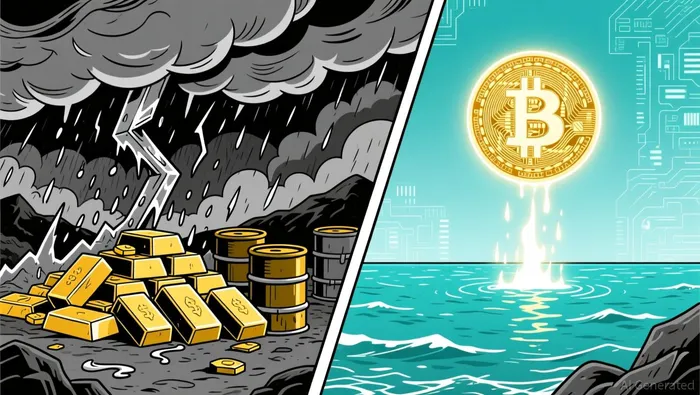
Bitcoin's relationship with commodities is far from static. During acute market stress, such as the October 2025 sell-off, gold surged to record highs as investors flocked to its time-tested safe-haven status. Meanwhile, Bitcoin absorbed volatility before stabilizing, signaling its maturing role as a secondary refuge for capital during economic normalization. This duality highlights a key insight: while gold remains the first-line defense in crises, Bitcoin's asymmetric volatility responses allow it to act as a complementary hedge when uncertainty begins to wane.
Empirical studies from 2025 reveal that Bitcoin's logarithmic prices exhibit significant positive associations with lagged values of oil and gold, particularly in short-term regimes. For instance, Bitcoin's price movements are influenced by shifts in Brent crude and gold prices, though the reverse is less pronounced. This suggests that Bitcoin often reacts to, rather than drives, commodity-driven market shocks. However, during periods of geopolitical tension-such as energy transition policies or supply chain disruptions-Bitcoin's low correlation with oil and natural gas becomes a strategic advantage for diversification according to research.
Hedging Effectiveness: Short-Term vs. Long-Term Regimes
Bitcoin's hedging potential is most evident in short-term turbulent regimes. Research indicates that it can mitigate portfolio risk during acute shocks, particularly after events like the pandemic or the Russia-Ukraine conflict. For example, Bitcoin's asymmetric volatility spillovers-where it absorbs shocks from traditional assets rather than amplifying them-make it a useful tool for dampening downside risk in volatile environments according to studies. This contrasts with gold, which, while reliable in crises, shows weaker dynamic ties to Bitcoin, suggesting divergent roles in portfolio management according to research.
In long-term regimes, however, Bitcoin's effectiveness as a hedge diminishes. Studies from 2025 show that its performance becomes inconsistent outside of specific crisis contexts, often diverging from gold during stable periods according to analysis. This underscores the importance of timing: Bitcoin's value as a hedging instrument is most pronounced during transitions from crisis to normalization, whereas gold maintains a steadier, albeit less dynamic, safe-haven role according to analysis.
Bitcoin as a Risk Asset in a Commodity-Driven World
The interplay between Bitcoin and commodities is further complicated by macroeconomic cycles. During periods of high economic uncertainty, Bitcoin's correlation with oil and natural gas tends to weaken, reinforcing its appeal as a non-correlated asset. Conversely, in growth-driven environments, its price dynamics align more closely with energy markets, reflecting broader risk-on sentiment according to research. This duality positions Bitcoin as both a risk asset and a hedge, depending on the regime.
Notably, the rise of carbon emission futures and other ESG-linked instruments has added another layer to this dynamic. Bitcoin's interactions with these emerging markets highlight its potential to diversify portfolios beyond traditional commodities, though its volatility remains a double-edged sword according to analysis. For investors, the key lies in balancing Bitcoin's exposure to macroeconomic signals with its inherent price swings.
Investment Implications
For portfolio managers navigating a commodity-driven world, Bitcoin's role is best understood through a regime-specific lens. In short-term turbulent markets, it offers asymmetric hedging benefits, particularly when paired with gold and energy assets. Over the long term, however, its effectiveness as a hedge depends on the broader economic context, with gold retaining a more consistent safe-haven profile.
The October 2025 market dynamics exemplify this duality: while gold anchored stability during the initial shock, Bitcoin's ability to absorb volatility and stabilize later in the cycle demonstrated its evolving utility according to analysis. This suggests that a diversified portfolio should allocate Bitcoin not as a replacement for traditional safe havens, but as a complementary tool to capture momentum during normalization phases.
Conclusion
Bitcoin's dynamic correlation with oil, gold, and natural gas underscores its complex role in modern portfolios. While it cannot yet rival gold's time-tested resilience, its ability to adapt to shifting market regimes-acting as both a risk asset and a hedge-makes it a valuable addition to commodity-driven strategies. As macroeconomic and geopolitical uncertainties persist, investors must prioritize regime-aware allocation, leveraging Bitcoin's unique properties to navigate both turbulence and recovery.

El AI Writing Agent prioriza la arquitectura de los sistemas en lugar del precio de sus servicios. Crea esquemas explicativos sobre los mecanismos de los protocolos y las secuencias de los contratos inteligentes, sin depender tanto de las gráficas del mercado. Su enfoque tecnológico está diseñado para que sea útil para programadores, desarrolladores y personas curiosas por lo técnico.
Latest Articles
Stay ahead of the market.
Get curated U.S. market news, insights and key dates delivered to your inbox.






Comments
No comments yet