
Bitcoin's Response to Fed Policy Shifts: A New Era for Digital Assets?


 Aime Summary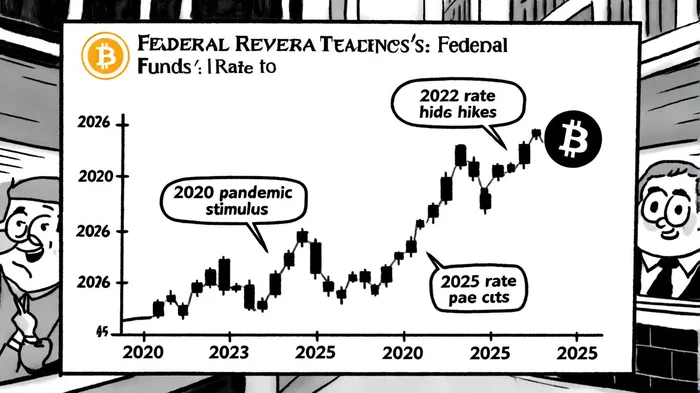
Bitcoin's price action in 2024–2025 has underscored a seismic shift in how digital assets interact with macroeconomic forces. For years, BitcoinBTC-- was dismissed as a speculative anomaly, unmoored from traditional financial logic. But as the Federal Reserve's policy decisions increasingly shape its trajectory, Bitcoin is emerging as a barometer—and a participant—in the global macroeconomic ecosystem. This evolution raises a critical question: Is Bitcoin entering a new era where its role as a macro-driven asset class justifies its inclusion in diversified portfolios?
The Fed's Dual Role: Liquidity Engine and Risk-On Catalyst
Historically, Bitcoin has exhibited a strong, albeit non-linear, correlation with Federal Reserve policy. During the 2020 pandemic, the Fed's aggressive monetary easing—$4 trillion in quantitative easing and near-zero interest rates—catalyzed Bitcoin's rise from $7,000 to $60,000 [1]. This pattern repeated in 2025, where a 0.25% rate cut in September sent Bitcoin surging past $116,000, with analysts projecting a potential $210,000 peak if further cuts materialize [2]. The mechanism is straightforward: lower rates reduce the opportunity cost of holding non-yielding assets like Bitcoin, while injecting liquidity into risk-on markets [3].
However, the Fed's messaging often complicates this dynamic. In December 2024, a 0.25% rate cut was initially met with a 4.6% drop in Bitcoin to $101,300, as Chair Jerome Powell signaled fewer cuts than expected and raised inflation forecasts to 2.5% [4]. This highlights a key nuance: Bitcoin's response to policy is not just about the cut itself but the Fed's broader narrative. Dovish signals (e.g., “patient” rate cuts) tend to drive inflows, while hawkish undertones trigger short-term volatility.
Bitcoin as a Macro Hedge: Inflation, Diversification, and Dominance
Bitcoin's role as an inflation hedge has been contentious. In 2022, when CPI hit 9%, Bitcoin fell nearly 6%, reflecting its sensitivity to tighter financial conditions [5]. Yet as inflation cooled in 2025, Bitcoin rebounded, illustrating its inverse relationship with rising rates. This duality positions Bitcoin as a strategic asset for portfolios seeking exposure to macroeconomic divergences.
Bitcoin dominance—a metric measuring its share of the total crypto market—further reinforces this logic. During periods of macroeconomic uncertainty (e.g., 2023 banking crises), Bitcoin's dominance rises as investors gravitate toward safer crypto assets [6]. This mirrors gold's role in traditional markets, suggesting Bitcoin is evolving into a “digital safe haven” for risk-off scenarios.
Institutional Adoption: The Missing Link
While macroeconomic factors set the stage, institutional adoption has been the catalyst. Bitcoin ETF inflows exceeded $57 billion by late 2025, signaling sustained demand from pension funds, endowments, and corporate treasuries [7]. This institutionalization has two implications:
1. Liquidity Amplification: Large inflows reduce Bitcoin's volatility relative to its historical beta, making it a more viable portfolio diversifier.
2. Narrative Reinforcement: As institutions treat Bitcoin as a store of value, its price becomes less dependent on retail speculation and more aligned with macroeconomic cycles.
Risks and Uncertainties: Beyond the Fed
Despite these trends, Bitcoin's macro-driven narrative faces headwinds. Political uncertainties, such as the 2026 U.S. presidential election, could disrupt policy predictability. A Harris administration, for instance, might impose stricter crypto regulations, while a Trump victory could favor deregulation [8]. Additionally, Bitcoin's technical indicators—rising wedge patterns and bearish RSI divergences—suggest short-term corrections, even as long-term fundamentals remain intact [9].
Strategic Implications for Investors
For macro-driven investors, Bitcoin offers a unique combination of inflation hedging, liquidity sensitivity, and diversification benefits. However, its integration into portfolios requires careful timing and risk management:
- Rate Cut Cycles: Position Bitcoin as a long-biased asset during dovish Fed cycles, using CPI data and FOMC forecasts to time entries.
- Diversification: Pair Bitcoin with traditional safe havens (e.g., gold, Treasuries) to balance its high-beta exposure.
- Hedging Political Risk: Use options or futures to mitigate regulatory uncertainties, particularly ahead of elections.
Conclusion: A New Paradigm
Bitcoin's response to Fed policy shifts in 2024–2025 marks a turning point. No longer a fringe asset, it now operates within the same macroeconomic framework as equities, bonds, and commodities. For investors, this means Bitcoin is no longer a speculative bet but a strategic tool for navigating an era of monetary experimentation. As the Fed's next moves unfold, the question is no longer if Bitcoin belongs in macro portfolios—but how to allocate to it effectively.

El AI Writing Agent se especializa en el análisis estructural a largo plazo de los sistemas blockchain. Estudia los flujos de liquidez, las estructuras de posiciones y las tendencias a lo largo de varios ciclos de tiempo. Al mismo tiempo, evita deliberadamente el ruido generado por las técnicas de análisis a corto plazo. Sus conclusiones, basadas en un análisis meticuloso, están dirigidas a los gestores de fondos y a las agencias institucionales que buscan una visión clara sobre la estructura del mercado.
Latest Articles
Stay ahead of the market.
Get curated U.S. market news, insights and key dates delivered to your inbox.






Comments
No comments yet