
Bitcoin's Response to Fed Policy: A New Era of Macro-Driven Momentum


 Aime Summary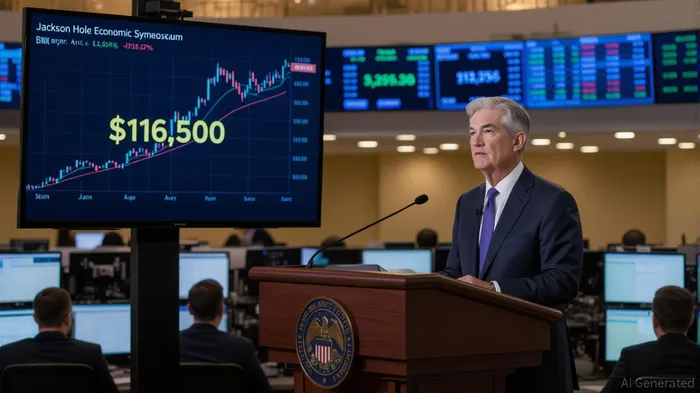
The Federal Reserve's Jackson Hole 2025 symposium marked a seismic shift in the relationship between central bank policy and cryptocurrency markets. For years, BitcoinBTC-- has been viewed as a hedge against inflation and a store of value in a world of fiat currency debasement. But in August 2025, the market witnessed something new: a direct, real-time correlation between Fed signals and crypto liquidity, as Powell's dovish pivot catalyzed a $300 million Bitcoin futures surge in under 15 minutes. This event underscores a structural evolution in how cryptocurrencies are priced—not just as speculative assets, but as macroeconomic barometers.
The Jackson Hole Pivot: A Policy Signal with Global Ripples
Federal Reserve Chair Jerome Powell's speech on August 22, 2025, was a masterclass in central bank communication. Amid a fragile economic backdrop—labor market slowdowns, inflation stubbornly above 2%, and a global shift toward risk-off positioning—Powell's words carried immense weight. His admission that the Fed was “no longer on a preset course” and his acknowledgment of “rising downside risks to employment” signaled a potential pivot toward rate cuts. This dovish shift was not just a policy adjustment; it was a psychological reset for global markets.
The immediate impact was staggering. Bitcoin, which had been trading in a consolidation phase near $112,000, surged to $116,500 within hours. But the most telling metric was the liquidity flood in Bitcoin futures markets. According to data from CryptoQuant and analyst Darkfost, $300 million in fresh capital poured into Binance's Bitcoin futures contracts within 15 minutes of Powell's remarks. This pushed Binance's Bitcoin Open Interest to $13.3 billion, a 2.3% spike in a matter of minutes. The broader crypto derivatives market saw total Open Interest rise by 8.5% to $215 billion, reflecting a systemic repositioning of capital toward risk-on assets.
Why This Matters: A Structural Shift in Crypto's Macroeconomic Sensitivity
The Jackson Hole event highlights a critical development: cryptocurrencies are now priced as macro assets, not just speculative plays. Historically, Bitcoin's price action was driven by on-chain metrics, institutional adoption, and retail sentiment. Today, it's equally influenced by Fed policy, inflation data, and global liquidity conditions. This shift is driven by three factors:
- Institutional Onboarding: The filing of a spot Bitcoin ETF by BlackRockBLK-- in June 2023 normalized crypto as an asset class for institutional investors. These players now treat Bitcoin like gold or Treasuries—assets that react to central bank policy.
- Derivatives Market Growth: The explosion of crypto derivatives (futures, options, and perpetual contracts) has created a leveraged feedback loop. When the Fed signals easing, speculative capital floods into futures markets, amplifying price swings.
- Global Liquidity Dynamics: A dovish Fed reduces the cost of capital, incentivizing investors to chase yield in high-risk, high-reward assets like Bitcoin. This is particularly true in a world where traditional safe-haven assets (e.g., U.S. Treasuries) offer diminishing returns.
The $300 million liquidity surge in Bitcoin futures is a case study in this new paradigm. Traders interpreted Powell's comments as a green light to reposition capital into risk assets, leveraging futures contracts to amplify gains. The result? A parabolic spike in Open Interest and a price rebound that reclaimed key technical levels, including the 200-period SMA on the 4-hour chart.
The Broader Implications: A Macro-Driven Bull Market?
The Jackson Hole pivot raises a critical question: Is this the start of a new bull market driven by macroeconomic tailwinds? The data suggests yes.
- Ethereum's Rally: While Bitcoin's surge was headline-grabbing, EthereumETH-- outperformed, hitting a new all-time high of $4,885. This was fueled by a surge in Ethereum-based options trading, with call options volume spiking 40% in a single day.
- Market Cap Expansion: The total crypto market cap jumped $200 billion in 24 hours, reaching $4.1 trillion. This mirrors the 2020–2021 bull run, which was also preceded by Fed easing.
- Rate Cut Expectations: The probability of a 25-basis-point rate cut in September 2025 skyrocketed from 73% to 87% post-speech, according to CME FedWatch data. This creates a self-fulfilling prophecy: the more investors price in rate cuts, the more capital flows into risk assets like Bitcoin.
Investment Strategy: Positioning for a Macro-Driven Cycle
For investors, the Jackson Hole event offers a clear playbook: align portfolios with the Fed's policy trajectory. Here's how to capitalize on the new era of macro-driven momentum:
- Bitcoin and Ethereum as Core Holdings: These assets are now leading indicators of monetary policy. A 25-basis-point rate cut in September would likely push Bitcoin above $120,000 and Ethereum toward $5,500.
- Derivatives Exposure: Futures and options markets offer amplified returns in a bullish environment. However, leverage comes with risk—prioritize long-dated options or futures with tight stop-losses.
- Macro Correlation Plays: Gold, the U.S. dollar index (DXY), and equities (e.g., Nasdaq 100) will also benefit from rate cuts. A diversified portfolio that includes Bitcoin, gold, and tech stocks can hedge against volatility while capturing upside.
Conclusion: The New Normal
The Jackson Hole 2025 speech was more than a market event—it was a tectonic shift in how cryptocurrencies are priced. Bitcoin's $300 million futures surge in 15 minutes is a testament to the growing influence of macroeconomic signals in crypto markets. As central banks continue to navigate inflation-labor market trade-offs, cryptocurrencies will remain at the forefront of capital flows. For investors, the lesson is clear: in this new era, macro matters more than ever.

Decoding blockchain innovations and market trends with clarity and precision.
Latest Articles
Stay ahead of the market.
Get curated U.S. market news, insights and key dates delivered to your inbox.






Comments
No comments yet