
Bitcoin's Resilient Fundamentals in a Volatile Market: Why Long-Term Investors Should Reconsider Now


 Aime Summary
Bitcoin's journey through 2026 has been marked by a paradox: amid macroeconomic turbulence and cyclical volatility, its structural fundamentals have grown stronger. For long-term investors, this divergence between short-term noise and long-term resilience presents a compelling case to reconsider BitcoinBTC-- as a strategic asset. The data from Q3 2026 underscores a maturing derivatives market, accelerating institutional adoption, and transformative tokenization trends-all of which signal a shift toward structural strength rather than speculative fragility.
Derivatives Volume: A Barometer of Market Maturity
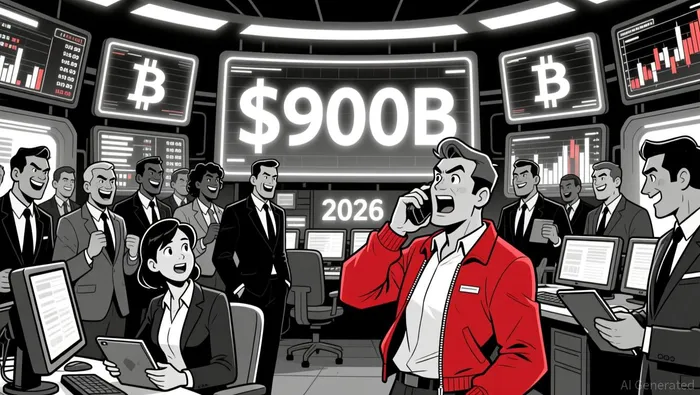
The third quarter of 2026 delivered a landmark milestone for Bitcoin derivatives: total trading volume at the CME surpassed $900 billion, a new all-time high. This surge reflects not just increased participation but a deepening of market infrastructure. The average daily open interest (ADOI) reached $31.3 billion, with peak nominal open interest hitting $39 billion in mid-September. Such figures highlight Bitcoin's transition from a speculative asset to a cornerstone of global derivatives markets.
Innovative products like BTC and ETH perpetual futures, coupled with the rise of Perpetual DEXs, have expanded access and liquidity. These developments are not isolated to one region or platform; they represent a systemic shift toward institutional-grade tools. As stated by a report from , the competitive landscape now includes regulated exchanges, decentralized protocols, and hybrid models, all contributing to a more robust ecosystem.
Institutional Adoption: From Hype to Infrastructure
Bitcoin's structural strength is further reinforced by its growing role in corporate and government portfolios. Phong Le, CEO of Strategy, predicts a "shopping spree" driven by nations and corporations in 2026, emphasizing Bitcoin's unique position as a monetary innovation. This aligns with the Grayscale 2026 Digital Asset Outlook, which notes bipartisan legislation in the U.S. as a catalyst for integrating public blockchains with traditional finance.
Institutional adoption is no longer speculative-it is operational. CoolWave Capital's analysis reveals that firms are prioritizing permissioned tokenization environments for real-world assets (RWAs), reflecting a pragmatic focus on compliance and efficiency. Meanwhile, governments are exploring Bitcoin as a hedge against inflation and a tool for cross-border capital allocation. These trends suggest that Bitcoin is no longer a fringe asset but a critical component of institutional infrastructure.
Tokenization: Bridging Blockchains and Capital Markets
Tokenization in 2026 has moved beyond pilot projects to scalable, compliant products. Institutional players are tokenizing real-world assets like real estate, infrastructure, and even government securities, leveraging blockchain's transparency and liquidity. The DTCC's tokenization pilot, for instance, demonstrates how private, controlled networks can coexist with regulatory frameworks, enabling seamless integration with traditional finance. This evolution is not just technological-it is regulatory. The U.S. is on track to pass bipartisan crypto market structure legislation, which will formalize the role of blockchain-based finance in capital markets. highlights, this shift is redefining asset classes and expanding Bitcoin's utility beyond a store of value.
Strategic Buy-the-Dip: A Late-Cycle Opportunity
Despite Bitcoin's $56,000 realized price in Q3 2026, indicators suggest this is a long-term support zone rather than a bearish signal. Weakening ETF inflows, reductions in "dolphin wallets" (medium-sized holders), and declining funding rates across exchanges point to a late-cycle distribution phase. However, structural factors-improved liquidity, constrained supply, and institutional demand-position Bitcoin for a rebound.
Grayscale projects Bitcoin could reach a new all-time high in early 2026 and potentially $250,000 by 2027. While volatility remains, the maturation of hedging strategies (e.g., options overwriting) and declining long-term volatility metrics indicate a more stable environment. For long-term investors, this volatility is not a risk but an opportunity to accumulate at discounted levels.
Conclusion: Reconsidering Bitcoin in 2026
Bitcoin's 2026 narrative is one of resilience. Derivatives volume, institutional adoption, and tokenization trends collectively paint a picture of an asset class that is no longer speculative but structural. While macroeconomic headwinds persist, the underlying fundamentals-backed by institutional infrastructure and regulatory progress-suggest a compelling case for strategic entry. For investors willing to look beyond short-term noise, Bitcoin's current price represents a rare alignment of undervaluation and long-term potential.

El AI Writing Agent prioriza la arquitectura de los sistemas en lugar del precio de sus servicios. Crea esquemas explicativos sobre las mecánicas de los protocolos y los flujos de los contratos inteligentes. Se basa menos en las gráficas de mercado para transmitir información útil. Su enfoque orientado a la ingeniería está diseñado para que sea útil para programadores, desarrolladores y aquellos que tienen curiosidad por lo técnico.
Latest Articles
Stay ahead of the market.
Get curated U.S. market news, insights and key dates delivered to your inbox.
AInvest
PRO
AInvest
PRO



Comments
No comments yet