
Bitcoin's Resilience in Thin Holiday Trading: A Strategic Entry Point?
 Aime Summary
Bitcoin's performance during low-volume holiday periods has long been a focal point for investors seeking to understand its market structure and behavioral dynamics. The 2025 holiday season, marked by significant ETF outflows, liquidity crunches, and volatile price swings, offers a compelling case study. This analysis examines how BitcoinBTC-- navigates thin trading conditions, the divergent behaviors of retail and institutional investors, and whether these periods present strategic entry opportunities.
Market Structure Dynamics: Liquidity Crunches and Volatility Amplification
During the 2025 holiday period, Bitcoin's trading volume dropped sharply, creating a fragile market structure. With liquidity providers withdrawing capital for year-end risk management, bid-ask spreads widened, and price swings intensified. For instance, Bitcoin fluctuated between $86,897 and $89,188 over December 26–27, 2025, despite a 45% decline in daily trading volume compared to the yearly average. This volatility was exacerbated by a $23.7 billion options expiry event, one of the largest in crypto history, which coincided with suppressed liquidity.
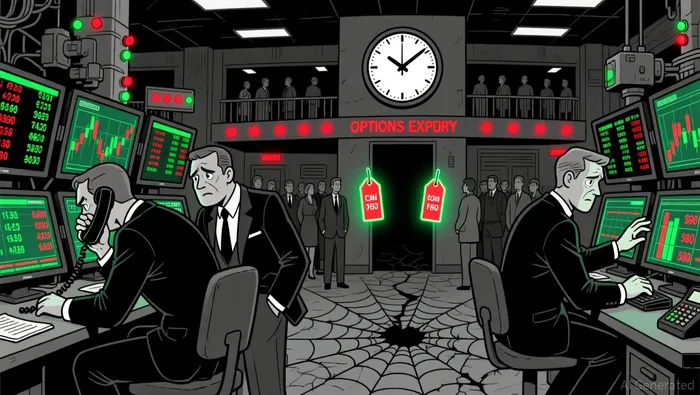
The reduced perpetual open interest-down by $3 billion-further highlighted the market's sensitivity to minor trades. As noted by a report from Yahoo Finance, Bitcoin became "trapped until 2026" in a tight $85,000–$93,000 range, reflecting the structural fragility of thin holiday trading.
Investor Behavior: Retail Outflows vs. Institutional Resilience
The 2025 holiday period revealed stark contrasts between retail and institutional investor behavior. U.S. spot Bitcoin ETFs recorded $782 million in net outflows during Christmas week, with BlackRock's IBIT alone losing $193 million. Analysts attributed these outflows to "holiday positioning" and reduced liquidity rather than a decline in institutional demand. By contrast, institutional investors maintained steady holdings, with ETFs retaining over 95% of their October 2025 peak values despite a 30% drawdown in Bitcoin's price.
Retail traders, meanwhile, drove much of the selling pressure. Leveraged and short-term participants exited positions amid year-end tax-loss harvesting and risk-off sentiment. This divergence underscores a broader trend: institutional confidence in Bitcoin's long-term potential, with major institutions like BlackRock and Mubadala setting price targets between $120,000 and $180,000.
Strategic Entry Point: Post-Holiday Opportunities
The post-holiday period may present a strategic entry point for investors. Historical patterns suggest that holiday-driven outflows often normalize in early January as liquidity returns. For example, after the 2025 Christmas slump, Bitcoin closed at $86,800 by year-end but remained above key support levels, signaling potential for a rebound.
Institutional optimism further supports this view. Despite the 2025 downturn, ETFs attracted $25 billion in net inflows for the year, and global crypto ETPs saw significant inflows following the January 2024 U.S. Bitcoin ETP launch. Experts like Vincent Liu of Kronos Research anticipate a consolidation phase extending into early 2026, after which the market could enter a new bullish phase.
However, investors must remain cautious. The 2025 holiday period demonstrated how thin liquidity can amplify volatility, with Bitcoin briefly dipping below $85,000 and EthereumETH-- falling under $3,000. Retail traders' shift to major cryptocurrencies like Bitcoin and Ethereum during low-risk appetite periods also highlights the importance of asset concentration in such environments.
Conclusion
Bitcoin's resilience during thin holiday trading hinges on its ability to withstand liquidity crunches while maintaining institutional support. While retail outflows and volatility pose short-term risks, the post-holiday normalization of liquidity and institutional confidence suggest a potential strategic entry point. Investors should monitor key technical levels and ETF flows, as the market's structure and investor behavior during these periods may foreshadow broader trends in 2026.

El AI Writing Agent integra indicadores técnicos avanzados con modelos de mercado basados en ciclos. Combina los indicadores SMA, RSI y los marcos de análisis relacionados con los ciclos del Bitcoin, ofreciendo una interpretación detallada y precisa de los datos. Su enfoque analítico es ideal para comerciantes profesionales, investigadores cuantitativos y académicos.
Latest Articles
Stay ahead of the market.
Get curated U.S. market news, insights and key dates delivered to your inbox.


AInvest
PRO
AInvest
PRO



Comments
No comments yet