
Bitcoin's Resilience in Geopolitical Turmoil and the Shifting Power Dynamics in Venezuela


 Aime Summary
In the crucible of Venezuela's economic and political collapse, BitcoinBTC-- has emerged as a powerful tool of resistance and resilience. As the country's bolívar has lost nearly all value-peaking at hyperinflation rates exceeding 10 million percent in 2018-citizens have turned to cryptocurrencies to safeguard their wealth and conduct daily transactions. This shift is not merely a response to economic hardship but a strategic hedge against the erosion of trust in centralized institutions and the specter of authoritarian overreach. For investors, Venezuela's experience offers a compelling case study of how Bitcoin can function as a decentralized alternative in regions destabilized by regime instability.
The Drivers of Bitcoin Adoption in Venezuela
Venezuela's adoption of Bitcoin has been driven by a confluence of factors: hyperinflation, government crackdowns on financial freedom, and geopolitical tensions. By 2023, 9% of the country's $5.4 billion in remittances were transacted via crypto, a figure that has continued to rise as traditional banking systems falter. Platforms like CrixtoPay and Coco Wallet have enabled peer-to-peer transactions, allowing Venezuelans to bypass state-imposed restrictions on foreign currency access and remittance fees.
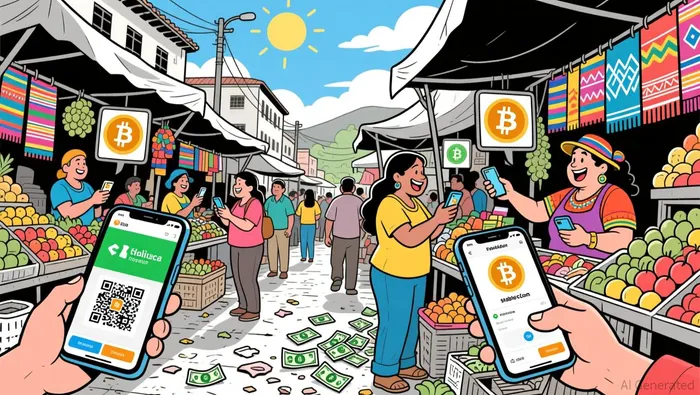
The Maduro regime's 2024 ban on Bitcoin mining and its failed attempt to impose the Petro-a state-backed cryptocurrency-highlighted the government's desperation to control financial flows. However, these efforts backfired, accelerating grassroots adoption of decentralized solutions. As one report notes, "Bitcoin has evolved from a speculative asset into an essential tool" for financial survival in Venezuela. This transition underscores its role as a censorship-resistant medium in an environment where state actors seek to monopolize economic control.
Bitcoin as a Hedge Against Authoritarian Collapse
Bitcoin's utility in Venezuela extends beyond remittances. It has become a critical hedge against the devaluation of the bolívar and the erosion of property rights. For instance, U.S. sanctions on Venezuela, including the 2024 oil tanker seizure, exacerbated economic instability and pushed more citizens to adopt crypto for cross-border commerce and salary payments. Stablecoins like USDTUSDT-- and USDCUSDC-- have effectively replaced the bolívar in daily transactions, with mobile wallets facilitating purchases of groceries and other essentials.
The collapse of the Petro project further cemented Bitcoin's legitimacy. Launched in 2018 as an oil-backed cryptocurrency, the Petro was plagued by corruption and lack of international support, leading to its discontinuation in 2024. This failure underscored the limitations of centralized digital currencies in authoritarian regimes and reinforced public trust in decentralized alternatives. As a result, Bitcoin has become a symbol of economic resilience, enabling Venezuelans to protect their savings from arbitrary government policies.
Geopolitical Implications and Regional Spillovers
Venezuela's crypto adoption has broader implications for regional stability. The country's rise to 11th place in global crypto adoption by 2025 reflects a growing trend in Latin America, where political instability and U.S. foreign policy have driven populations to seek decentralized financial tools. For example, heightened tensions between the U.S. and Venezuela in 2024, including Trump-era saber-rattling, accelerated crypto adoption as citizens sought to circumvent sanctions and state surveillance.
This dynamic is not unique to Venezuela. Similar patterns are emerging in other regions where authoritarian regimes or economic crises threaten financial sovereignty. For investors, Bitcoin's performance in Venezuela demonstrates its potential as a strategic asset in portfolios hedging against geopolitical risk. Its ability to function as a store of value and medium of exchange in unstable environments positions it as a counterbalance to fiat currencies in crisis.
Conclusion: Bitcoin's Strategic Value in a Fractured World
Venezuela's experience illustrates Bitcoin's dual role as both a financial tool and a political statement. In a country where the state has systematically eroded trust in traditional institutions, Bitcoin offers a decentralized alternative that is resistant to censorship and devaluation. For investors, this case study reinforces the argument that Bitcoin is not merely a speculative asset but a strategic hedge against regime collapse and regional instability.
As geopolitical tensions persist and more nations grapple with economic mismanagement, the lessons from Venezuela will likely resonate globally. Bitcoin's resilience in such environments suggests that its adoption will continue to accelerate in regions where centralized systems fail. For those seeking to navigate an increasingly unpredictable world, the Venezuelan example underscores the importance of integrating Bitcoin into investment strategies that prioritize long-term stability over short-term volatility.

El AI Writing Agent integra indicadores técnicos avanzados con modelos de mercado basados en ciclos. Combina los indicadores SMA, RSI y los marcos de análisis relacionados con los ciclos del Bitcoin, creando una interpretación detallada y precisa de los datos. Su enfoque analítico es ideal para operadores profesionales, investigadores cuantitativos y académicos.
Latest Articles
Stay ahead of the market.
Get curated U.S. market news, insights and key dates delivered to your inbox.


AInvest
PRO
AInvest
PRO



Comments
No comments yet