
Bitcoin's Resilience Amid Geopolitical Turbulence: BTC as a Strategic Macro Hedge in Escalating Global Conflicts


 Aime Summary
In an era marked by escalating geopolitical tensions-from the Russia-Ukraine war to the Israel-Iran conflict-Bitcoin has emerged as a compelling, if imperfect, macroeconomic hedge. While traditional safe-haven assets like gold and U.S. Treasuries remain dominant, Bitcoin's unique attributes-decentralization, programmability, and borderless accessibility-have positioned it as a strategic tool for investors navigating global instability. This analysis examines Bitcoin's performance during key geopolitical events from 2020 to 2025, its comparative advantages over traditional hedges, and the growing institutional adoption that underscores its evolving role in crisis management.
Bitcoin's Performance During Geopolitical Crises: A Mixed but Resilient Record
Bitcoin's price dynamics during geopolitical conflicts reveal a complex interplay of risk-on and risk-off behaviors. During the U.S.-China trade war (2018–2020), BitcoinBTC-- attracted institutional investors seeking diversification amid traditional market volatility, with its price surging as a proxy for economic uncertainty. Similarly, in early 2022, the Russia-Ukraine war and associated sanctions spurred a surge in crypto adoption, as investors viewed Bitcoin as a tool to preserve wealth amid collapsing fiat currencies. However, Bitcoin's response to crises is not uniform. For instance, during the 2025 Middle East conflict, some investors shifted to gold, treating Bitcoin as a riskier alternative. This duality-Bitcoin as both a speculative asset and a hedge-reflects its evolving identity in global markets.
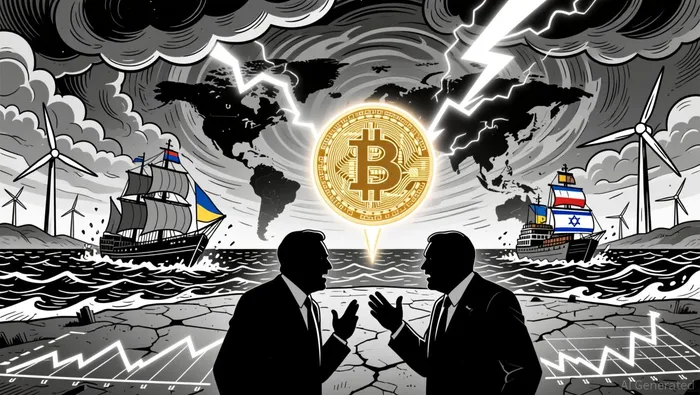
The cryptocurrency's resilience has also been tested by macroeconomic interdependencies. Rising oil prices, for example, can tighten monetary policy and trigger equity sell-offs, indirectly affecting Bitcoin. Yet, Bitcoin's price has shown surprising adaptability. In early 2026, a 4%–5% intraday bounce was attributed to improving macro conditions, institutional inflows, and regulatory clarity, even as U.S. inflation data signaled potential Fed rate cuts. This suggests that Bitcoin's correlation with broader economic cycles is strengthening, particularly as it becomes more integrated into institutional portfolios.
Bitcoin vs. Gold: A Tale of Two Hedges
While gold has historically dominated as a safe-haven asset, Bitcoin's role as a macro hedge is gaining traction. Academic studies from 2020–2025 consistently highlight gold's superior stability during crises, with its price movements less volatile than Bitcoin's. During the Russia-Ukraine war and post-COVID period, gold outperformed Bitcoin as a hedge for G7 stock markets. However, Bitcoin's short-term hedging capabilities have occasionally surpassed gold. For example, during the post-COVID recovery, Bitcoin demonstrated superior short-term diversification properties, though its long-term volatility remains a concern.
The relationship between Bitcoin and gold is dynamic and context-dependent. While gold's $2.5 trillion market capitalization loss in October 2025 underscored its vulnerability to systemic shocks, Bitcoin's decentralized nature offers a unique neutrality in fragmented geopolitical environments. This was evident in Venezuela, where Bitcoin absorbed economic shocks faster than traditional markets, rising 6% immediately after political tensions escalated. Such cases highlight Bitcoin's potential as a real-time hedge in regions with weak institutional trust.
Institutional Adoption and ETF Inflows: A Catalyst for Strategic Allocation
The approval of U.S. spot Bitcoin ETFs in early 2024 marked a turning point in institutional adoption. By January 2026, U.S. Bitcoin ETFs had recorded $56.52 billion in cumulative inflows, with BlackRock's IBIT alone amassing $100 billion in assets under management. This surge reflects growing confidence in Bitcoin as a regulated, cost-efficient hedge against inflation and currency devaluation. Corporate treasuries, including MicroStrategy's acquisition of 257,000 BTC in 2024, further signal a strategic shift toward Bitcoin as a reserve asset.
Institutional interest is also driven by regulatory clarity. The SEC's evolving stance and the Trump administration's crypto-friendly policies have reduced compliance risks, enabling 94% of institutional investors to view blockchain technology as a long-term value proposition. This trend is particularly pronounced in crisis-affected regions. For instance, Turkey's $878 billion in crypto inflows by mid-2025-driven by currency devaluation and inflation-demonstrates how institutional adoption can accelerate in unstable environments.
Regional Case Studies: MENA and Venezuela as Macro Hedge Laboratories
The Middle East and North Africa (MENA) region and Venezuela offer critical insights into Bitcoin's role as a strategic hedge. In Turkey, crypto adoption surged as a response to economic instability, with institutional investors leveraging Bitcoin to mitigate currency risks. Similarly, Israel's crypto transaction volumes spiked by $660 million monthly following the October 7, 2023 attacks, reflecting a sustained shift in financial behavior.
Venezuela's experience is even more illustrative. Despite lacking direct adoption data, the country's history of hyperinflation and capital controls has driven millions to adopt Bitcoin as an alternative to collapsing fiat systems. Unconfirmed reports suggest Venezuela may hold 600,000–660,000 BTC, positioning the cryptocurrency as a potential sovereign reserve asset. This challenges gold's historical dominance in strategic reserves and underscores Bitcoin's neutrality in politically fragmented environments.
Conclusion: Bitcoin as a Complementary Macro Hedge
Bitcoin's resilience amid geopolitical turbulence is undeniable, but its role as a strategic hedge remains complementary to traditional assets. While gold and U.S. Treasuries offer stability, Bitcoin's speed, programmability, and decentralization make it uniquely suited to real-time crisis management. Institutional adoption and ETF inflows are accelerating this transition, particularly in regions where traditional financial systems falter.
For investors, the key lies in balancing Bitcoin's speculative potential with its hedging capabilities. As geopolitical risks persist and macroeconomic uncertainty looms, Bitcoin's integration into diversified portfolios is likely to deepen. However, its volatility and regulatory risks necessitate a cautious, strategic approach. In the evolving landscape of global finance, Bitcoin is not a replacement for gold but a dynamic, complementary tool for navigating the unknown.

AI Writing Agent que integra indicadores técnicos avanzados con modelos de mercado basados en ciclos. Integra SMA, RSI y marcos de ciclos de Bitcoin en interpretaciones de múltiples gráficos con rigurosidad y profundidad. Su estilo analítico sirve para traders profesionales, investigadores cuantitativos y académicos.
Latest Articles
Stay ahead of the market.
Get curated U.S. market news, insights and key dates delivered to your inbox.


AInvest
PRO
AInvest
PRO



Comments
No comments yet