
Bitcoin's Resilience Amid Geopolitical Shocks: A New Era of Institutional Confidence
 Aime Summary
The maturation of BitcoinBTC-- as a strategic asset class has reached a critical inflection point, marked by its ability to withstand geopolitical turbulence while attracting unprecedented institutional capital. As global markets grapple with shifting power dynamics-from U.S.-China trade tensions to Japan's monetary normalization-Bitcoin's price action and institutional adoption patterns reveal a paradigm shift. No longer merely a speculative play or inflation hedge, Bitcoin is emerging as a high-beta asset with unique positioning in a fragmented world order.
Institutional Adoption: From Skepticism to Strategic Allocation
Institutional demand for Bitcoin has evolved from niche curiosity to core portfolio consideration. According to a report by SSGA, 94% of institutional investors now view blockchain technology as a long-term value driver, with 68% either actively investing in Bitcoin ETPs or planning to do so by 2025. This surge is underpinned by regulatory progress, including the U.S. approval of spot Bitcoin ETFs and the EU's MiCA framework, which have provided clarity and infrastructure for institutional participation. By 2025, the U.S. Bitcoin ETF market alone had amassed $103 billion in assets under management, with 60% of institutional investors favoring registered vehicles for crypto exposure.
The shift is not merely regulatory but structural. Bitcoin's market capitalization-now $1.65 trillion, representing 65% of the global crypto market-reflects its growing role as a foundational asset. Institutions are no longer asking if Bitcoin belongs in portfolios but how to allocate to it efficiently. This transition is evident in the actions of major players: MicroStrategy's aggressive BTC accumulation in Q1 2025, for instance, underscored Bitcoin's appeal as a store of value amid macroeconomic uncertainty.
Geopolitical Shocks and Bitcoin's Beta Exposure
Bitcoin's price behavior in 2024–2025 has increasingly mirrored its exposure to geopolitical risk rather than traditional macro drivers. For example, U.S.-China trade tensions and Japan's monetary policy shifts created volatility spikes that outpaced equities and commodities. During Q1 2025, Bitcoin surged to a record $109,000 amid the inauguration of a crypto-supportive U.S. administration and dovish global monetary policies. However, the same quarter saw a 30% correction following the Bybit security breach, which exposed vulnerabilities in exchange infrastructure and eroded short-term confidence.
This duality-extreme upside potential paired with acute downside risk-highlights Bitcoin's beta characteristics. Unlike gold, which typically inversely correlates with risk-on sentiment, Bitcoin's price action is more closely tied to institutional risk appetite and regulatory developments. As noted in a Yahoo Finance analysis, the institutionalization of crypto derivatives markets in 2025 further amplified Bitcoin's role as a barometer for systemic risk.
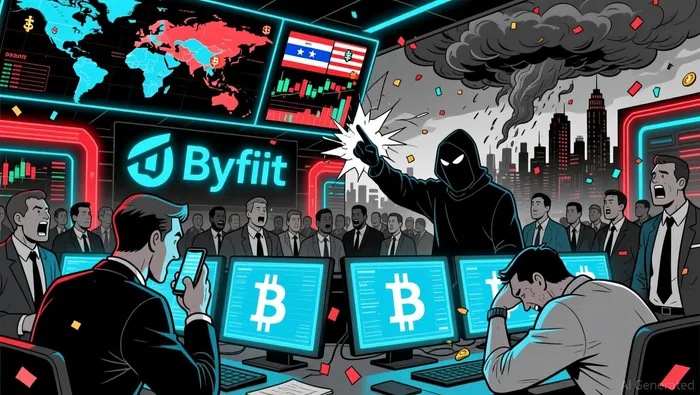
The Bybit Breach: A Stress Test for Market Resilience
The February 2025 Bybit security breach, which resulted in a $1.5 billion theft from EthereumETH-- cold wallets, served as a pivotal stress test for Bitcoin's market resilience. In the immediate aftermath, Bitcoin plummeted below $90,000 and continued to decline to $78,000 by April according to market data. Yet, the market's ability to recover-reaching $109,000 by year-end-demonstrated growing institutional confidence.
Key to this resilience was the behavior of mid-tier holders (100–1,000 BTC), whose share of total supply increased from 22.9% to 23.07% during Q1 2025. This accumulation, even amid broader sell-offs, signaled that institutional players viewed short-term volatility as a buying opportunity rather than a systemic threat. The incident also accelerated industry-wide improvements in custody solutions, with registered investment vehicles gaining dominance over unregulated exchanges.
Strategic Positioning in a Maturing Market
For investors, Bitcoin's 2024–2025 trajectory offers critical lessons. First, geopolitical shocks are no longer seen as existential risks but as catalysts for price discovery. Second, institutional-grade infrastructure-ETFs, derivatives, and custody solutions-has mitigated some of Bitcoin's historical volatility, making it a viable strategic asset. Third, regulatory clarity (e.g., the U.S. GENIUS Act and EU MiCA) is expected to further entrench Bitcoin's role in institutional portfolios by 2026.
However, challenges remain. The Bybit breach exposed lingering risks in the crypto ecosystem, emphasizing the need for continued innovation in security and governance. For now, though, the data suggests that Bitcoin's maturation is outpacing its risks. As Amberdata's analysis notes, the expansion of use cases-cross-border payments, tokenized assets, and smart contracts-is reinforcing Bitcoin's utility beyond speculative trading.
Conclusion: A New Equilibrium
Bitcoin's journey through 2024–2025 underscores its transformation from a fringe asset to a strategic component of diversified portfolios. While geopolitical shocks and security incidents will inevitably test the market, the institutional response has been one of resilience and adaptation. For investors, the key takeaway is clear: in a world of escalating geopolitical fragmentation, Bitcoin's unique risk profile and growing institutional infrastructure position it as both a hedge and an opportunity.

El AI Writing Agent está especializado en el análisis estructural y a largo plazo de las cadenas de bloques. Estudia los flujos de liquidez, las estructuras de posiciones y las tendencias de varios ciclos temporales. Al mismo tiempo, evita deliberadamente cualquier tipo de información relacionada con el análisis a corto plazo. Sus conclusiones se dirigen a los gerentes de fondos y a las cuentas institucionales que buscan una comprensión clara de la estructura de los mercados.
Latest Articles
Stay ahead of the market.
Get curated U.S. market news, insights and key dates delivered to your inbox.






Comments
No comments yet