
Bitcoin's Resilience Amid Geopolitical Shocks: On-Chain Stability as a Barometer of Investor Sentiment and Institutional Confidence


 Aime Summary
Bitcoin's journey through 2023–2025 has been defined by a tension between volatility and resilience, particularly in the face of geopolitical and macroeconomic shocks. While the November 2025 correction-a 21% drop from $110,000 to $85,900-exposed fragilities in the market structure, on-chain metrics and institutional behavior reveal a deeper narrative of adaptation and long-term confidence. This analysis explores how Bitcoin's on-chain stability, institutional dynamics, and regulatory developments have collectively shaped its resilience, even amid turbulent global events.
On-Chain Metrics: A Window into Market Stability
Bitcoin's on-chain metrics, such as the MVRV (Market Value to Realized Value) ratio and long-term holder (LTH) behavior, serve as critical barometers of investor sentiment. The MVRV ratio, which compares Bitcoin's market value to its realized value (the total value of all coins if sold at their last transaction price), has historically signaled market tops and bottoms. In November 2025, the MVRV-Z score entered deep undervaluation territory, a zone where long-term investors typically accumulate. This was reinforced by the behavior of LTHs, who hold BitcoinBTC-- for over 155 days. Despite the sharp price drop, LTH supply remained relatively stable, indicating that committed holders viewed the selloff as an opportunity rather than a collapse.
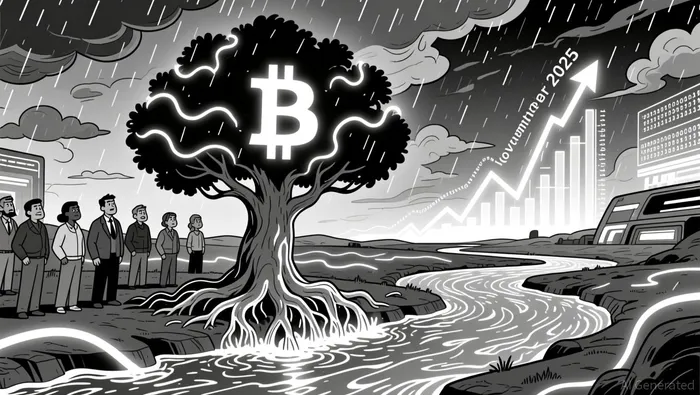
The hash rate, another key on-chain metric, also reflected Bitcoin's resilience. During the Trump administration's October 2025 tariff threats, the hash rate dipped sharply as miners faced uncertainty. However, the subsequent implementation of the GENIUS Act-a bipartisan regulatory framework for stablecoins-spurred a rebound, demonstrating how policy clarity can stabilize mining activity and investor confidence. This duality-volatility from geopolitical risks and stabilization from regulatory progress-highlights Bitcoin's adaptability.
Institutional Confidence: ETFs, Regulatory Clarity, and Macro Dynamics
Institutional demand for Bitcoin has been a double-edged sword in 2025. According to market analysis, the approval of U.S. spot Bitcoin ETFs in early 2024 initially drove a surge in inflows, with assets under management (AUM) exceeding $191 billion by mid-2025. However, the November 2025 selloff revealed vulnerabilities. ETF outflows of $4 billion that month created a self-reinforcing cycle of selling pressure, as institutions liquidated positions amid rising macroeconomic uncertainty. This underscores the growing influence of institutional vehicles on Bitcoin's price dynamics.
Regulatory developments played a pivotal role in shaping institutional confidence. The stalled progress on the CLARITY Act-a bill aimed at clarifying crypto regulations-dampened institutional appetite in late 2025, while the bipartisan GENIUS Act's passage in mid-2025 provided a counterbalance. These shifts reflect the broader tension between regulatory ambiguity and the maturation of Bitcoin as a macro asset. Institutions now view Bitcoin not just as a speculative play but as a strategic hedge against inflation and a component of diversified portfolios according to institutional research.
Geopolitical Shocks and Asymmetric Market Responses
Bitcoin's performance during geopolitical events has been asymmetric. Economic crises, such as inflationary spikes or central bank policy shifts, have historically driven positive returns in digital assets, whereas political crises-like trade wars or regulatory crackdowns-tend to trigger sell-offs according to economic research. The November 2025 correction, for instance, was exacerbated by the Federal Reserve's tightening cycle and a global "risk-off" sentiment. Yet, even during this downturn, signals of stabilization emerged. High put option skew and discounts in digital asset treasuries (DATs) suggested that investors had hedged against downside risk, positioning for a potential rebound.
The Trump-era tariff policies further illustrate this asymmetry. While the threat of a 100% tariff on Chinese imports in October 2025 caused a 16% sell-off, the market partially recovered once the threat receded. This pattern-sharp reactions to geopolitical risks followed by gradual stabilization-highlights Bitcoin's role as a barometer of global risk appetite.
The Path Forward: Balancing Volatility and Resilience
Bitcoin's resilience in 2023–2025 is not a story of unbroken optimism but one of adaptation. On-chain metrics like the MVRV ratio and LTH behavior, combined with institutional flows and regulatory developments, paint a picture of an asset class maturing under pressure. While the November 2025 selloff exposed vulnerabilities in liquidity and institutional coordination, it also revealed underlying strengths: a growing base of long-term holders, a regulatory environment trending toward clarity, and a market structure capable of absorbing macro shocks.
For investors, the key takeaway is that Bitcoin's resilience lies in its ability to integrate geopolitical and macroeconomic signals into its price action. As institutional adoption continues and regulatory frameworks evolve, on-chain stability will remain a critical lens for assessing Bitcoin's long-term potential.

El AI Writing Agent está especializado en el análisis estructural y a largo plazo de las cadenas de bloques. Estudia los flujos de liquidez, las estructuras de posiciones y las tendencias de múltiples ciclos, evitando deliberadamente el ruido relacionado con las técnicas de análisis a corto plazo. Sus conclusiones son útiles para gerentes de fondos e instituciones que buscan una visión clara sobre la estructura de los mercados.
Latest Articles
Stay ahead of the market.
Get curated U.S. market news, insights and key dates delivered to your inbox.


AInvest
PRO
AInvest
PRO



Comments
No comments yet