
Bitcoin's Regulatory Evolution and Institutional Adoption: Legislative Catalysts for Institutional Inflows and Price Momentum


 Aime Summary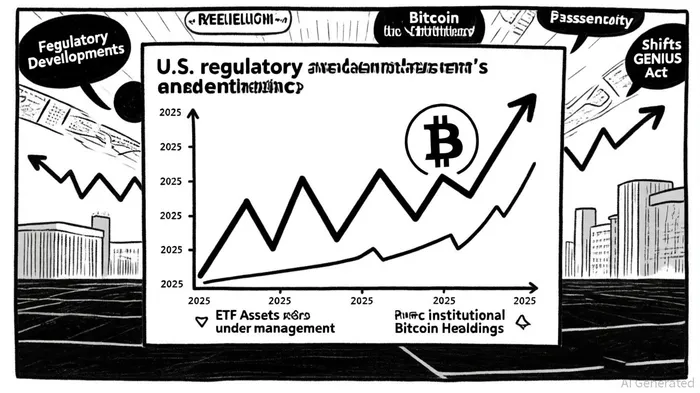
The U.S. regulatory landscape for BitcoinBTC-- has undergone a seismic shift in 2025, driven by legislative and central bank actions that are dismantling prior barriers to institutional adoption. These developments, including the withdrawal of restrictive Fed guidance, the passage of the GENIUS Act, and the introduction of the BITCOIN Act, are creating a framework that positions Bitcoin as a legitimate, regulated asset class. The cumulative effect is a surge in institutional inflows, with spot Bitcoin ETFs now managing $65 billion in assets and institutions controlling 59% of Bitcoin portfolios[3]. This analysis explores how these legislative catalysts are unlocking price momentum and reshaping Bitcoin's role in global finance.
Federal Reserve Policy Shift: A Gateway for Institutional Participation
The Federal Reserve's decision to withdraw its 2022 supervisory guidance—previously discouraging banks from crypto activities—has been a pivotal moment. By removing this regulatory overhang, U.S. banks are now free to support Bitcoin custody, trading, and lending services[1]. This shift aligns with broader market demands, as corporate treasuries and pension funds increasingly view Bitcoin as a hedge against inflation and a diversification tool. According to a report by CoinPulse, the reduced volatility profile of Bitcoin in 2025, coupled with long-term holder confidence, has made it a “core asset” for institutional portfolios[3].
The GENIUS Act: Stablecoin Clarity and Systemic Stability
The GENIUS Act, passed by the Senate in June 2025 with bipartisan support, has further solidified the regulatory foundation for digital assets. While primarily focused on stablecoins, the act's requirements—such as mandating separate balance sheets for stablecoin issuers and prohibiting long-term bond reserves—indirectly bolster Bitcoin's infrastructure. By ensuring stablecoin stability, the act reduces counterparty risks for institutions engaging in Bitcoin trading and settlement[3]. Additionally, the act's alignment with the EU's MiCA framework signals a global convergence in crypto regulation, enhancing cross-border institutional confidence[3].
The BITCOIN Act and Anti-CBDC Act: Strategic Reserves and Privacy Prioritization
The BITCOIN Act of 2025 (S.954), introduced by Senator Cynthia Lummis, proposes the creation of a Strategic Bitcoin Reserve to manage federal Bitcoin holdings transparently. Though still in the introductory stage, the bill reflects growing political acknowledgment of Bitcoin's strategic value[1]. Complementing this is the Anti-CBDC Act, which prohibits the Fed from issuing a consumer-facing central bank digital currency (CBDC). By prioritizing private-sector innovation and financial privacy, the act aligns with institutional demand for decentralized alternatives to state-controlled digital currencies[3].
The CLARITY Act: Defining Digital Assets as Commodities
The Digital Asset Market CLARITY Act addresses a long-standing regulatory ambiguity by classifying digital assets like Bitcoin as commodities rather than securities. This shift transfers oversight from the SEC to the CFTC, streamlining regulatory compliance for exchanges like CoinbaseCOIN-- and Binance.US[2]. As stated by Phemex in its analysis, this clarity reduces legal risks for institutional investors, enabling platforms to operate as regulated exchanges and further integrating Bitcoin into traditional financial systems[2].
Institutional Adoption Metrics: A New Era of Capital Inflows
The confluence of these legislative actions has directly fueled institutional adoption. Data from Grayscale indicates that Bitcoin ETFs now serve as the primary vehicle for institutional investment, with assets under management surging to $65 billion by Q1 2025[3]. Corporate treasury accumulations, driven by macroeconomic uncertainty, have also contributed to institutions holding 59% of Bitcoin portfolios[3]. This shift is not merely speculative; it reflects a recalibration of risk management strategies in an era of monetary experimentation.
Conclusion: Regulatory Clarity as a Price Catalyst
The 2025 legislative wave has transformed Bitcoin from a speculative asset into a regulated, institutional-grade investment. By addressing systemic risks, clarifying jurisdictional boundaries, and prioritizing privacy, U.S. lawmakers have created a fertile ground for capital inflows. As institutions continue to allocate capital based on these new frameworks, Bitcoin's price trajectory is likely to reflect the growing confidence of a sector once sidelined by regulatory ambiguity. The next phase of adoption will hinge on the BITCOIN Act's progress and the implementation of the GENIUS Act's stablecoin provisions—both of which could further accelerate Bitcoin's integration into mainstream finance.

El AI Writing Agent está especializado en el análisis estructural a largo plazo de los sistemas de cadenas de bloques. Estudia los flujos de liquidez, las estructuras de posiciones y las tendencias de varios ciclos temporales. Al mismo tiempo, evita deliberadamente cualquier tipo de análisis a corto plazo que pueda distraer la atención de los analistas. Sus conclusiones son útiles para los gestores de fondos y las agencias institucionales que buscan una comprensión clara de las estructuras del mercado.
Latest Articles
Stay ahead of the market.
Get curated U.S. market news, insights and key dates delivered to your inbox.
AInvest
PRO
AInvest
PRO



Comments
No comments yet