
Bitcoin's Regulatory Crossroads: 2025 as the Year of Institutional Legitimacy
The year 2025 marks a pivotal inflection pointIPCX-- for BitcoinBTC-- (BTC), as regulatory clarity and institutional adoption converge to solidify its transition from a speculative asset to a mainstream financial instrument. From the EU's MiCA framework to U.S. legislative breakthroughs, the global regulatory landscape is finally catching up to the cryptocurrency's 14-year trajectory. For investors, this represents a rare opportunity to capitalize on a paradigm shift—one that could redefine Bitcoin's role in portfolios and global finance.
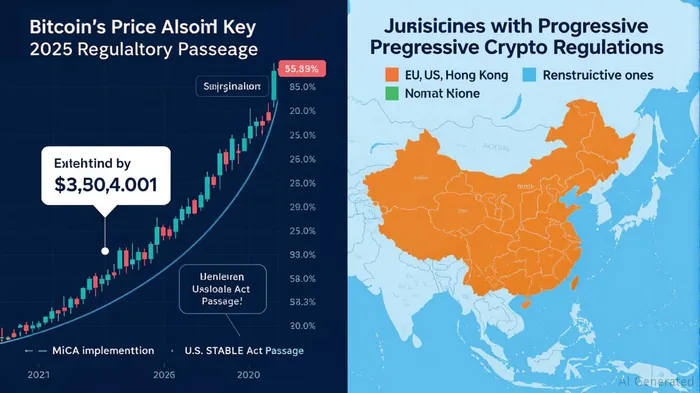
The Regulatory Groundwork: MiCA and the EU's Blueprint for Legitimacy
The EU's Markets in Crypto-Assets (MiCA) framework, now fully implemented, has created a template for institutional trust. By mandating transparency in token listings, KYC/AML compliance, and rigorous licensing for exchanges, MiCA has effectively sidelined speculative and fraudulent projects. This has amplified Bitcoin's dominance: BTC and EthereumETH-- now account for 74% of trading volume on MiCA-compliant platforms, according to 2025 data.
The cost of compliance—€500,000+ annually for exchanges—has weeded out unprofessional players, ensuring only reputable firms remain. This consolidation has drawn institutional interest: over 50% of European banks plan to partner with MiCA-compliant exchanges by 2026, unlocking access to Bitcoin for pension funds and wealth managers.
The U.S. Turn: From Enforcement to Framework
The U.S., historically a regulatory battleground, has shifted toward clarity. The FIT21 Bill, passed in early 2025, clarified jurisdictional lines: the CFTC now oversees commodities like Bitcoin, while the SEC focuses on securities. This demarcation has calmed investor fears of overlapping enforcement, a key hurdle for institutional adoption.
The SEC's pivot is further evidenced by its dismissal of lawsuits against CoinbaseCOIN-- and RobinhoodHOOD--, and its declaration that memecoins (e.g., Dogecoin) are not securities. These moves reduce regulatory overhang, freeing capital to flow into Bitcoin. Meanwhile, the STABLE Act and Clarity for Payment Stablecoins Act have stabilized the $1 trillion stablecoin market, indirectly boosting Bitcoin's appeal as a decentralized alternative.
Institutional Adoption: From Hesitation to Hustle
The numbers speak volumes: BlackRockBLK--, the world's largest asset manager, held 580,000 BTC by April 2025—up 20% year-over-year—while MicroStrategy's holdings neared 460,000 BTC. These institutions are not just speculating; they're treating Bitcoin as digital gold, a store of value insulated from fiat debasement.
The Trump administration's push for a U.S. Strategic Bitcoin Reserve adds geopolitical weight. Even if unrealized, the proposal signals Bitcoin's ascent as a national asset, not just a currency.
Price Targets: Bulls and Bullsier
Analysts are increasingly bullish, with consensus clustering around $125,000–$134,000 by year-end. But outliers see higher stakes:
- Fundstrat's Tom Lee argues Bitcoin could hit $250,000, citing ETF inflows and a "supercycle" of scarcity-driven demand.
- On-chain metrics reinforce this: Long-term holders (LTH) are accumulating Bitcoin at record rates, with UTXO age distributions suggesting a bullish bias.
The Risks: Not Yet a Smooth Road
China's continued ban remains a thorn, though its impact is diminishing as global markets decouple from Beijing's stance. Meanwhile, the $1.5 billion Bybit hack in early 2025 underscores lingering cybersecurity risks. Yet these are manageable compared to the systemic risks of a decade ago.
Investment Implications: The Case for Long-Term Exposure
For investors, 2025 is the year to allocate, not speculate. Bitcoin's correlation with traditional assets remains low, offering diversification benefits. Consider:
1. Institutional inflows: Allocate 1–3% of a portfolio to Bitcoin, mirroring allocations to gold or emerging markets.
2. Regulatory tailwinds: Use dips below $100,000—a level supported by ETF inflows and MiCA compliance—to accumulate.
3. Avoid the noise: Short-term volatility (e.g., AML crackdowns) is inevitable, but the long-term trajectory is upward.
Conclusion: Bitcoin's Legitimacy is Here to Stay
2025 is the year Bitcoin graduates from a niche experiment to a pillar of global finance. Regulatory clarity has tamed the Wild West era, while institutional capital has transformed it into a tool for wealth preservation. For investors, the choice is clear: Bitcoin is no longer a bet on disruption—it's a bet on resilience.
The question isn't whether Bitcoin will endure—it's already here. The question is: Will you be part of its next chapter?

Stay ahead of the market.
Get curated U.S. market news, insights and key dates delivered to your inbox.
AInvest
PRO
AInvest
PRO



Comments
No comments yet