
Bitcoin Rebounds to $88K Amid Macroeconomic and Market Uncertainties
 Aime Summary
- Bitcoin rebounded to $88,000 amid volatility and macroeconomic uncertainties, indicating ongoing market sensitivity at this key level.
- Options data show elevated downside risk and increased hedging activity, with near-term options suggesting potential sharp price movements.
- Market participants are positioning for macroeconomic events, including the Federal Reserve meeting and U.S. government funding deadline, which could significantly influence Bitcoin's price trajectory.
Bitcoin's price briefly dipped below $88,000, triggering liquidation-driven selloffs, but quickly bounced back. This level has become a critical pivot point for traders, acting as both a trap door and a reference for rebounds.
The options market is signaling caution. Traders are paying more to hedge against sudden price drops, as shown by the negative left-tail skew. Additionally, near-term options are more expensive, suggesting positioning for gap-risk.
This week's macroeconomic calendar includes a Federal Reserve meeting and a government funding deadline. The Fed is expected to hold rates steady, but commentary could influence sentiment. A government shutdown, if it occurs, may tighten liquidity and affect broader markets.
Bitcoin's recent bounce above $88K is seen as a sign that core demand remains intact, despite macroeconomic headwinds like dollar strength and U.S. fiscal risks.
Bitcoin miners are also experiencing significant changes due to a winter storm. Some are selling surplus power to strained grids, which is more profitable than regular mining. This has led to a reduction in Bitcoin production and a drop in the network's hashrate.
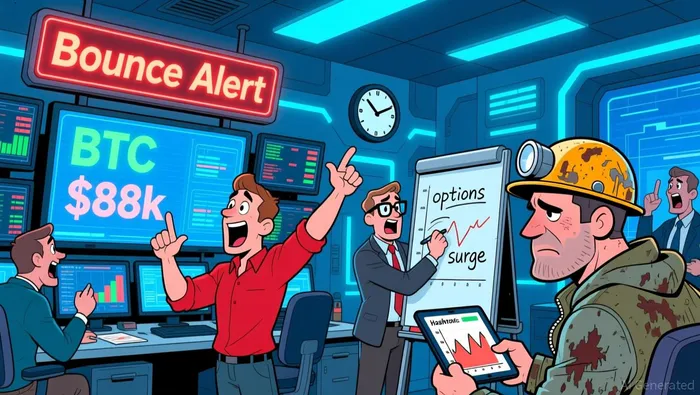
The hashrate for BitcoinBTC-- has dropped to a seven-month low, reducing competition and increasing profitability for remaining miners. This has also led to a rise in mining stock prices.
Bitcoin ETF outflows in late 2025 and early 2026 have sparked debate among investors and analysts. These outflows could indicate a cyclical correction or a deeper bearish shift in institutional sentiment.
Bitcoin remains below the 90,000 mark amid macroeconomic defensiveness, with geopolitical risks and a weak U.S. dollar contributing to ongoing caution. The market is watching upcoming FOMC meetings and mega-cap earnings for potential turning points.
The Crypto Fear & Greed Index remains at 29, indicating sustained market anxiety. This is attributed to low retail and institutional confidence and could signal potential accumulation opportunities.
Bitcoin's 2025 correction shows bearish technical indicators and extreme fear in sentiment, creating potential entry points for long-term investors. Institutional sentiment remains bullish, with 70% of investors viewing Bitcoin as undervalued.
What Drives Bitcoin's Volatility Amid Macroeconomic Uncertainties?
Bitcoin's price movements are closely tied to macroeconomic developments. The recent bounce back to $88K was driven by a mix of technical and macro factors. Traders are monitoring key events such as the Federal Reserve's meeting, the U.S. government funding deadline, and ongoing legislative reviews.
The market structure is also signaling caution. Traders are paying more to protect against sudden price drops, and the cost of near-term options is elevated. This suggests positioning for potential gap-risk, which could be triggered by macroeconomic news.
The U.S. dollar's performance and geopolitical risks are also influencing Bitcoin's price. A stronger dollar typically weighs on risk assets, while geopolitical tensions add to market uncertainty. These factors are contributing to the current bearish sentiment.
How Are Bitcoin Miners Responding to Market and Environmental Conditions?
Bitcoin miners are adapting to the winter storm by selling surplus power back to the grid, which is more profitable than regular mining. This strategy has led to a reduction in Bitcoin production and a drop in the network's hashrate.
The reduction in mining activity has created a less competitive environment for remaining miners. This could lead to increased profitability for those still online, especially larger and better-capitalized operations.
The hashrate for Bitcoin has dropped to a seven-month low, reducing competition and increasing profitability for remaining miners. This has also led to a rise in mining stock prices.
Miners who are not participating in demand response programs are being forced to shut down due to high electricity costs. This has led to a significant drop in hash rate for mining pools like FoundryUSA and Luxor.
What Signals Does the Options Market and Investor Sentiment Provide About Bitcoin's Future?
The options market is showing elevated downside risk and increased hedging activity. Traders are positioning for potential gap-risk, with near-term options being more expensive. This suggests that traders are preparing for sudden price movements.
The Crypto Fear & Greed Index remains at 29, indicating sustained market anxiety. This is attributed to low retail and institutional confidence and could signal potential accumulation opportunities. Historical context shows that readings in the fear zone often precede market bottoms.
Bitcoin's 2025 correction shows bearish technical indicators and extreme fear in sentiment, creating potential entry points for long-term investors. Institutional sentiment remains bullish, with 70% of investors viewing Bitcoin as undervalued.
Bitcoin ETF outflows in late 2025 and early 2026 have sparked debate among investors and analysts. These outflows could indicate a cyclical correction or a deeper bearish shift in institutional sentiment.
The recent outflows suggest a potential near-term bottom, supported by historical patterns and the resilience of ETF structures. However, the broader macroeconomic and regulatory environment introduces uncertainty.
Institutional investors are recalibrating their positions, balancing risk aversion with opportunistic inflows. The interplay of macroeconomic catalysts and investor sentiment will determine whether this is a cyclical correction or the onset of a deeper bearish shift.
Investors should monitor key indicators such as Bitcoin's performance against the S&P 500 and gold, the trajectory of ETF flows, and the Fed's policy direction. In the short term, the $84,099 cost basis and $70,000–$100,000 consolidation range will be critical for market positioning.
For institutions, patience and strategic rebalancing may prove more valuable than panic. The market appears to be in a transitional phase, where the interplay of macroeconomic catalysts and investor sentiment will determine the next phase of Bitcoin's price action.

Blending traditional trading wisdom with cutting-edge cryptocurrency insights.
Latest Articles
Stay ahead of the market.
Get curated U.S. market news, insights and key dates delivered to your inbox.


AInvest
PRO
AInvest
PRO



Comments
No comments yet