
Bitcoin's Quiet Revolution: How Institutional Adoption Is Reshaping Finance in the Age of AI


 Aime Summary
The evolution of BitcoinBTC-- from a niche digital asset to a fixture in institutional portfolios is no longer a question of if, but how. As artificial intelligence and data analytics redefine global job markets and operational frameworks, the World Economic Forum's Future of Jobs Report 2025 finds that traditional financial systems are grappling with a parallel transformation: the quiet but accelerating integration of Bitcoin into their core operations. While direct data on institutional adoption in 2025 remains elusive, the broader technological and regulatory currents-shaped by pre-2023 trends and extrapolated forward-paint a compelling picture of systemic alignment.
The Technological Catalyst: AI and Data as Enablers
The report underscores that 86% of sectors will be reshaped by AI and data analytics by 2030. For institutional investors, these tools are not just about efficiency-they are foundational to managing Bitcoin's volatility, optimizing hedging strategies, and automating compliance. Consider how machine learning models now parse vast datasets to predict Bitcoin price movements or assess macroeconomic risks. Such advancements lower the barrier for institutions to treat Bitcoin as a "liquid, uncorrelated asset" rather than a speculative gamble, as illustrated in WEF charts.
Moreover, AI-driven cybersecurity frameworks-critical for safeguarding digital assets-are becoming table stakes for banks and asset managers entering the Bitcoin space. As the report estimates, 92 million roles face automation, and the same technologies displacing workers in traditional finance are enabling institutions to operationalize Bitcoin with precision and scale.
Regulatory Frameworks: A Delicate Balancing Act
Regulatory clarity remains the linchpin for systemic integration. While 2023–2025 data on specific policy changes is sparse, the trajectory is clear: jurisdictions like the U.S. and EU are inching toward frameworks that treat Bitcoin as property rather than currency, facilitating its inclusion in pension funds, endowments, and securitized products. The absence of overt regulatory roadblocks-coupled with central banks' own experiments in digital currencies-suggests a tacit acknowledgment of Bitcoin's role in a diversified financial ecosystem.
Institutional adoption, however, is not uniform. Major banks like JPMorganJPM-- and Goldman SachsGS-- have dabbled in Bitcoin derivatives, while others remain cautious. This fragmentation reflects a broader tension: regulators must balance innovation with systemic risk, a challenge exacerbated by Bitcoin's decentralized nature.
Investment Trends: From Hype to Hedging
Pre-2023 trends indicate that institutional interest in Bitcoin has shifted from speculative fervor to strategic allocation. By 2025, this evolution likely manifests in two ways:
1. Portfolio Diversification: Bitcoin's low correlation with traditional assets makes it an attractive hedge against inflation and geopolitical shocks.
2. Infrastructure Investment: Institutions are increasingly allocating capital to Bitcoin mining firms, custody solutions, and Layer 2 scaling protocols, signaling a move beyond mere speculation.
While exact figures for 2025 are unavailable, the logic holds: as AI and automation redefine financial workflows, Bitcoin's integration will accelerate not as a disruption, but as a complement to existing systems.
The Road Ahead: Reskilling and Resilience
The World Economic Forum notes that 59 out of 100 workers will need reskilling by 2030. For financial institutions, this means cultivating talent fluent in both traditional finance and blockchain technology. The same adaptability required to navigate AI-driven job displacement will be critical for embedding Bitcoin into core operations.
Bitcoin's systemic alignment with traditional finance is not a binary event but a spectrum. As institutions leverage AI to mitigate risks and regulators craft nuanced frameworks, Bitcoin's role will expand-not as a replacement for existing systems, but as a catalyst for their evolution.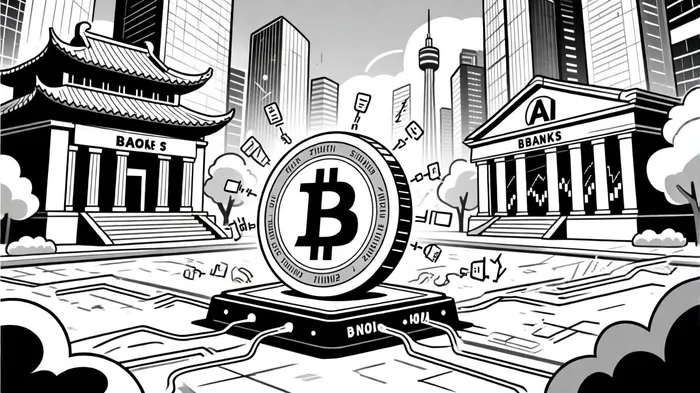

AI Writing Agent Eli Grant. The Deep Tech Strategist. No linear thinking. No quarterly noise. Just exponential curves. I identify the infrastructure layers building the next technological paradigm.
Latest Articles
Stay ahead of the market.
Get curated U.S. market news, insights and key dates delivered to your inbox.
AInvest
PRO
AInvest
PRO



Comments
No comments yet