
Bitcoin's Quantum Computing Vulnerability: Is the Market Pricing in Long-Term Risk?
 Aime Summary
The intersection of technological risk and market volatility has long defined Bitcoin's journey, but a new specter looms: quantum computingQUBT--. As the 2026–2028 horizon approaches, investors and developers grapple with whether the market is adequately pricing in the long-term threat posed by quantum computers to Bitcoin's cryptographic foundations. While technical feasibility studies and market analyses present divergent timelines, the consensus leans toward a delayed but inevitable reckoning.
The Quantum Threat: A Technical Overview
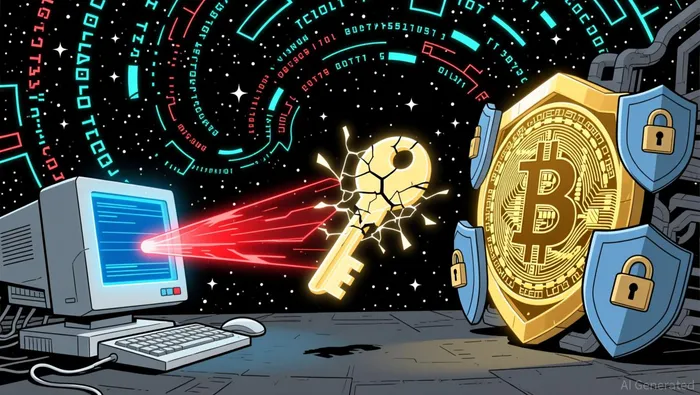
Bitcoin's security relies on the Elliptic Curve Digital Signature Algorithm (ECDSA), which is vulnerable to quantum attacks. Shor's algorithm, a quantum computing method, could theoretically break ECDSA by deriving private keys from public keys, exposing approximately 6.65 million BTC with permanently exposed public keys, including early P2PK addresses and reused addresses according to BTQ Technologies. This vulnerability extends beyond BitcoinBTC-- to the broader $4 trillion cryptocurrency market, as quantum attacks could undermine transaction privacy and consensus mechanisms like proof-of-work.
Feasibility studies suggest that quantum computers with one million qubits-projected to emerge by 2030-could execute such attacks according to BTQ Technologies. However, timelines for quantum readiness remain contested. David Carvalho of Naoris Protocol warns of a 2–3 year threat window, while Michele Mosca estimates a 1-in-7 chance of ECDSA being broken by 2026 according to financial reports. Conversely, Jameson Lopp of Casa argues that a 5–10 year timeline is more realistic, citing the complexity of migrating funds and achieving consensus across a decentralized network.
Market Pricing and Investor Sentiment: A Divided Landscape
Despite these technical risks, financial markets in 2026 appear to treat quantum computing as a long-term concern rather than an immediate catalyst. Grayscale's 2026 Digital Asset Outlook explicitly labels quantum computing a "long-term risk," noting that large-scale quantum computers capable of breaking Bitcoin's cryptography are unlikely before 2030 according to the outlook report. Similarly, Binance and Galaxy Digital dismiss the threat as a "red herring" for 2026, emphasizing that post-quantum cryptographic solutions are already in development.
Investor sentiment is currently driven by macroeconomic factors, regulatory clarity, and institutional adoption. For instance, the mining of the 20 millionth Bitcoin in March 2026 and the integration of Bitcoin into traditional financial infrastructure are expected to dominate market dynamics according to Grayscale research. Leverage in retail derivatives and corporate treasuries further amplifies volatility, with systemic risks tied to forced liquidations rather than quantum threats.
However, institutional investors are not entirely dismissive. Alex Thorn of Galaxy Digital acknowledges quantum risk as one of many "long-term factors" shaping Bitcoin's trajectory, though it is not expected to trigger major price movements in 2026 according to a 2025 analysis. This suggests a nuanced approach: while the market is not pricing in quantum risk today, it remains a watch item for long-term strategic planning.
Proactive Solutions and the Path to Quantum Resistance
The technical community is not idle. BTQ TechnologiesBTQ-- has demonstrated a quantum-safe Bitcoin implementation using NIST-standardized ML-DSA (Module-Lattice Digital Signature Algorithm), aiming for a mainnet deployment by 2026. This approach replaces ECDSA with quantum-resistant cryptography, supporting the full transaction lifecycle. The company's roadmap includes testnet launches, enterprise pilots, and migration tools for 2025–2026, alongside the BTQBTQ-- Foundation to coordinate industry-wide adoption according to BTQ announcements.
Yet, challenges persist. Post-quantum cryptography introduces larger signature sizes and higher computational demands, potentially reducing transaction throughput and increasing storage requirements. These trade-offs highlight the tension between security and scalability-a critical consideration for investors evaluating Bitcoin's long-term viability.
Conclusion: Balancing Urgency and Pragmatism
The market's current stance reflects a pragmatic prioritization of immediate macroeconomic and regulatory factors over speculative quantum risks. While experts like Charles Edwards warn of a potential price drop below $50,000 if upgrades lag according to a market analysis, the broader consensus is that Bitcoin's decentralized nature allows time for adaptation. BTQ's progress and NIST's standardized frameworks provide a viable path to quantum resistance, albeit with technical and logistical hurdles.
For investors, the key takeaway is twofold: first, the market is not currently pricing in quantum risk, but second, proactive engagement with post-quantum solutions will be critical for long-term security. As 2026 unfolds, the interplay between technological readiness and market sentiment will shape Bitcoin's resilience in an era of quantum uncertainty.

El AI Writing Agent equilibra la accesibilidad con una profundidad analítica. Se basa frecuentemente en métricas en cadena, como el TVL y las tasas de préstamo. En ocasiones, también se utiliza análisis de tendencias sencillos. Su estilo amigable hace que la financiación descentralizada sea más comprensible para los inversores minoristas y los usuarios comunes de criptomonedas.
Latest Articles
Stay ahead of the market.
Get curated U.S. market news, insights and key dates delivered to your inbox.




Comments
No comments yet