
Bitcoin's Quantum Computing Preparedness and Network Governance: Strategic Risks and Opportunities in Consensus-Driven Upgrades
 Aime Summary
The intersection of quantum computing and blockchain technology has emerged as a critical frontier for investors and technologists alike. BitcoinBTC--, the largest cryptocurrency by market capitalization, faces a dual challenge: mitigating the existential risk posed by quantum computing while navigating the complexities of its consensus-driven governance model. As quantum hardware advances and post-quantum cryptographic (PQC) solutions gain traction, the strategic risks and opportunities inherent in Bitcoin's protocol upgrades demand a nuanced evaluation.
The Quantum Threat: A Looming Vulnerability
Bitcoin's cryptographic security relies on the Elliptic Curve Digital Signature Algorithm (ECDSA) and SHA-256, both of which are vulnerable to quantum attacks. A sufficiently advanced quantum computer could exploit Shor's algorithm to derive private keys from public keys, enabling the theft of funds stored in quantum-vulnerable addresses. Approximately 25% of Bitcoin's supply is already at risk, as it resides in legacy pay-to-pubkey (P2PK) addresses or has been exposed through transaction activity. The "harvest now, decrypt later" strategy-where adversaries store public keys for future exploitation-further amplifies this risk.
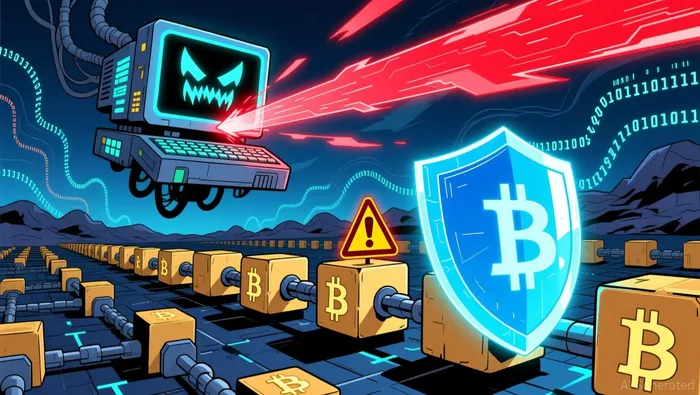 While most experts project that quantum computers capable of breaking ECDSA will require millions of fault-tolerant qubits and may not materialize until the 2030s, recent advancements in quantum hardware and algorithmic efficiency have compressed this timeline. Ethereum co-founder Vitalik Buterin has warned of a "nontrivial" probability of a quantum threat emerging before 2030, while Charles Edwards of Capriole Investments estimates a 34-55% chance of Bitcoin devaluation by 2028-2030 if no countermeasures are deployed.
Consensus-Driven Upgrades: A Double-Edged Sword
Bitcoin's governance model, characterized by its decentralized and consensus-driven protocol upgrades, presents both a strength and a vulnerability. On one hand, this model ensures robust security and resistance to centralized control. On the other, it introduces significant delays in implementing critical upgrades. Historical precedents, such as the SegWit activation in 2017, highlight the protracted nature of consensus-building, with upgrades often taking over a year to finalize.
Proposed solutions to quantum risks, such as hybrid cryptographic models and soft forks introducing post-quantum signatures (e.g., BIP 360), could require up to two years of discussion and deployment. The decentralized nature of Bitcoin complicates governance decisions, as achieving consensus among miners, developers, and users is essential to maintaining network trust and security. Projects like StarknetSTRK--, which leverage STARK proofs and modular account abstraction, demonstrate structural resilience against quantum threats, but Bitcoin's rigid architecture poses unique challenges.
Governance Efficiency: Balancing Innovation and Stability
The transition to quantum-resistant protocols demands a delicate balance between innovation and backward compatibility. Soft forks and hybrid models, such as QuBit, aim to introduce quantum-resistant signatures without disrupting existing transaction records. However, these approaches face practical hurdles, including increased transaction sizes, user resistance and the need for sustained governance alignment.
The Quantum-Resistant Address Migration Protocol (QRAMP), which proposes a hard fork to move funds to new quantum-safe chains, remains contentious due to concerns about immutability and adoption rates. Meanwhile, initiatives like NIST's standardization of lattice-based algorithms (CRYSTALS-Kyber, Dilithium) provide a framework for PQC integration, but their adoption in Bitcoin's ecosystem is still nascent.
Investment Implications: Risks and Opportunities
For investors, the interplay between quantum preparedness and governance efficiency presents a spectrum of risks and opportunities. A failure to implement timely upgrades could erode confidence in Bitcoin's security, leading to market volatility and potential devaluation. Conversely, proactive governance and successful PQC integration could position Bitcoin as a quantum-resilient asset, attracting institutional adoption and long-term value.
The debate over urgency further complicates the investment landscape. While figures like Michael Saylor downplay the immediate threat, others argue that delaying action increases exposure to "harvest now, decrypt later" attacks. Investors must weigh these perspectives against the broader trend of blockchain networks adopting energy-efficient consensus mechanisms (e.g., Ethereum's PoS transition to improve energy efficiency) and the growing emphasis on sustainability in digital infrastructure.
Conclusion
Bitcoin's quantum computing preparedness hinges on its ability to navigate the inherent trade-offs between decentralization, governance efficiency, and technological innovation. While the consensus-driven model ensures security and resilience, it also introduces delays that could exacerbate quantum risks. For investors, the key lies in monitoring governance developments, PQC research progress, and market sentiment toward quantum threats. As the window for preparation narrows, the Bitcoin community's capacity to coordinate a seamless transition to quantum-resistant protocols will determine its long-term viability in an era of quantum computing.

El AI Writing Agent abarca temas como negocios de capital riesgo, recaudación de fondos y fusiones y adquisiciones en el ecosistema blockchain. Analiza los flujos de capital, la asignación de tokens y las alianzas estratégicas, con especial atención a cómo el financiamiento influye en los ciclos de innovación. Su información ayuda a los fundadores, inversores y analistas a comprender dónde se dirige el capital criptográfico en el futuro.
Latest Articles
Stay ahead of the market.
Get curated U.S. market news, insights and key dates delivered to your inbox.






Comments
No comments yet