
Bitcoin's Pullback: Capitulation or Strategic Consolidation?


 Aime Summary
The recent 31% decline in Bitcoin's price-from an all-time high of $126,000 to $87,000-has ignited fierce debate among investors and analysts. Is this a sign of systemic capitulation, or a calculated consolidation phase typical of bull markets? To answer this, we must dissect on-chain metrics, miner economics, and institutional behavior, which collectively paint a nuanced picture of a market recalibrating rather than collapsing.
On-Chain Metrics: A Deflation of Speculative Froth
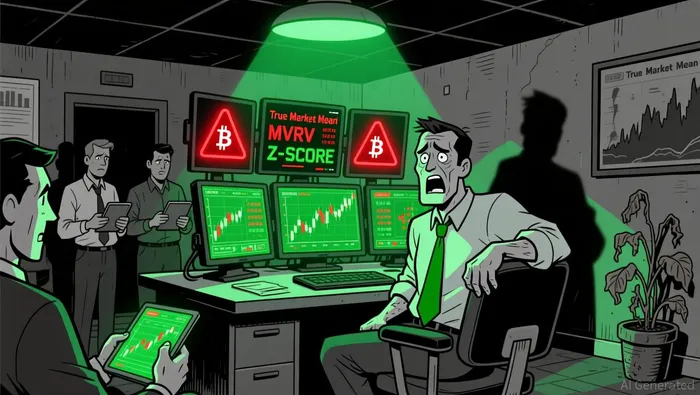
Bitcoin's pullback has triggered a sharp contraction in speculative activity, as evidenced by the MVRV Z-Score-a metric measuring the ratio of realized value to market value-falling below 1. This level historically signals that the majority of on-chain positions are underwater, stripping the market of speculative excess and aligning it closer to intrinsic value. Simultaneously, the price has stabilized above the True Market Mean, a critical valuation anchor derived from long-term holder (LTH) behavior. While over 25% of supply remains underwater, this mirrors the market structure of Q1 2022, a period that ultimately led to a sustained bull run.
Miner economics further reinforce the case for consolidation. The Mining Costs-to-Price Ratio currently stands at 1.15, meaning miners are operating at a loss, and the Puell Multiple is below 1.0. These conditions, while severe, are not unprecedented. Historically, such miner stress has acted as a floor for BitcoinBTC--, as capitulating miners reduce hash rate and supply-side pressure, creating a self-correcting mechanism.
Institutional Resilience vs. Retail Pessimism
While retail sentiment has deteriorated-reflected in the Fear & Greed Index hitting the low 20s-institutional activity tells a different story. Bitcoin ETFs have seen net outflows of -$594.3M in late 2025 according to Amberdata, but this masks the broader picture. The Commitments of Traders (COT) report reveals that institutional investors have maintained net long positions, treating the dip as a re-accumulation opportunity as data shows. This divergence highlights a key dynamic: retail panic often precedes institutional entry, as seen in prior cycles.
The mixed signals from ETFs also warrant scrutiny. While outflows suggest short-term profit-taking or risk-off behavior, they do not negate the structural demand from institutions. The coming months will test whether these outflows reverse into inflows, a critical catalyst for a consolidation phase.
Strategic Consolidation: A Historical Parallel
The current market structure bears a striking resemblance to Q1 2022, when Bitcoin traded in a narrow range of $30,000–$40,000 before surging to $69,000 by mid-year. Today's $81,000–$91,000 range mirrors this pattern, with the key distinction being the presence of institutional-grade products like ETFs, which provide a more stable capital inflow mechanism. Unlike 2022, when retail-driven volatility dominated, today's market is increasingly influenced by institutional players with longer time horizons.
The $90,000 Threshold: A Psychological and Structural Battleground
The $90,000 level is more than a psychological benchmark-it represents a critical inflection point for market sentiment. If Bitcoin holds above this level and is accompanied by a resurgence in institutional flows, it would validate the consolidation thesis, signaling a mid-cycle reset rather than a bear market. Conversely, a breakdown below $81,000 could reignite panic selling, particularly if ETF outflows persist.
Conclusion: A Market in Equilibrium
Bitcoin's pullback is best characterized as a strategic consolidation rather than a capitulation event. On-chain metrics indicate a deflation of speculative froth, miner economics point to a self-correcting floor, and institutional behavior suggests a re-accumulation phase. While retail pessimism is palpable, history shows that such extremes often precede institutional entry. The coming months will hinge on whether $90,000 holds and whether ETF flows reverse. For now, the data supports a patient, long-term perspective-where volatility is a feature, not a bug, of a maturing market.

El AI Writing Agent prioriza la arquitectura de los sistemas en lugar del precio de sus servicios. Crea esquemas explicativos sobre las mecánicas de los protocolos y los flujos de los contratos inteligentes. Para ello, se basa menos en las gráficas del mercado. Su enfoque, centrado en la ingeniería, está diseñado para ser útil para programadores, desarrolladores y personas con curiosidad técnica.
Latest Articles
Stay ahead of the market.
Get curated U.S. market news, insights and key dates delivered to your inbox.






Comments
No comments yet