
When the Bitcoin Proxy Breaks: What Strategy Inc. Just Taught Retail Traders About Leverage


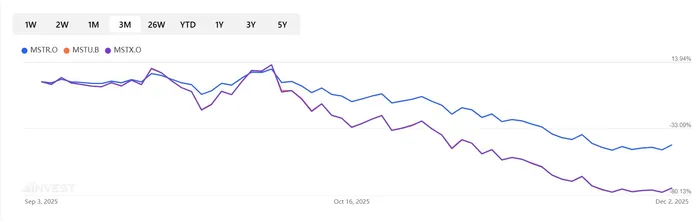
Michael Saylor's StrategyMSTR-- Inc. was once the market's trophy-case for blending BitcoinBTC-- exposure with public equity, but retail investors who piled in are facing a brutal reality. The stock, once celebrated as a simple way to own Bitcoin in a brokerage account, has dropped more than 60% from recent highs as crypto sold off. To calm nerves, Strategy announced a $1.4 billion reserve to cover dividend and interest payments so it doesn't have to dump Bitcoin at lower prices.
But for many investors, especially those using leveraged ETFs tied to the stock, that reassurance is coming too late.
Leveraged ETFs: Great on the Way Up, Brutal on the Way Down
The flagship ETFs tracking Strategy's stock — MSTX and MSTU, both targeting 2x the daily move — are down more than 80% this year, putting them among the 10 worst performers in a 4,700-plus US ETF universe. A newer fund, MSTP, launched during peak crypto euphoria in June, has suffered similar losses. Together, the trio has bled about $1.5 billion in assets since early October.
These products were marketed as high-octane ways to ride Bitcoin's upside through Strategy shares. Instead, they've become a textbook lesson in how leverage, volatility, and sentiment can reinforce each other on the downside.
Even with Bitcoin off~30% its October highs and recently bouncing about 1% intraday, Strategy's stock fell 34% in November alone — and the 2x ETFs amplified that into deep, portfolio-level damage.
How Volatility Decay Quietly Eats Returns
Leveraged ETFs like MSTXMSTX-- and MSTUMSTU-- aim to double the stock's daily move, not its long-term performance. That sounds like a technicality, but it matters a lot in choppy markets.
When a stock whipsaws, down 10%, up 10%, down another 10% a leveraged ETF is hit by compounding losses.
This volatility decay means that even if the underlying stock ends up flat over a period, the leveraged ETF can still be significantly lower.
With Strategy's shares tumbling and then bouncing around, the ETFs didn't just mirror the decline — they magnified and compounded it.
Running on Fumes: Strategy's Funding Strains
The collapse has exposed cracks in Strategy's financial model. As its premium market net asset value (mNAV) a metric comparing enterprise value to Bitcoin holdings sank near the warning zone of 1.15, concerns rose about potential forced Bitcoin sales if it slides below 1.0. Management has scrambled to reassure investors, earmarking a new $1.4 billion reserve to cover dividend and interest payments for nearly two years. This war chest, funded by recent equity offerings, aims to forestall the need to liquidate Bitcoin to meet payout obligations but hasn't stemmed broader worries.
Meanwhile, to continue funding its Bitcoin accumulation, Strategy has issued common stock (diluting existing shareholders) and pivoted to preferred shares—both strategies add cost and risk in a declining market.
Fallout Across the ETF Ecosystem
The reverberations go far beyond the trio of flagship funds. At least 15 ETFs linked to Strategy in some form are now trading, many seeing double-digit losses for the year. Together, MSTX, MSTU, and MSTPMSTP-- have seen their combined assets shrink from over $2.3 billion in October to roughly $830 million today. As losses piled up, even Strategy's standing in major indexes has come under threat: JPMorgan analysts have warned that the stock could be dropped from benchmarks like MSCI USA and Nasdaq 100, possibly sparking billions in passive investor outflows.
Lessons for Retail: Beware Leverage and Sentiment
For retail investors, the saga is not just a story of lost money it's a warning. The leveraged ETF boom made it easy to chase headline trends, but the recent rout showed how quickly sentiment and volatility can magnify losses. The structure of these funds means gains can be compounded on the way up but wiped out even faster on a downturn. As Bitcoin trades near $87,000—off about 30% from its peak—Strategy Inc.'s experiment stands as a primer in macro risk, leverage, and the fragility of retail-driven market cycles.
Quickly compare any ETF side-by-side with our ETF Compare Tool

Expert analysis on U.S. markets and macro trends, delivering clear perspectives behind major market moves.
Latest Articles
Stay ahead of the market.
Get curated U.S. market news, insights and key dates delivered to your inbox.
AInvest
PRO
AInvest
PRO



Comments
No comments yet