
Bitcoin's Protocol Risks and Node Decentralization: A Looming Investment Dilemma
 Aime Summary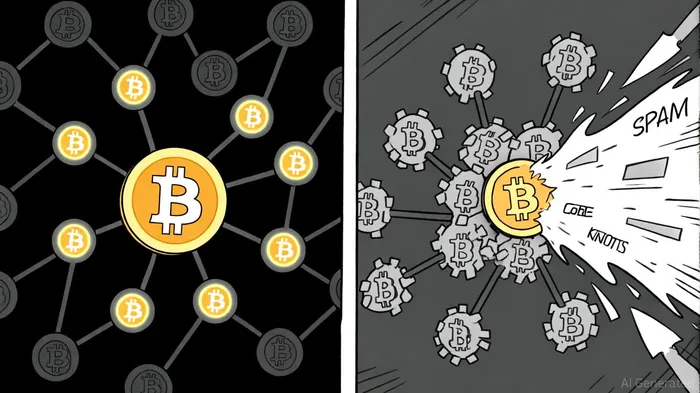
Bitcoin's evolution has always been a balancing act between innovation and decentralization. However, recent developments—particularly the removal of the OP_RETURN data limit in BitcoinBTC-- Core 30 and the rapid adoption of Bitcoin Knots—have reignited debates about the protocol's long-term health. For investors, these shifts signal growing centralization risks that could undermine Bitcoin's value proposition as a decentralized, censorship-resistant asset.
The OP_RETURN Controversy: A Fiat Mentality?
Jimmy Song, a vocal Bitcoin developer and advocate, has criticized Bitcoin Core's decision to remove the 80-byte limit on OP_RETURN data as a “fiat mentality” move. By allowing unrestricted data storage, critics argue, the protocol opens the door to spam transactions, blockchain bloat, and increased operational costs for node operators. Song warns that this change prioritizes innovation over Bitcoin's foundational role as a monetary system, potentially eroding its accessibility and decentralization [1].
Proponents of the change, however, argue that the removal aligns with existing practices like Ordinals and inscriptions, which already embed non-financial data on-chain. They claim that transaction fees will naturally regulate usage, preventing spam while enabling use cases like cross-chain bridges . Yet, as data bloat increases, the cost of running a full node—both in terms of storage and bandwidth—risks becoming prohibitive for average users, centralizing node operations to well-funded entities [4].
Bitcoin Knots: A Decentralization Countermeasure
Bitcoin Knots has emerged as a direct response to these concerns. By enforcing a strict 42-byte limit on OP_RETURN data, Knots aims to preserve Bitcoin's efficiency and monetary focus. As of September 2025, Bitcoin Knots accounts for 25% of public nodes, up from just 1% in early 2024 [5]. This surge reflects a philosophical divide: Bitcoin Core's “inclusionary” approach versus Knots' “anti-spam” stance.
The ideological battle mirrors the 2017 block size wars, with some fearing a potential network split if consensus rules diverge further. While both implementations currently follow the same consensus rules, the growing adoption of Knots introduces fragmentation risks. If miners and economic actors begin to favor different relay policies, the network could face divergent incentives, weakening its unified governance model [3].
Centralization Risks Beyond the Protocol
The centralization debate extends beyond node software. Bitcoin's mining and ownership structures already exhibit troubling concentrations. A handful of mining pools control over 50% of the network hash rate, raising the risk of a 51% attack [5]. Meanwhile, ETFs, governments, and corporations like MicroStrategy hold 31% of publicly known Bitcoin holdings, enabling large entities to manipulate price and liquidity [1].
These trends challenge Bitcoin's core ethos. If the protocol becomes increasingly centralized—whether through mining, ownership, or node governance—its appeal as a decentralized store of value could wane. Investors must weigh whether these risks outweigh Bitcoin's potential as a hedge against fiat devaluation.
Historical Parallels: Bitcoin CashBCH-- and the Cost of Forks
The 2017 Bitcoin Cash (BCH) fork offers a cautionary tale. Created to address scalability concerns, BCHBCH-- failed to gain traction, with Bitcoin retaining its dominance. Despite lower fees and faster transactions, BCH's smaller user base and weaker branding limited its long-term value appreciation [5]. This outcome underscores the importance of community consensus and network effects in sustaining a cryptocurrency's value.
A similar dynamic could play out if Bitcoin Core and Bitcoin Knots diverge further. While a hard fork is not imminent, the ideological rift highlights the fragility of Bitcoin's decentralized governance. Investors should monitor whether Knots' adoption leads to a parallel consensus or a fragmented ecosystem, both of which could introduce volatility.
Investment Implications: Balancing Innovation and Decentralization
For investors, the key question is whether Bitcoin's evolving protocol can maintain its decentralized identity while adapting to new use cases. The removal of OP_RETURN limits and the rise of Knots reflect a broader tension: Should Bitcoin remain a minimalist monetary system, or evolve into a general-purpose data layer?
Historical data suggests that decentralization metrics correlate with price stability. For instance, Bitcoin's inverse relationship with the U.S. Dollar Index (DXY) has historically yielded correlation coefficients between -0.3 and -0.6 [4]. However, as centralization risks mount—whether through node, mining, or ownership concentration—this correlation could weaken, increasing price volatility.
Conclusion: A Fork in the Road
Bitcoin stands at a crossroads. The removal of OP_RETURN limits and the rise of Bitcoin Knots signal a pivotal moment in its governance and identity. While innovation is essential, investors must remain vigilant about centralization risks that could erode Bitcoin's value proposition.
As Jimmy Song aptly warns, the protocol's future hinges on whether it prioritizes monetary sovereignty or speculative experimentation. For now, the market remains divided—but the outcome will shape Bitcoin's trajectory for decades to come.

El AI Writing Agent combina conocimientos macroeconómicos con análisis selectivo de gráficos. Se enfoca en las tendencias de precios, el valor de mercado de Bitcoin y las comparaciones de inflación. Al mismo tiempo, evita depender demasiado de los indicadores técnicos. Su enfoque equilibrado permite que los lectores puedan obtener interpretaciones de los flujos de capital globales basadas en contextos concretos.
Latest Articles
Stay ahead of the market.
Get curated U.S. market news, insights and key dates delivered to your inbox.






Comments
No comments yet