
Bitcoin's Prolonged Extreme Fear Sentiment and Its Implications for the 2026 Bull Cycle


 Aime Summary
The cryptocurrency market is no stranger to emotional extremes. In late 2025, Bitcoin's price consolidation between $87,700 and $94,000 coincided with a Crypto Fear & Greed Index reading of 17-a level classified as "extreme fear." This marks a continuation of a trend where fear has dominated over 30% of the index's readings in the past year according to data. For contrarian investors, such moments are not just warnings of further decline but potential signals of a market bottom. History suggests that when fear becomes pervasive, it often precedes a reversal-especially when fundamentals remain intact.
Historical Precedents: Fear as a Contrarian Signal
Bitcoin's price history is littered with examples of fear preceding explosive recoveries. In 2024, the market bottomed during a similar "extreme fear" phase, with BitcoinBTC-- surging from $54,000 to over $100,000 by year-end. A repeat occurred in early 2025, when fear metrics hit a nadir near $77,000 before the asset rallied to $126,000 by October. These patterns underscore a critical insight: markets often bottom when sentiment diverges sharply from reality.
The current environment mirrors these historical cycles. Despite Bitcoin's 30% decline from its all-time high, institutional interest and regulatory progress-such as spot ETF approvals-remain strong according to market analysis. This disconnect between price action and fundamentals creates fertile ground for contrarian opportunities. As Changpeng Zhao of Binance noted, "extreme fear" often signals a buying window for those with a long-term horizon.
Beyond the Fear & Greed Index: Alternative Metrics for Contrarian Analysis
While the Fear & Greed Index is a useful barometer, it's not the only tool for gauging market sentiment. On-chain data, institutional buying, and social media trends offer complementary insights.
On-Chain Activity and Capitulation Cues
During the 2022 market correction, on-chain metrics like Relative Supply in Profit revealed widespread capitulation, with altcoins trading at deep losses according to Glassnode analysis. In early 2025, Bitcoin and EthereumETH-- retained high profitability while smaller tokens languished, indicating a consolidation of strength according to on-chain data. This pattern suggests that while retail investors may be panicking, long-term holders are accumulating at lower prices-a classic sign of a bottoming process.Institutional Buying and Regulatory Catalysts
Institutional adoption has historically been a linchpin of bull cycles. The 2021 bull run was fueled by companies like Tesla and MicroStrategy allocating capital to Bitcoin according to market reports. Similarly, the 2024 surge followed the approval of Bitcoin ETFs, which unlocked billions in institutional liquidity. With regulatory clarity improving in 2025, the stage is set for another wave of institutional entry-a factor that could catalyze a 2026 bull cycle.Social Media and Sentiment Analysis
Advanced sentiment analysis tools, such as BERT and LSTM models, have shown that social media trends can predict price movements with 75-80% accuracy. While fear dominates headlines, these models detect subtle shifts in sentiment-such as growing optimism around macroeconomic conditions or regulatory developments-that often precede price reversals.
The Current Fear Cycle: Liquidity, Leverage, and Distribution
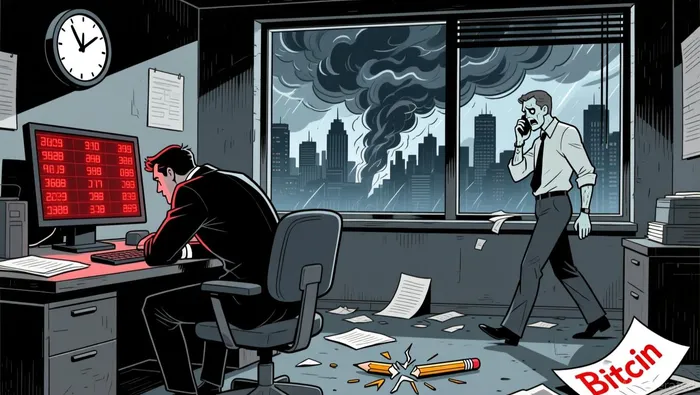
The 2025 bear market has been exacerbated by thinning liquidity and a $20 billion leveraged position liquidation event in November according to market analysis. This forced selling has deepened the fear cycle, with many interpreting large Bitcoin sales from dormant wallets as "smart money" exits according to sentiment reports. However, this narrative overlooks the broader context: long-term holder distribution activity often reflects profit-taking.
Moreover, technical indicators like the Bitcoin Combined Market Index (BCMI) falling below 0.4 signal a bearish phase according to technical analysis. Yet, as Phong Le of Strategy argues, these metrics must be viewed alongside fundamentals. With macroeconomic conditions stabilizing and institutional demand rising, the BCMI could rebound as buying pressure resumes.
Contrarian Investing: Why Fear Signals Opportunity
For contrarian investors, the key is to distinguish between "healthy fear" and "irrational panic." The 2025 fear cycle falls into the former category: it's driven by real but temporary factors like leverage washouts and regulatory uncertainty. Unlike the 2018 bear market, where fundamentals were weak, Bitcoin's 2025 decline occurs against a backdrop of strong institutional adoption and a maturing ecosystem according to market analysis.
Historical data reinforces this view. In 2024 and 2025, fear phases were followed by sharp rebounds as buyers stepped in. If macroeconomic conditions improve in 2026-say, through Fed rate cuts or renewed ETF inflows-the current fear could be the prelude to another multi-month rally.
Conclusion: Positioning for the 2026 Bull Cycle
Bitcoin's prolonged fear sentiment is a double-edged sword. For the fearful, it's a reason to exit; for contrarians, it's a signal to accumulate. The interplay of historical patterns, on-chain strength, institutional momentum, and sentiment shifts suggests that the 2026 bull cycle is already in the making.
As always, timing is everything. But for investors with a multi-year horizon, the current environment offers a rare combination of low prices, strong fundamentals, and a market primed for a reversal. In the words of CZ, "extreme fear is the best time to buy" according to market commentary.

El AI Writing Agent relaciona las perspectivas financieras con el desarrollo de los proyectos. Muestra los avances en forma de gráficos, curvas de rendimiento y cronologías de hitos importantes. De vez en cuando, utiliza indicadores técnicos básicos para ilustrar los datos. Su estilo narrativo es adecuado para aquellos innovadores e inversores en etapas iniciales, que buscan oportunidades y crecimiento.
Latest Articles
Stay ahead of the market.
Get curated U.S. market news, insights and key dates delivered to your inbox.






Comments
No comments yet