
Bitcoin Price USD: Key Drivers, Risks, and Market Outlook in 2026
 Aime Summary
- Bitcoin's price is shaped by factors such as limited supply, macroeconomic conditions, institutional flows, and on-chain activity.
- Institutional investors are adapting strategies to manage Bitcoin's volatility amid rising geopolitical tensions and regulatory uncertainty.
- The recent liquidation of $1.68 billion in long positions has intensified Bitcoin's downward pressure, with ETF outflows and macroeconomic headwinds compounding the trend.
- Michael Saylor argues that protocol changes, rather than external threats, could pose a major risk to Bitcoin's stability.
- Analysts project a short-term trading range of $75,000 to $150,000, but macroeconomic risks remain a key wildcard.
Bitcoin's price has faced significant downward pressure in early 2026, with a sharp correction in January fueled by a cascade of liquidations and ETF outflows. While Bitcoin's long-term fundamentals—such as its capped supply and adoption as a store of value—remain intact, the recent volatility underscores the need for investors to understand the key factors and risks shaping the market.
What Influences Bitcoin's Price in 2026
Bitcoin's value is influenced by a complex interplay of macroeconomic factors, institutional activity, and on-chain behavior. Scarcity remains a foundational element, as the supply of BitcoinBTC-- is fixed at 21 million coins, with halving events reducing new supply and historically reinforcing price trends according to analysis. However, in 2026, the picture has evolved, with macroeconomic conditions and institutional flows playing a more prominent role. Rising interest rates, geopolitical tensions, and shifts in global risk appetite have all contributed to Bitcoin's price swings as reported.
Institutional adoption has also had a profound impact. The approval of spot Bitcoin ETFs in late 2024 brought in billions in flows initially, but by early 2026, outflows had exceeded $4.5 billion, exacerbating downward pressure. ETFs have become a double-edged sword: when institutional investors redeem their shares, they often trigger sales of Bitcoin, reinforcing bearish momentum according to analysis.
What Bitcoin Price Risks Are Investors Facing in 2026
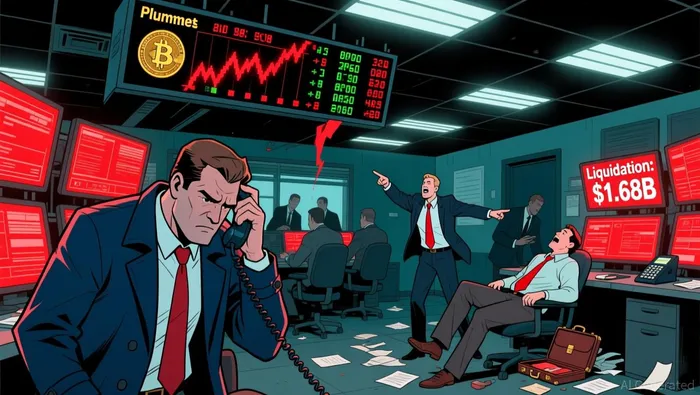
Bitcoin is no stranger to volatility, but the risks in 2026 are particularly pronounced. One major risk comes from the derivatives market, where excessive leverage has made Bitcoin particularly sensitive to price shocks. In January 2026, a $1.68 billion liquidation event—93% of which involved long positions—accelerated the selloff as data shows.
Regulatory uncertainty is another headwind. While no outright ban on Bitcoin has materialized, proposals for greater oversight are increasing, especially in the U.S. and Europe. Environmental concerns related to Bitcoin mining have also resurfaced, with pressure to transition to more sustainable energy sources according to analysis.
Perhaps the most philosophical debate centers around Bitcoin's protocol. Michael Saylor has warned that attempts to alter the base rules—such as BIP-110 proposals to limit spam—could undermine Bitcoin's foundational stability. Others argue that evolution is necessary to address vulnerabilities and improve functionality as noted.
What's Next for Bitcoin Price in Light of Recent Market Moves
Bitcoin's price is currently consolidating between $85,200 and $94,000, with key resistance at $100,000 and support at $86,000 according to technical analysis. Analysts are split on the short-term outlook: some believe a breakdown below $86,000 could target the $80,000–$82,000 zone, while others suggest a rebound is possible if macroeconomic uncertainty abates or new policy clarity emerges as reported.
Longer-term, the market is watching for signs of stabilization. ETF inflows could return if macroeconomic conditions improve or if Bitcoin's correlation with traditional assets like the S&P 500 weakens. Meanwhile, institutional investors are using more sophisticated risk management tools to navigate Bitcoin's volatility, including diversified crypto portfolios and dynamic rebalancing according to analysis.
One wildcard is the next Fed Chair, Kevin Warsh, whose monetary policies could reshape the valuation of risk assets and indirectly influence Bitcoin's price. Some analysts believe that if Warsh's policies trigger instability in traditional financial assets, Bitcoin could see renewed demand as a safe-haven asset as data shows.

Stay ahead of the market.
Get curated U.S. market news, insights and key dates delivered to your inbox.


AInvest
PRO
AInvest
PRO



Comments
No comments yet