
Bitcoin's Price Surge in November 2025: Macroeconomic Catalysts and Institutional Adoption


 Aime Summary
Macroeconomic Catalysts: Liquidity and the U.S. Government Shutdown
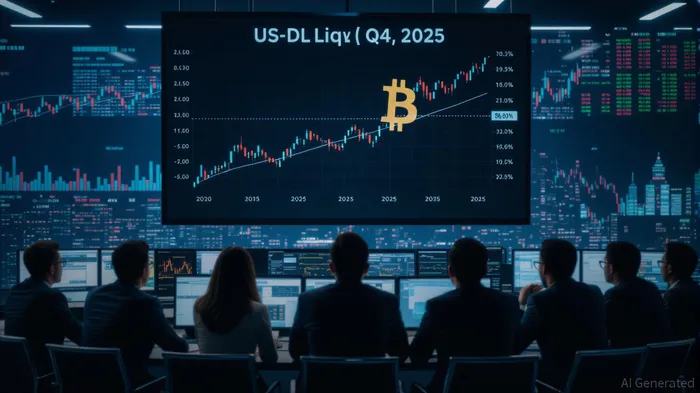
The U.S. government shutdown, which began on October 1, 2025, acted as a critical macroeconomic catalyst. By freezing hundreds of billions of dollars in the Treasury General Account (TGA), the shutdown drained liquidity from financial markets, triggering a 5% decline in Bitcoin's price during the same period, according to a Yahoo Finance report. Bitcoin, as a liquidity-sensitive risk asset, typically corrects when liquidity tightens and rebounds when it expands. Analysts emphasize that the resumption of government spending-expected by mid-November-would flood the system with liquidity, creating favorable conditions for a Bitcoin recovery, as noted in the same report.
The correlation between Bitcoin and dollar liquidity, as measured by the USDLiq Index, remains robust at 0.85, one of the highest among asset classes, according to the Yahoo Finance report. This suggests that Bitcoin's price movements are increasingly tethered to broader monetary conditions, mirroring trends observed in equities and commodities. As the TGA balance stabilized in late October, Bitcoin's price began to reflect optimism about liquidity normalization, setting the stage for its November rally.
Institutional Adoption: ETFs and Systematic Capital Inflows
While macroeconomic conditions provided the backdrop, institutional adoption emerged as the primary driver of Bitcoin's sustained surge. The launch of BlackRock's iShares Bitcoin ETF (IBIT) on the Australian Securities Exchange (ASX) in mid-November 2025 marked a pivotal milestone. Offering a 0.39% management fee, the ETF mirrored its U.S. counterpart, which had amassed over $98 billion in assets under management since its 2024 debut, according to a Coinotag report. This expansion into Australia, a market with stringent regulatory frameworks, signaled growing institutional confidence in Bitcoin's legitimacy.
JPMorgan's strategic alignment with the trend further underscored the shift. The bank's holdings in BlackRock's IBIT surged by 64% in Q3 2025, reaching $343 million, despite CEO Jamie Dimon's public skepticism, as reported by a Coinpaprika report. This discrepancy highlights the growing influence of institutional demand, as banks and endowments hedge against macroeconomic uncertainties. Notably, the Harvard endowment allocated over $100 million to a U.S. Bitcoin ETF, while Deutsche Bank projected Bitcoin's inclusion on central bank balance sheets by 2030, as reported in the Coinotag piece.
The institutional narrative extends beyond ETFs. Bitwise Asset Management's Chief Investment Officer, Matt Hougan, emphasized that the market is transitioning from retail speculation to systematic allocation strategies, according to a Bitcoin News report. Products like staking-based ETFs-exemplified by Bitwise's SolanaSOL-- staking ETF-are attracting regulated capital, fostering sustainable valuation growth. Meanwhile, corporate strategies such as Tuttle Capital's "Crypto Blast" ETFs, which blend stock and crypto exposure, illustrate the diversification of institutional approaches, as detailed in a Coinotag report.
Balancing Optimism and Caution
Despite the bullish momentumMMT--, November 2025 also revealed market fragility. Bitcoin and EthereumETH-- spot ETFs recorded net outflows of $578 million and $219 million, respectively, on November 4, as investors shifted toward alternative assets like Solana, according to the Coinotag report. This selective migration underscores the need for caution, even as institutional adoption accelerates.
Conclusion: A New Era for Bitcoin
Bitcoin's November 2025 surge reflects a maturing market dynamic. Macroeconomic catalysts, particularly liquidity cycles tied to government fiscal policy, continue to shape short-term volatility. However, the institutional infrastructure-bolstered by ETFs, staking products, and global regulatory alignment-is laying the groundwork for long-term stability. As BlackRock's ASX launch and JPMorgan's holdings demonstrate, Bitcoin is no longer a speculative fringe asset but a core component of diversified portfolios. The coming months will test whether this institutional momentum can sustain Bitcoin's trajectory amid evolving macroeconomic headwinds.

Blending traditional trading wisdom with cutting-edge cryptocurrency insights.
Latest Articles
Stay ahead of the market.
Get curated U.S. market news, insights and key dates delivered to your inbox.
AInvest
PRO
AInvest
PRO



Comments
No comments yet