
Bitcoin Price Could Be Shaped by AI and Fed Policy Moves
 Aime Summary
Bitcoin's price could be impacted by artificial intelligence's influence on employment and central bank liquidity injections. The future of BitcoinBTC-- depends on how AI affects economic growth, real interest rates, and policy responses. Bitcoin prices and energy consumption are interrelated, with price movements influencing mining energy use. AI-related market disruptions may lead to liquidity injections by central banks, historically supportive for Bitcoin. Bitcoin's divergence from tech stocks may signal growing financial instability and a liquidity crunch.
The Bitcoin price has long been a barometer for macroeconomic conditions, and as artificial intelligence reshapes the global economy, investors are watching closely for signs of volatility. In recent weeks, fears of AI-driven job displacement and software sector sell-offs have rippled through both traditional and cryptoBTC-- markets. As institutional investors and analysts dissect the implications, it's clear that the path of Bitcoin's price could be more influenced by policy responses than by the code itself.
The intersection of AI, employment, and monetary policy has become a focal point for Bitcoin investors. According to Greg Cipolaro of , AI-driven job losses could trigger liquidity injections by central banks—moves that historically support Bitcoin. On the flip side, if AI boosts productivity without widespread job displacement, higher real interest rates could weigh on Bitcoin's valuation. This nuanced dynamic is reshaping the way investors view Bitcoin's role in the broader market.
What Drives Bitcoin's Price in the Age of AI?
Bitcoin is often seen as a store of value, but its price is increasingly tied to macroeconomic narratives. If AI leads to widespread job losses, especially in the knowledge economy, central banks may respond by lowering interest rates or engaging in quantitative easing. These actions historically favor high-risk assets like Bitcoin.
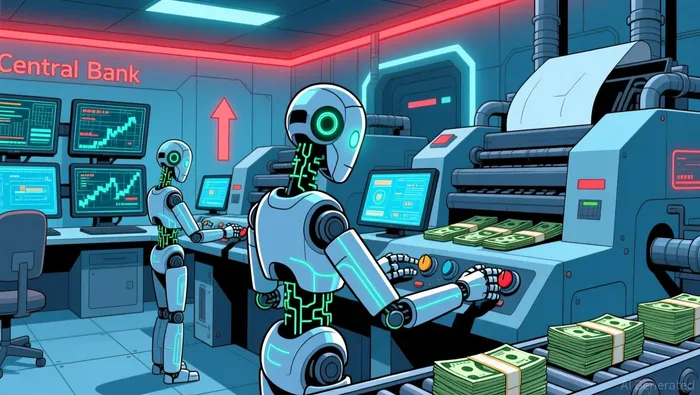
Arthur Hayes, investment chief at Maelstrom, warns that AI could render 20% of U.S. knowledge workers jobless, leading to a financial crisis similar in scale to the 2008 event. . In this scenario, the Federal Reserve may respond with liquidity injections, which have historically benefited Bitcoin.
Why Is Bitcoin's Price Linked to Software Stocks?
Bitcoin's recent performance has closely tracked software equities, especially during periods of market volatility. , with recent AI developments accelerating the sell-off. The correlation between Bitcoin and tech stocks suggests that crypto may still be viewed as an extension of the tech sector rather than an independent hedge.
However, that correlation could shift as the narrative around AI evolves. If investors begin to see Bitcoin as a monetary hedge against structural AI-driven labor disruption or currency debasement, its role in the market could change. This is a key question for investors to watch.
What to Watch for in Bitcoin's Price Outlook
Bitcoin's price is influenced by both structural and cyclical factors. The Federal Reserve's rate decisions, for example, play a crucial role in shaping Bitcoin's investment appeal. Historically, Bitcoin has outperformed during periods of low or falling interest rates, as investors seek higher returns in riskier assets.
John D'Agostino of CoinbaseCOIN-- has noted that Bitcoin's price corrections are a natural result of its mathematical constraints. While these corrections can be challenging, they also provide time for infrastructure and institutional adoption to mature. As regulatory clarity emerges and more institutions integrate Bitcoin into their portfolios, the long-term trajectory could be more stable.
Final Thoughts
Bitcoin's price is no longer just a function of its scarcity or demand from tech investors. It is increasingly shaped by macroeconomic forces and policy responses to technological disruption. As AI transforms industries and labor markets, the Fed and other central banks will likely play a pivotal role in determining Bitcoin's value. Investors should watch closely for signs of liquidity shifts, regulatory developments, and long-term productivity gains that could reshape the crypto landscape.
- , according to Maelstrom's analysis.
- Bitcoin's price may diverge from tech stocks as the financial system faces a liquidity crunch, according to Hayes.
- Historically, Bitcoin outperforms when the federal funds rate is low or falling, as investors seek higher returns.
- Bitcoin corrections are natural due to its mathematical properties, according to Coinbase's .
- Bitcoin's energy consumption and price movements are interrelated, with price fluctuations driving mining energy use.
- If AI leads to job losses, central banks may inject liquidity to stabilize the economy, potentially benefiting Bitcoin.
- AI-driven productivity gains without major job displacement could lead to higher real yields, which historically weigh on Bitcoin valuations.

Manténgase al tanto de las noticias de Wall Street en tiempo real.
Latest Articles
Stay ahead of the market.
Get curated U.S. market news, insights and key dates delivered to your inbox.
AInvest
PRO
AInvest
PRO



Comments
No comments yet