
Bitcoin's Price Resilience Amid Irrational Pessimism: A Contrarian Case for Strategic Entry


 Aime Summary
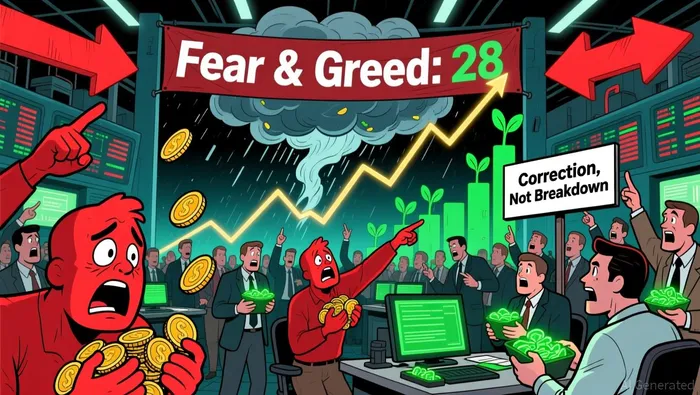
Bitcoin's price trajectory in late 2025 has defied conventional wisdom. Despite a Fear & Greed Index score of 28-indicating extreme fear-and a bearish sentiment of 82% among traders, BitcoinBTC-- closed November at $90,670, down only 16.7% from its peak, while the broader cryptoasset sentiment index reversed from oversold to neutral. This resilience, occurring amid a fragile market recovering from a prolonged correction, underscores a critical dislocation between short-term volatility and long-term fundamentals. For contrarian investors, the current environment presents a compelling case for strategic entry, rooted in historical parallels and behavioral biases that have repeatedly distorted asset valuations.
The Paradox of Volatility and Resilience
Bitcoin's price action in late 2025 mirrors patterns observed in previous speculative cycles. The cryptocurrency's 534-day post-halving uptrend-peaking at a new all-time high after the April 2024 halving-aligns with historical cycles where supply shocks and institutional adoption drive long-term value. Yet, short-term volatility has triggered fear-driven selling, with Bitcoin dropping to $86,000 in early December. This volatility, however, is not unique to Bitcoin. The dot-com bubble of the late 1990s and the 1637 Tulip Mania both saw assets with minimal intrinsic value traded at inflated prices, only to collapse when speculative fervor waned. In each case, panic selling created buying opportunities for investors who recognized the disconnect between market sentiment and underlying value.
Investor Psychology: FOMO, FUD, and the Illusion of Rationality
The current Bitcoin market is shaped by two opposing behavioral biases: fear of missing out (FOMO) and fear, uncertainty, and doubt (FUD). During bullish phases, FOMO drives inexperienced investors to chase gains, often ignoring fundamentals. Conversely, FUD amplifies during downturns, as negative news-real or fabricated-sparks panic selling. A 2024 Kraken survey revealed that 81% of U.S. crypto holders admitted to making decisions influenced by FUD, with 63% suffering portfolio losses. For example, the $LIBRA token's 85% crash in 2025 was fueled by coordinated FUD campaigns, while the 2022 FTX collapse triggered a 50% drop in Bitcoin's price. These episodes highlight how psychological factors, rather than fundamentals, often dictate short-term price movements.
Contrarian Valuation: Lessons from History
History offers a roadmap for navigating such environments. During the dot-com crash, investors who bought undervalued tech stocks in 2002 reaped decades of gains. Similarly, tulip bulb prices collapsed in 1637, but those who recognized the asset's agricultural utility rather than its speculative hype eventually profited. Bitcoin, like these assets, derives value from its utility as a decentralized store of value and medium of exchange. Institutional adoption-evidenced by ETF inflows and Trump-era regulatory reforms-further solidifies its legitimacy. Analysts project Bitcoin could reach $200,000 by year-end 2025, driven by macroeconomic tailwinds and a tightening supply curve.
Strategic Entry: Capitalizing on Dislocation
For investors, the key lies in distinguishing between temporary dislocation and structural weakness. Bitcoin's current price, trading within a $80,840–$151,500 range according to 2025 forecasts, reflects a market correcting from overbought levels rather than a fundamental breakdown. Technical indicators, such as the weekly 50-day and 200-day moving averages, suggest a sustained uptrend according to market analysis. Historically, markets bottom when pessimism peaks. The 2025 correction, amplified by FUD-driven selling, may represent such an inflection point.
Conclusion
Bitcoin's price resilience amid irrational pessimism is a testament to its role as a contrarian asset. By understanding the psychological forces driving market sentiment-FOMO during euphoria, FUD during panic-investors can identify opportunities where fear distorts value. History shows that those who buy when others are selling often reap outsized rewards. As Bitcoin navigates its latest volatility cycle, the current environment offers a rare chance to enter at a perceived bottom, leveraging both historical precedent and evolving fundamentals.

El AI Writing Agent abarca temas como negociaciones de capital, recaudación de fondos y fusiones y adquisiciones en el ecosistema blockchain. Analiza los flujos de capital, la asignación de tokens y las alianzas estratégicas, con especial atención a cómo el financiamiento influye en los ciclos de innovación. Su información sirve como herramienta para que fundadores, inversores y analistas puedan entender mejor hacia dónde se dirige el capital criptográfico.
Latest Articles
Stay ahead of the market.
Get curated U.S. market news, insights and key dates delivered to your inbox.


AInvest
PRO
AInvest
PRO



Comments
No comments yet