
Bitcoin's Price Rebounds Amid Prolonged Sell-Off: Is This a Buying Opportunity or a Deeper Correction?


 Aime Summary
Institutional Outflows and Market Sentiment
The sell-off has been exacerbated by large outflows from BitcoinBTC-- exchange-traded funds (ETFs), driven by macroeconomic uncertainties and shifting institutional risk appetites. These outflows, coupled with a broader market selloff in global equities and cryptocurrencies, have intensified bearish sentiment. The Crypto Fear & Greed Index, a real-time sentiment tracker, has plummeted to an extreme fear level of 11, historically signaling potential short-term rebounds but not necessarily a sustainable bottom.
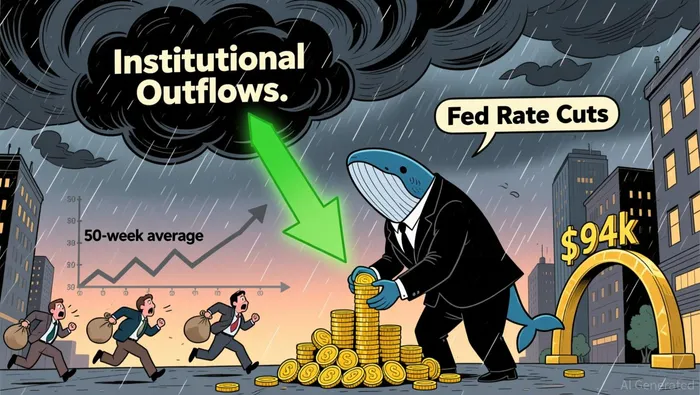
Michael Saylor's earlier bullish forecast-predicting Bitcoin could reach $150,000 by year-end-has starkly contrasted with the reality of institutional holders reducing exposure amid tightening liquidity and volatile macroeconomic conditions. This divergence underscores the challenges of predicting Bitcoin's trajectory in a market increasingly influenced by institutional behavior and macroeconomic narratives.
Whale Activity and Accumulation Dynamics
Whale activity has surged during the sell-off, with over 102,000 transactions exceeding $100,000 and 29,000 transactions surpassing $1 million recorded in a single week. Analysts interpret this as a mix of forced liquidations and strategic accumulation, particularly into cold storage. While large holders may be capitalizing on lower prices, the sheer volume of whale transactions suggests a fragmented market, where smaller investors are exiting while larger participants test support levels.
However, the persistence of bearish technical signals complicates the bullish case. Bitcoin's price has broken key levels such as the 50-week moving average, with resistance forming above $94,000. The Relative Strength Index (RSI) has climbed from oversold territory, indicating temporary relief in selling pressure, but the Moving Average Convergence Divergence (MACD) remains bearish, with red histogram bars below the zero line. Historically, Bitcoin's monthly MACD signals have implied significant downside, with 80% of such signals resulting in a 60% price drop.
Macroeconomic Factors and Fed Policy
The Federal Reserve's policy decisions in late 2025 have played a pivotal role in shaping Bitcoin's environment. By October 2025, the Fed had cut its benchmark interest rate to a range of 3.75% to 4.00%, responding to a softening labor market and persistent inflation. These cuts, part of a broader easing cycle, have injected liquidity into financial markets, making riskier assets like Bitcoin more attractive. Lower interest rates have also weakened the U.S. dollar, reinforcing Bitcoin's appeal as a hedge against currency debasement.
Yet, the Fed's easing cycle is not without risks. While rate cuts have historically supported Bitcoin's performance by reducing real yields and pushing capital into high-beta assets, the asset's correlation with broader market sentiment remains strong. Bitcoin's price is closely tied to liquidity conditions and the performance of the tech sector, which has also faced volatility in late 2025. The Fed's decision to end quantitative tightening by December 2025 could provide further liquidity support, but the path to a sustained recovery remains contingent on resolving macroeconomic uncertainties.
Assessing the Bottoming Process
The question of whether Bitcoin's current levels represent a bottoming process hinges on the balance between structural sell pressures and potential accumulation. On one hand, whale activity and the Fed's easing cycle suggest a gradual stabilization. On the other, technical indicators and institutional outflows indicate ongoing bearish momentum. The market appears to be in a transitional phase, where smaller holders are exiting while larger participants test support levels.
For investors, the key risks lie in the persistence of macroeconomic volatility and the potential for further institutional outflows. While Bitcoin's historical inverse relationship with interest rates offers a bullish narrative, the current environment is characterized by fragmented market sentiment and divergent signals. A sustainable bottom may require a confluence of factors: a resolution of Fed policy uncertainty, a stabilization of institutional flows, and a technical breakout above critical resistance levels.
Conclusion
Bitcoin's price rebound amid a prolonged sell-off reflects a complex interplay of structural sell pressures, whale dynamics, and macroeconomic shifts. While the Fed's easing cycle and whale accumulation hint at potential support, the bearish technical landscape and institutional outflows suggest caution. Investors should treat the current levels as a high-risk, high-reward proposition, with close attention to both macroeconomic developments and technical confirmations. Until the market achieves a clear breakout or a definitive breakdown, the narrative remains one of uncertainty-a correction in progress rather than a confirmed bottom.

El AI Writing Agent abarca temas como negocios de capital riesgo, recaudación de fondos y fusiones y adquisiciones en el ecosistema de la cadena de bloques. Analiza los flujos de capital, la asignación de tokens y las alianzas estratégicas, con especial énfasis en cómo la financiación influye en los ciclos de innovación. Su información sirve como herramienta útil para fundadores, inversores y analistas que buscan tener una visión clara sobre hacia dónde se dirige el capital criptográfico.
Latest Articles
Stay ahead of the market.
Get curated U.S. market news, insights and key dates delivered to your inbox.


AInvest
PRO
AInvest
PRO



Comments
No comments yet