
Bitcoin's Recent Price Decline: A Confluence of Macro Policy Shifts and Institutional Sentiment


 Aime Summary
Macroeconomic Policy Shifts: The Fed's Dovish Dilemma
The U.S. Federal Reserve's policy trajectory in 2025 initially buoyed Bitcoin's price. Rate cuts and signals of monetary easing in early 2025 drove a 30% surge in BitcoinBTC--, pushing it to record levels. However, the Fed's subsequent hesitation to commit to further cuts introduced volatility. By November, delayed U.S. jobs data and conflicting central bank messaging reduced the likelihood of a December rate cut from 98% to 67%, triggering a sharp sell-off. This uncertainty signaled tighter monetary conditions, directly impacting risk assets like Bitcoin.
Bitcoin's negative correlation with the U.S. dollar (DXY index) further amplified its decline. As the dollar strengthened amid Fed caution, Bitcoin's price weakened, reflecting its sensitivity to liquidity dynamics. Meanwhile, global central banks maintained neutral or restrictive stances, reinforcing a shift toward traditional safe-haven assets like bonds.
Institutional Sentiment: ETF Outflows and Portfolio Rebalancing
Institutional adoption of Bitcoin reached a pivotal stage in 2025, with 59% of institutional investors allocating at least 10% of their portfolios to the asset. Spot Bitcoin ETFs, such as BlackRock's IBIT, became cornerstones of this adoption, amassing $65 billion in assets under management by April 2025. However, late-2025 macroeconomic pressures triggered a reversal.
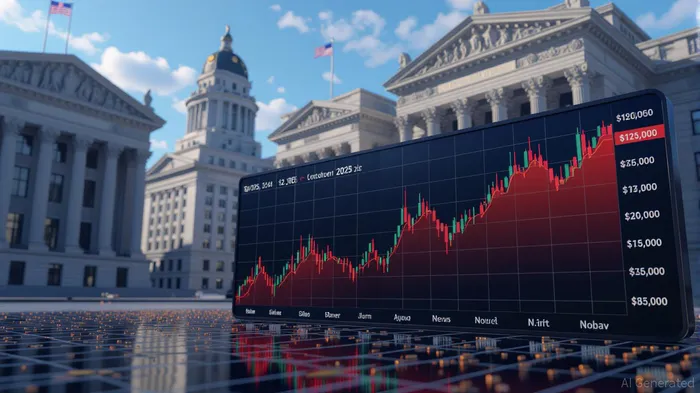 November 2025 saw record outflows from U.S. spot Bitcoin ETFs, totaling $3.79 billion, with IBIT alone losing $2.47 billion. These outflows were driven by profit-taking and a reallocation of capital toward higher-yield altcoins like SolanaSOL--, which offered staking rewards and lower fees. The thinning liquidity in Bitcoin's market exacerbated price declines, creating a self-reinforcing cycle of selling pressure. According to market analysis, this event highlighted Bitcoin's heightened sensitivity to liquidity shifts.
Regulatory uncertainties also played a role. While the SEC's enforcement actions declined under its new chair, Paul Atkins, the lack of clarity on token classification and the stalled CLARITY Act dampened institutional confidence. This regulatory ambiguity, combined with the Fed's policy indecision, created a risk-off environment where investors prioritized stability over growth.
Interplay of Macro and Institutional Factors
The November 2025 selloff was not merely a function of one factor but a convergence of macroeconomic and institutional forces. The Fed's delayed jobs data announcement on November 21, which reduced the chance of a December rate cut, coincided with a $900 million single-day ETF outflow. This event underscored Bitcoin's heightened sensitivity to liquidity shifts and policy expectations.
Moreover, the broader market environment-marked by a 0.6 correlation between Bitcoin and the S&P 500-highlighted the interconnectedness of crypto and traditional markets. A sharp drop in the S&P 500 in November accelerated risk-off sentiment, compounding Bitcoin's decline. Meanwhile, leveraged long positions in Bitcoin futures faced $2 billion in liquidations, further destabilizing the market.
Outlook and Strategic Considerations
Despite the short-term turbulence, Bitcoin's long-term fundamentals remain anchored in global money supply growth and institutional adoption. Central banks' continued expansion of liquidity provides a floor for Bitcoin's price. Institutions like Harvard University and Japan's Metaplanet have continued accumulating Bitcoin, signaling underlying confidence.
For investors, the key lies in balancing macroeconomic signals with institutional behavior. While the Fed's projected two rate cuts in 2025 may offer eventual support, near-term volatility is likely to persist. Diversification into altcoins with staking yields and a focus on regulatory developments-such as the SEC's December tokenization agenda-could mitigate risks.
In conclusion, Bitcoin's late-2025 decline underscores the critical role of macro policy and institutional sentiment in shaping its trajectory. Navigating this landscape requires a nuanced understanding of both central bank dynamics and institutional portfolio strategies, as the crypto market continues to evolve toward institutional-grade maturity.

Mezclando la sabiduría tradicional en el comercio con las perspectivas más avanzadas sobre criptomonedas.
Latest Articles
Stay ahead of the market.
Get curated U.S. market news, insights and key dates delivered to your inbox.


AInvest
PRO
AInvest
PRO



Comments
No comments yet