
Bitcoin's Post-Powell Momentum and the Case for a Strategic Long-Entry: Navigating Fed Dovishness, Institutional ETF Flows, and the Crypto-Stocks Correlation


 Aime Summary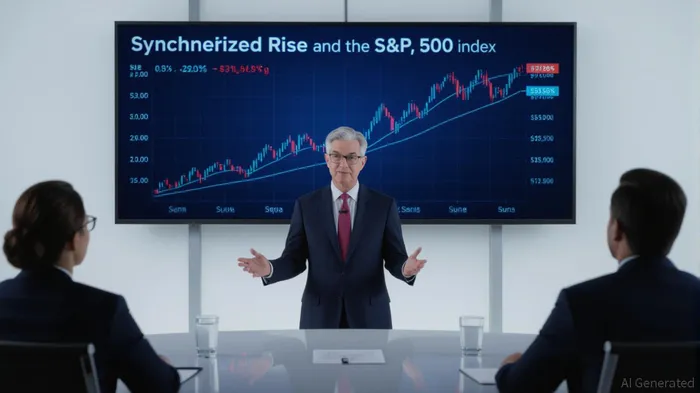
The Federal Reserve's pivot toward dovishness in August 2025 has ignited a seismic shift in global markets, creating a rare alignment between traditional equities and cryptocurrencies. With Jerome Powell's Jackson Hole address signaling a potential September rate cut and a broader easing of monetary policy, investors are recalibrating portfolios to capitalize on a risk-on environment. For BitcoinBTC--, this moment represents more than a short-term rally—it is a structural inflection pointIPCX-- that demands a strategic long-entry for those willing to navigate the interplay of macroeconomic tailwinds, institutional flows, and cross-asset correlations.
Fed Dovishness: A Catalyst for Risk-On Rebalancing
Powell's August 2025 remarks were a masterclass in policy signaling. By acknowledging the “curious state of balance” in the labor market and hinting at rate cuts to counteract inflationary pressures from Trump-era policies, he effectively flipped the script from “higher for longer” to “lower for longer.” The CME FedWatch tool now pegs the probability of a September cut at 90%, a development that has sent shockwaves through asset markets.
Bitcoin's response was immediate and pronounced. The cryptocurrency surged 3.2% to $116,483.18 within 24 hours, nearing its previous all-time high of $124,000. This move was not isolated: the S&P 500 and Nasdaq Composite also posted double-digit gains, while the VIX volatility index plummeted 14%, reflecting a sharp decline in market anxiety. The Fed's dovish pivot has weakened the U.S. dollar, historically a headwind for Bitcoin, and redirected capital toward high-growth assets.
Institutional ETF Flows: Ethereum's Quiet Takeover
While Bitcoin's rally is notable, the more compelling story lies in the divergence of institutional flows between Bitcoin and EthereumETH--. In Q3 2025, Ethereum ETFs attracted $2.96 billion in net inflows, outpacing Bitcoin's $2.1 billion in outflows. This shift is not a mere anomaly but a reflection of Ethereum's structural advantages:
- Yield Generation: Ethereum's proof-of-stake model offers staking yields of 3.5% APY, a feature absent in Bitcoin.
- Regulatory Clarity: The CLARITY Act's reclassification of Ethereum as a digital commodity has removed legal barriers for institutional adoption.
- Utility-Driven Demand: Ethereum's role in DeFi ($140B TVL) and tokenized real-world assets (RWAs) positions it as a foundational infrastructure asset.
BlackRock's ETHA ETF, for instance, surged to $10 billion in AUM in just 10 days, capturing 2.5% of Ethereum's total supply. Meanwhile, Bitcoin ETFs like Fidelity's FBTC and Ark's ARKB faced redemptions totaling $523 million in a single day. This reallocation underscores a broader trend: institutions are prioritizing assets that offer both capital appreciation and utility.
The Crypto-Stocks Correlation: A New Era of Convergence
The post-Powell rally has revealed an unprecedented correlation between crypto and traditional equities. The S&P 500 and Bitcoin both reached multi-month highs in tandem, a phenomenon driven by shared drivers of risk-on sentiment. As the Fed signals easing, investors are rotating into assets that benefit from lower discount rates and inflation hedging.
Ethereum's 13% surge to $4,740 in the wake of Powell's speech exemplifies this dynamic. The crypto market's $4 trillion valuation rebound mirrors the equity market's optimism, with both asset classes serving as proxies for a broader macroeconomic narrative: a world where liquidity is abundant, and the cost of capital is declining.
Strategic Implications for Investors
For investors, the post-Powell environment presents a compelling case for a strategic long-entry into Bitcoin. Here's how to approach it:
- Hedge Against Dollar Depreciation: As the Fed unwinds its tightening cycle, the U.S. dollar's weakness will likely persist. Bitcoin's inverse correlation with the dollar makes it an attractive hedge.
- Leverage Institutional Momentum: While Ethereum's ETF inflows are impressive, Bitcoin remains the dominant crypto asset. A long position in Bitcoin can capitalize on its role as a macro hedge and its potential to outperform in a low-rate environment.
- Monitor Correlation Metrics: The alignment between crypto and equities suggests that risk-on sentiment is here to stay. Investors should track the VIX and equity indices to gauge the sustainability of this trend.
However, caution is warranted. The “sell the news” phenomenon could trigger short-term volatility as markets price in the Fed's signals. Position sizing and stop-loss strategies will be critical to managing risk.
Conclusion: A New Chapter in Digital Asset Investing
The Federal Reserve's dovish pivot has created a rare confluence of conditions: a weakening dollar, a surge in risk-on sentiment, and a structural reallocation of capital into crypto. For Bitcoin, this is a moment to act. While Ethereum's institutional adoption is reshaping the crypto landscape, Bitcoin's role as a store of value and macro hedge remains irreplaceable.
Investors who recognize this inflection point and position accordingly will find themselves at the forefront of a new era in digital asset investing. The question is no longer whether Bitcoin is a viable long-term asset—it is how to allocate capital to it in a way that balances growth, risk, and the evolving macroeconomic landscape.

Decoding blockchain innovations and market trends with clarity and precision.
Latest Articles
Stay ahead of the market.
Get curated U.S. market news, insights and key dates delivered to your inbox.
AInvest
PRO
AInvest
PRO



Comments
No comments yet