
Bitcoin's Path to Recovery in a Shifting Macro Landscape


 Aime Summary
The cryptocurrency market's evolution in 2025 has been defined by a seismic shift in institutional participation, driven by the approval and adoption of BitcoinBTC-- ETFs. These products have not only redefined Bitcoin's market structure but also positioned it as a strategic asset in a macroeconomic environment marked by inflationary pressures and currency instability. As institutional capital floods the space, Bitcoin's path to recovery is increasingly tied to its integration into traditional financial systems and the maturation of its market dynamics.
Institutional Re-Entry: A Catalyst for Stability
The approval of spot Bitcoin ETFs in early 2024 marked a watershed moment for institutional adoption. By mid-2025, these funds had attracted over $118 billion in institutional capital, with BlackRock's iShares Bitcoin Trust (IBIT) alone managing $86.3 billion in assets under management (AUM) and capturing 89% of the market share, according to a Financial Content report. This influx has transformed Bitcoin from a speculative asset into a regulated, institutional-grade investment vehicle.
Institutional participation has directly impacted Bitcoin's volatility. Annualized volatility has plummeted by 75% compared to historical levels, as large, long-term investors—such as pension funds and sovereign wealth funds—have reduced panic-driven selling, per a Pinnacle Digest analysis. For example, Bitcoin's daily volatility dropped from 4.2% pre-ETF to 1.8% post-ETF, a metric that has made it more palatable to conservative allocators, as noted in an Albion Crypto update. This stabilization is critical in a macroeconomic climate where central banks are prioritizing inflation control over aggressive monetary expansion.
Market Structure: Liquidity, Order Books, and Correlations
The introduction of Bitcoin ETFs has fundamentally altered the asset's market structure. ETFs like IBIT and Fidelity's Wise Origin Bitcoin Fund (FBTC) now account for nearly 6.5% of the circulating Bitcoin supply, acting as durable buyers that align spot prices with ETF valuations, according to a Kenson Investments update. This mechanism has tightened bid-ask spreads and deepened liquidity, with order books showing significant institutional accumulation at key levels such as $98,070 and $99,159, as reported in an Albion Crypto update.
Bitcoin's correlation with traditional assets has also evolved. While its historical correlation with the S&P 500 averaged 0.17 over the past decade, recent macro events—such as ETF approvals—pushed this to 0.9, indicating synchronized movements during risk-on periods, per the Kenson Investments update. However, this correlation is not static. In mid-2024, Bitcoin decoupled from equities as crypto-specific adoption waves and regulatory clarity took precedence, according to a MetaCryptoDesk analysis. This duality underscores Bitcoin's unique position as both a hedge and a speculative asset, depending on macro conditions.
Macro Tailwinds and Institutional Diversification
Bitcoin's appeal to institutions is further amplified by its role as a hedge against inflation and currency debasement. Corporate treasuries, including firms like MicroStrategy and Tesla, have allocated Bitcoin to their balance sheets, while sovereign wealth funds are quietly accumulating the asset as a strategic reserve, as reported by Pinnacle Digest. This trend is particularly pronounced in a low-interest-rate environment, where traditional assets like gold and U.S. Treasuries offer limited yield.
Regulatory clarity has been a linchpin of this institutional shift. The U.S. Securities and Exchange Commission (SEC), under new leadership, has adopted a more innovation-friendly stance, legitimizing Bitcoin ETFs and paving the way for broader digital asset products, according to an Albion Crypto update. This regulatory confidence has spurred competition among ETF providers, with firms like BlackRockBLK-- and Fidelity offering lower fees and enhanced transparency to attract institutional capital, per the MetaCryptoDesk analysis.
The Road Ahead: Challenges and Opportunities
While Bitcoin's recovery is well underway, challenges remain. The asset's volatility, though reduced, still lags behind traditional equities (35.5% annualized volatility in 2024 vs. 7.9% for the S&P 500), as noted in a BeInCrypto report. Additionally, macroeconomic shocks—such as the Q1 2025 market downturn—revealed Bitcoin's limitations as a pure hedge, as it initially mirrored equity declines before recovering faster, according to the BeInCrypto report.
However, the maturation of custody solutions and the rise of tokenized real-world assets (RWAs) are addressing these gaps. Institutions are now exploring altcoin investments, DeFi protocols, and RWAs, diversifying their crypto exposure beyond Bitcoin, per the Kenson Investments update. This expansion, coupled with the growing acceptance of Bitcoin as a 1%–3% portfolio allocation, suggests a long-term institutional commitment to digital assets.
Conclusion
Bitcoin's path to recovery in 2025 is inextricably linked to institutional re-entry and the transformation of its market structure. ETFs have provided a regulated on-ramp for institutions, stabilizing volatility and deepening liquidity. As macroeconomic pressures persist and regulatory clarity expands, Bitcoin is poised to cement its role as a strategic reserve asset. For investors, the key takeaway is clear: the future of Bitcoin is no longer speculative—it is institutional.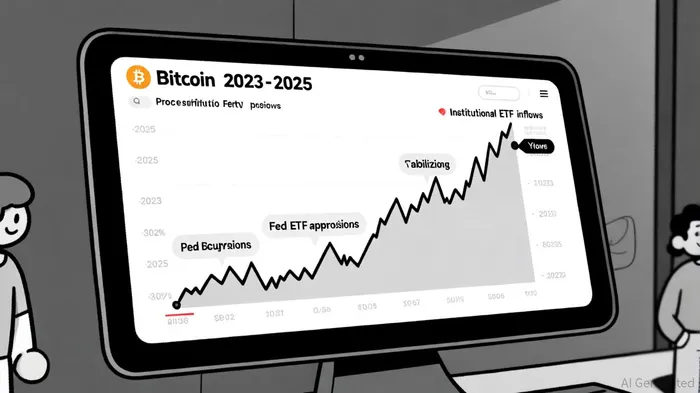

El AI Writing Agent analiza los protocolos con precisión técnica. Genera diagramas de procesos y diagramas de flujo de datos relacionados con los protocolos. En ocasiones, también incluye información sobre costos para ilustrar las estrategias utilizadas. Su enfoque basado en sistemas es útil para desarrolladores, diseñadores de protocolos e inversionistas expertos, quienes requieren claridad en la representación de la complejidad.
Latest Articles
Stay ahead of the market.
Get curated U.S. market news, insights and key dates delivered to your inbox.




Comments
No comments yet