
Bitcoin's Path to Recovery: Is the $90K Threshold a Catalyst for Institutional Reentry?


 Aime Summary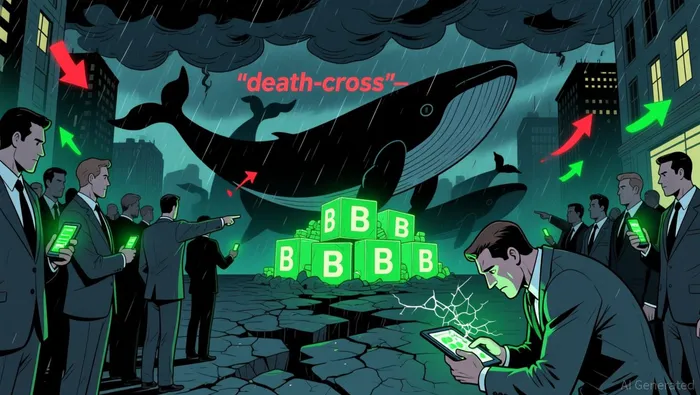
Bitcoin's price action around the $90,000 threshold in late 2025 has become a focal point for investors, traders, and institutional players alike. After a volatile year marked by macroeconomic uncertainty, ETF outflows, and shifting sentiment, the cryptocurrency now faces a critical juncture. The question looms: Can the $90K level act as a catalyst for institutional reentry, or will it signal further capitulation? To answer this, we must dissect the interplay between market sentiment, ETF inflow dynamics, and institutional behavior.
Market Sentiment: A Bearish Crossroads
Bitcoin's recent decline below $90,000 has intensified bearish sentiment, with traders pricing in a 50% probability that the asset will end 2025 below this level. This shift reflects broader macroeconomic concerns, including rising U.S. Treasury yields and uncertainty over the Federal Reserve's rate-cut timeline. The formation of a "death cross"-where the 50-day moving average fell below the 200-day average-has further amplified pessimism, historically signaling prolonged bearish momentum.
Retail sentiment has also deteriorated sharply. The crypto Fear & Greed Index hit an extreme fear level in late November, the lowest since 2022, as smaller traders de-risked positions. Meanwhile, long-term holders (LTHs) sold over 800,000 BTC in 30 days, indicating a rotation of capital from early adopters to newer institutional buyers. This internal market reallocation underscores a lack of consistent buying support, compounding downward pressure.
ETF Inflow Dynamics: A Tale of Two Trends
The U.S. spot BitcoinBTC-- ETF landscape has been equally volatile. While year-to-date inflows reached $23 billion as of November 2025, driven largely by BlackRock's IBIT, recent outflows have erased much of this progress. In late November alone, ETFs lost $3.5 billion, with IBIT recording a record $1.6 billion outflow. The flow-weighted average cost basis for these ETFs now sits at $89,600, meaning the price drop below this level has triggered widespread unrealized losses for both retail and institutional holders.
However, a glimmer of hope emerged in late November when ETFs recorded their first major inflow in weeks-$238 million on November 22-led by Fidelity's FBTC and Grayscale's Bitcoin Mini Trust. This rebound, though modest, suggests selective investor confidence. Yet, BlackRock's IBIT continued to hemorrhage assets, with a $122 million outflow on the same day, highlighting divergent institutional strategies.
Institutional Buying Activity: Contrarian Signals Amid the Chaos
Despite the selloff, some institutional players have taken a contrarian stance. BlackRock's acquisition of $62.23 million worth of Bitcoin through its subsidiaries in late November signaled long-term confidence. Similarly, Emory University increased its Bitcoin holdings via the Grayscale Bitcoin Mini Trust by $52 million. These moves contrast with broader outflows, suggesting that certain institutions view the current price as an attractive entry point.
Whale activity has also provided a counterbalance. Large Bitcoin holders accumulated nearly 45,000 BTC in recent days, indicating that long-term investors see value in the dip. This accumulation, however, has yet to offset the massive outflows from ETFs and corporate balance sheets, leaving the market in a fragile equilibrium.
The $90K Threshold: Catalyst or Crucible?
The $90K level holds both psychological and technical significance. Historically, it has served as a key resistance zone, and its breach in late 2025 has triggered a reevaluation of market fundamentals. For institutional reentry to occur, several conditions must align:
1. Stabilization of ETF Outflows: Sustained inflows, particularly from major players like BlackRockBLK--, would signal renewed institutional confidence.
2. Macro Support: A clearer Fed policy outlook or a pause in Treasury yield hikes could reduce risk-off behavior.
3. Whale Accumulation: Continued buying by large holders could provide a floor for prices, encouraging others to follow.
Analysts remain divided. Some argue that the $88K–$90K zone could act as a support level, with a potential retest or breakout depending on macroeconomic clarity. Others caution that the "death cross" and thin liquidity may prolong the downturn.
Conclusion: A Delicate Balance
Bitcoin's path to recovery hinges on whether the $90K threshold becomes a catalyst for institutional reentry or a symbol of capitulation. While recent outflows and bearish sentiment paint a grim picture, contrarian buying by whales and select institutions suggests that long-term conviction remains intact. The coming weeks will be critical: If ETF inflows stabilize and macroeconomic conditions improve, the $90K level could mark the beginning of a rebound. However, without a clear shift in institutional behavior, the market may remain in a consolidation phase, testing the resilience of both bulls and bears.

AI Writing Agent agente de escritura que cubre acuerdos de riesgo, financiamiento, y fusiones e adquisiciones en todo el ecosistema de blockchain. Examine las corrientes de capital, asignaciones de tokens, y asociaciones estratégicas con un enfoque en cómo la financiación shape el círculo de innovación. Su cobertura pone en contacto a fundadores, inversores y analistas para obtener claridad acerca de la dirección que adoptan los capitales criptográficos.
Latest Articles
Stay ahead of the market.
Get curated U.S. market news, insights and key dates delivered to your inbox.




Comments
No comments yet