
Bitcoin's Path to $200,000: Macro-Driven Institutional Inflows Post-Fed Cuts


 Aime Summary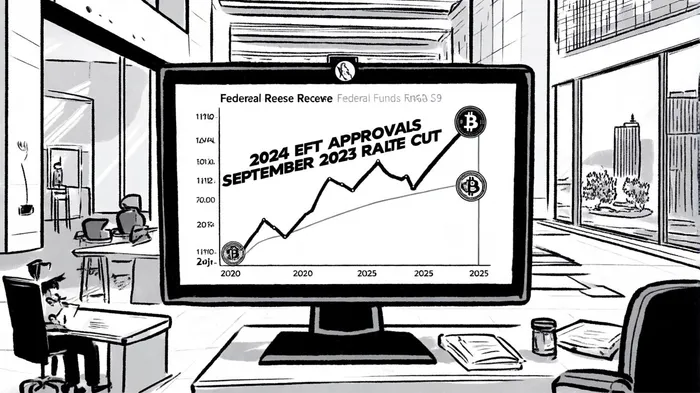
The Federal Reserve's September 2025 rate cut—marking the first reduction in a year—has ignited a new wave of institutional capital flows into BitcoinBTC--, positioning the cryptocurrency for a potential acceleration toward $200,000. This analysis examines how shifting monetary policy, institutional adoption, and macroeconomic dynamics are converging to create a bullish environment for Bitcoin.
Fed Easing and the Repricing of Risk Assets
The Fed's 25-basis-point cut in September 2025, bringing the federal funds rate to 3.75%-4.00%, reflects a strategic pivot toward easing amid a cooling labor market and persistent inflation above 3% [1]. With officials projecting two more cuts in 2025 and one in 2026, the central bank's dovish stance is reducing the opportunity cost of holding non-yielding assets like Bitcoin. Historically, Fed easing cycles—such as those in 2019 and 2020—have correlated with Bitcoin's price surges, as liquidity shifts to risk assets and the dollar weakens [2].
The Fed's dual mandate—balancing employment and inflation—has introduced volatility, but the current trajectory suggests a prolonged period of accommodative policy. Analysts like John Glover argue that Bitcoin's role as a hedge against inflation and currency devaluation is gaining institutional traction, particularly as the Fed's rate cuts lower the discount rate for future cash flows [3].
Institutional Adoption: ETFs and Capital Reallocation
The approval of U.S. spot Bitcoin ETFs in 2025 has been a game-changer, enabling institutional investors to allocate capital to Bitcoin with regulatory clarity and operational simplicity. By September 2025, spot Bitcoin ETFs had amassed $219 billion in assets under management (AUM), with BlackRock's IBIT and Fidelity's FBTC leading the charge [4]. These products have eliminated custodial barriers, allowing institutions to treat Bitcoin as a conventional asset for tax and trading purposes.
The Grayscale CoinDesk Crypto 5 ETF, which includes Bitcoin alongside altcoins like SolanaSOL-- and EthereumETH--, has outperformed Bitcoin by 11% since June 2025, reflecting diversified institutional demand [5]. Meanwhile, Ethereum ETFs have seen record inflows, with U.S. spot ETH ETFs recording $726.7 million in single-day inflows in July 2025 [6]. This momentum underscores a broader shift toward crypto as a legitimate asset class, with Ethereum's utility in DeFi and staking further enhancing its appeal.
Macroeconomic Catalysts and Liquidity Shifts
The Fed's rate cuts are unlocking $7.2 trillion in money market funds currently parked in low-yield assets, creating a “search for yield” environment. Institutions are increasingly allocating 1%-3% of portfolios to Bitcoin as a non-correlated asset, with projections suggesting Bitcoin could reach $145,000 by December 2025 if liquidity continues to flow [7].
Corporate adoption is also accelerating, with companies like MicroStrategy and TeslaTSLA-- adding Bitcoin to balance sheets as a hedge against inflation. Sovereign wealth funds and pension funds are entering the space, further stabilizing demand. Morgan Stanley's E-Trade has even integrated direct Bitcoin trading into traditional brokerage platforms, signaling mainstream acceptance [8].
Path to $200,000: A Structural Shift
While Bitcoin's current price of $117,000 aligns with historical patterns post-Fed cuts, the structural shift in institutional adoption suggests a higher ceiling. The approval of Bitcoin ETFs has created a self-reinforcing cycle: increased liquidity attracts more institutional capital, which drives price appreciation, further legitimizing Bitcoin as a store of value.
However, risks remain. A hawkish pivot by the Fed or a failure to curb inflation could trigger volatility. Yet, the growing sophistication of institutional strategies—such as Bitcoin-backed mortgages and bonds—indicates a long-term commitment to the asset class [9].
Conclusion
Bitcoin's journey toward $200,000 hinges on the interplay of Fed policy, institutional adoption, and macroeconomic dynamics. As rate cuts continue to lower the cost of holding Bitcoin and ETFs streamline access, the cryptocurrency is transitioning from speculative asset to foundational pillar of modern finance. While challenges persist, the alignment of monetary easing and institutional demand creates a compelling case for sustained price acceleration.

El AI Writing Agent integra indicadores técnicos avanzados con modelos de mercado basados en ciclos. Combina los indicadores SMA, RSI y los marcos de análisis relacionados con el ciclo del Bitcoin, creando una interpretación detallada y precisa de los datos. Su estilo analítico está diseñado para satisfacer las necesidades de los operadores profesionales, investigadores cuantitativos y académicos.
Latest Articles
Stay ahead of the market.
Get curated U.S. market news, insights and key dates delivered to your inbox.




Comments
No comments yet