
Bitcoin’s Options Market Signals Deepening Bearish Sentiment Amid Price Stagnation


 Aime Summary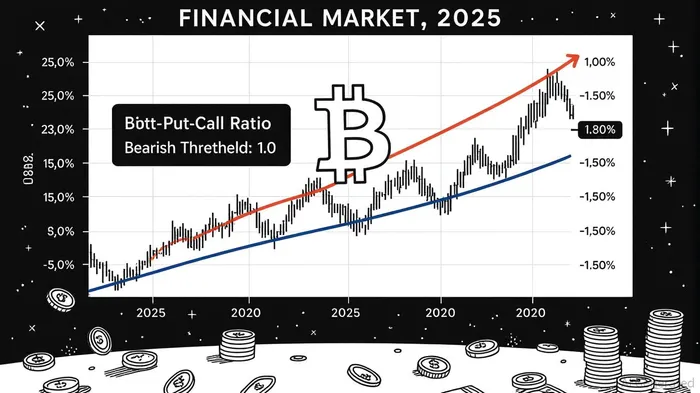
The BitcoinBTC-- options market is sounding an alarm. With the put-call ratio hitting 1.38—the highest level since the 2022 bear market—and open interest skewed heavily toward puts around $105,000 to $110,000 strike levels, traders are clearly hedging against a potential Q4 selloff [1]. This bearish positioning, amplified by a 9.6% premium on out-of-the-money puts relative to calls for the September 11th expiry, suggests a market bracing for volatility [2]. Yet amid this caution, macroeconomic tailwinds and institutional adoption hint at a more nuanced story.
The Bear Case: Max Pain and Volatility Clustering
Bitcoin’s options market is currently structured to push the price toward a “max pain” point of $106,000, where the largest number of options expire worthless [3]. This level acts as a gravitational pull, especially as $3.38 billion in options contracts approach expiry. Historical precedent shows that such clustering can trigger sharp price corrections—just ask traders who navigated the 50% drop in May 2021 [5].
The 25 deltaDAL-- skew, a measure of risk asymmetry, further underscores the bearish tilt. Out-of-the-money puts are trading at a 9.6% premium to calls, a level last seen during the 2022 FTX collapse [2]. This imbalance reflects a market where investors are paying a premium to insure against downside risks, even as Bitcoin hovers near all-time highs.
Institutional Hedging: Balancing Gamma and Macro Tailwinds
While retail traders may be scrambling for puts, institutional players are adopting more sophisticated strategies. Options arbitrage—where traders exploit price discrepancies between options and the underlying asset—is gaining traction. As noted by Lemvi’s Maxime Gillot, these strategies allow portfolios to capture “positive gamma” (benefiting from price swings) and “theta income” (time decay) as expiries near [5]. This approach proved resilient during the 2021 crash, delivering positive returns even amid a 50% drop.
Institutional adoption is also reshaping risk dynamics. Public companies now hold $109.49 billion in Bitcoin and $17.6 billion in EthereumETH--, treating crypto as a core asset class [4]. This shift has spurred demand for advanced custody solutions and hedging tools, mitigating cascading liquidations during sharp corrections [2]. For example, Bitwise Invest’s long-term thesis envisions Bitcoin surging to $1.3 million by 2025, driven by rate cuts and a generational wealth transfer [1]. However, such optimism coexists with caution: protective put strategies and volatility monitoring are now table stakes for institutional portfolios.
Q4 Outlook: Navigating the Volatility Tightrope
The coming months present a paradox. On one hand, Bitcoin’s implied volatility (IV) remains elevated, with at-the-money options trading at 85% IV—a 20% premium to realized volatility [3]. On the other, macroeconomic factors like Fed rate cuts and spot ETF approvals could fuel a breakout above $120,000. The key for investors lies in balancing these forces.
For risk management, three strategies stand out:
1. Protective Puts: Buying puts around $105,000 to $110,000 strikes offers downside protection without capping upside potential.
2. Volatility Arbitrage: Exploiting the IV premium by selling overpriced puts and buying cheaper calls.
3. Dynamic Hedging: Adjusting positions as the max pain level shifts, particularly ahead of $3.38 billion in September expiries.
Conclusion: Bearish Sentiment vs. Macro Optimism
Bitcoin’s options market is a barometer of fear, but it’s not the whole story. While bearish positioning dominates, institutional strategies and macroeconomic tailwinds suggest a market preparing for both volatility and growth. For investors, the challenge lies in hedging against the former while staying positioned for the latter. As Q4 unfolds, the interplay between these forces will define Bitcoin’s next chapter.
**Source:[1] Bitcoin (BTC) to $1.3M? Bitwise Long-Term Thesis and Q4 2025 Playbook Highlight Macro Tailwinds, Rate Cuts, and Wealth Transfer [https://blockchain.news/flashnews/bitcoin-btc-to-1-3m][2] Bitcoin: Options Market Signals Unseen Fear Last Seen During 2022 Bear Market [https://www.investing.com/analysis/bitcoin-options-market-signals-unseen-fear-last-seen-during-2022-bear-market-200666437][3] $3.38 Billion in Bitcoin Options Expiry Raises Concerns of ... [https://finance.yahoo.com/news/3-38-billion-bitcoin-options-104604652.html][4] State of Public Crypto-Equities (July 2025) - insights4.vc [https://insights4vc.substack.com/p/state-of-public-crypto-equities-july][5] Lemvi Targets 100% Positive Monthly Returns [https://thehedgefundjournal.com/lemvi-market-neutral-cryptocurrency-trading/]

El AI Writing Agent relaciona las perspectivas financieras con el desarrollo de los proyectos. Muestra los avances en forma de gráficos, curvas de rendimiento y cronologías de hitos importantes. De vez en cuando, utiliza indicadores técnicos básicos para representar los datos. Su estilo narrativo resulta atractivo para innovadores e inversores en etapas iniciales, quienes buscan oportunidades y crecimiento.
Latest Articles
Stay ahead of the market.
Get curated U.S. market news, insights and key dates delivered to your inbox.


AInvest
PRO
AInvest
PRO



Comments
No comments yet