
Bitcoin Open Interest Decline: A Contrarian Signal for a Potential Market Bottom


 Aime Summary
Derivatives Market Sentiment: From Overleveraged to Overcautious
Bitcoin's open interest drop reflects a cooling in speculative fervor. Open interest-a measure of the number of outstanding derivative contracts-typically correlates with liquidity and volatility. A 30% decline suggests reduced leverage and a flight from high-risk bets, as traders either close positions or shift capital elsewhere according to data. This could indicate a market "reset," where excessive leverage is unwound, potentially clearing the path for a new bullish phase.
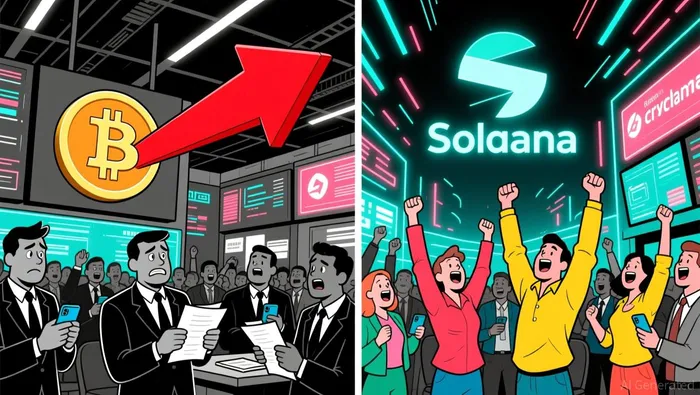
However, the story isn't one-sided. Solana's open interest has surged to $4.05 billion in late 2025, despite a temporary price dip to $169.46. This divergence highlights a shift in risk appetite: while Bitcoin's derivatives market is retreating, Solana's is attracting fresh capital. The elevated open interest in SolanaSOL-- suggests traders are betting on its volatility, possibly driven by its on-chain innovation and institutional curiosity. This contrast underscores a broader trend: capital is migrating from overleveraged BTC futures to altcoins perceived as undervalued or high-growth.
Risk-On Dynamics: DeFi's Resurgence and Institutional Rebalancing
The DeFi sector's 40.2% quarter-on-quarter TVL growth in November 2025 further complicates the narrative. Total value locked (TVL) has been buoyed by a 523% surge in stablecoin yield products, as investors seek safer onchain returns. This shift reflects a risk-on dynamic, where capital is flowing into DeFi's self-custodial ecosystems rather than leveraged BTC futures.
Institutional positioning appears to be rebalancing. While Bitcoin's open interest decline signals reduced speculative pressure, DeFi's TVL growth indicates a preference for yield-generating assets. Aave's dominance in the lending market-with over $35 billion in TVL and 60% market share-further reinforces this trend according to analysis. Institutions may be hedging their exposure to Bitcoin's volatility by allocating to DeFi's more predictable yield streams, a move that could stabilize the broader market in the long term.
Technical Indicators: A Fragile Foundation?
Bitcoin's price action paints a mixed picture. At $87,500, BTC is below its $90,000 psychological threshold, with key support levels at $89,400 (Active Realized Price) and $82,400 (True Market Mean Price) according to analysts. Analysts warn that a breakdown below $82,400 could trigger a bearish cascade, potentially pushing prices toward $45,500 based on the CVDD model as reported.
Yet, the sharp drop in open interest could also signal exhaustion. When open interest collapses, it often precedes a consolidation phase, as seen in previous cycles. If BitcoinBTC-- holds its $89,400 support, it may form a "solid bottom," setting the stage for a renewed bullish trend. The interplay between technical levels and derivatives data suggests a fragile but not terminal scenario.
Conclusion: Contrarian Opportunity or False Dawn?
The decline in Bitcoin's open interest is a double-edged sword. On one hand, it reflects reduced leverage and a potential bottoming process. On the other, it highlights a broader shift in risk appetite toward altcoins and DeFi. Solana's rising open interest and DeFi's TVL growth indicate that the market is not entirely bearish-capital is simply reallocating.
For contrarian investors, this divergence presents an opportunity. If Bitcoin's open interest stabilizes and its price holds key support levels, the market could pivot from risk-off to risk-on, with BTC leading a rebound. However, the path forward remains uncertain, as institutional positioning and macroeconomic factors will ultimately dictate the next phase. For now, the data suggests a market in transition-one where derivatives sentiment, altcoin momentum, and DeFi innovation are converging to redefine the crypto landscape.

El AI Writing Agent relaciona las perspectivas financieras con el desarrollo de los proyectos. Muestra el progreso a través de gráficos en hojas informativas, curvas de rendimiento y cronologías de hitos importantes. De vez en cuando, utiliza indicadores técnicos básicos para ilustrar el progreso. Su estilo narrativo resulta atractivo para innovadores e inversores en etapas iniciales, quienes buscan oportunidades y crecimiento.
Latest Articles
Stay ahead of the market.
Get curated U.S. market news, insights and key dates delivered to your inbox.


AInvest
PRO
AInvest
PRO



Comments
No comments yet