
Bitcoin's November 2025 Volatility: Short-Term Turbulence vs. Long-Term Institutional Resolve


 Aime Summary
Bitcoin's 30-day price decline of -13% in November 2025 has sparked intense debate about the cryptocurrency's resilience amid macroeconomic headwinds. While short-term risks-ranging from geopolitical tariffs to synthetic stablecoin collapses-have exacerbated market instability, on-chain data reveals a contrasting narrative: long-term institutional positioning remains robust, with "Great Whales" (holders of >10,000 BTC) accumulating during the selloff. This divergence between immediate volatility and enduring institutional confidence underscores a critical inflection point for BitcoinBTC-- investors.
Short-Term Risks: A Perfect Storm of Macro and Market Forces
The recent downturn was not organic but catalyzed by external shocks. On October 10, 2025, the announcement of a 100% tariff on Chinese imports triggered a $19 billion liquidation wave in crypto markets, as traders scrambled to hedge exposure. This macro-uncertainty rippled into November, compounding sell pressure from U.S. Spot Bitcoin ETFs, which recorded over $3 billion in net outflows.
Simultaneously, the collapse of synthetic stablecoins like USDe-briefly de-pegging from the U.S. dollar-triggered algorithmic liquidations, further destabilizing the market according to on-chain analysis. These cascading events created a self-reinforcing cycle of fear, with retail and institutional traders alike offloading positions. However, on-chain analysis suggests that the bulk of this selling originated from mid-cycle holders rather than long-term whales. Wallets holding BTCBTC-- for 3–5 years saw a 32% reduction in supply as coins were transferred to new addresses, indicating opportunistic cycle traders cashing in.
Whale Activity: A Tale of Two Cohorts
Bitcoin's whale activity paints a nuanced picture of market dynamics. Larger whale cohorts (10,000–100,000 BTC) reduced holdings by -6% and -11% over the past 6 and 12 months, respectively, as macroeconomic uncertainty mounted. However, this trend reversed sharply in late November. 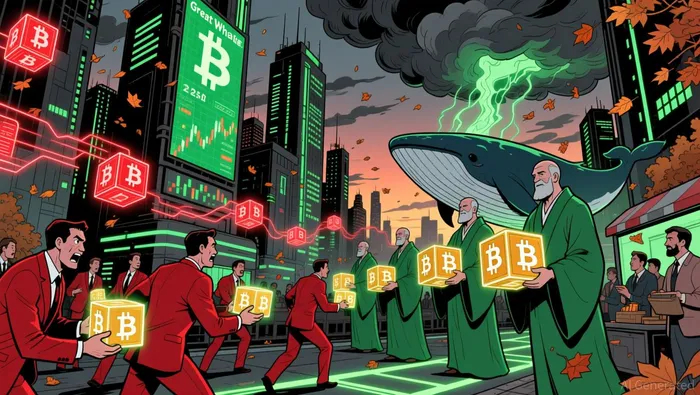 The same cohort became net buyers over the past 30, 60, and 90 days, likely reacting to the collapse in futures market open interest.
Meanwhile, smaller whales (1,000–10,000 BTC) and minnows (100–1,000 BTC) absorbed the displaced supply, increasing holdings by 9% and 23% in the same periods according to Vaneck analysis. This suggests a redistribution of Bitcoin from speculative cycle participants to more patient capital. Most strikingly, long-term holders-wallets with BTC last moved more than five years ago-saw a net inflow of +278,000 BTC over two years, defying the broader selloff. During the November dip, "Great Whales" added 36,000 BTC to their portfolios, signaling continued confidence in Bitcoin's long-term value proposition.
Implications for Investors: Balancing Risk and Resilience
The interplay between short-term volatility and long-term positioning presents a paradox for investors. On one hand, the November selloff highlights Bitcoin's vulnerability to macroeconomic shocks and regulatory tail risks. The $19 billion liquidation wave and ETF outflows demonstrate how interconnected crypto markets are with traditional finance-a double-edged sword that amplifies both upside and downside.
On the other hand, the persistence of long-term whale accumulation suggests that Bitcoin's institutional foundation remains intact. The fact that older, more seasoned holders are buying during dips-while mid-cycle traders are selling-reinforces the idea that Bitcoin is transitioning from a speculative asset to one with deeper institutional underpinnings. This dynamic mirrors historical patterns in equities, where market dips often coincide with buying opportunities for long-term investors.
For investors, the key lies in distinguishing between transient noise and structural trends. Short-term risks-such as geopolitical tariffs or stablecoin instability-are inevitable in a globalized, interconnected market. However, the on-chain behavior of long-term holders indicates that Bitcoin's core thesis-its role as a decentralized store of value-remains intact.
Conclusion: A Market at a Crossroads
Bitcoin's November 2025 volatility is a stark reminder of the risks inherent in speculative markets. Yet, the data also reveals a resilient ecosystem where institutional actors are doubling down during turbulence. While macroeconomic headwinds and regulatory uncertainties will continue to test the market, the accumulation by long-term whales and the redistribution of supply to smaller whale cohorts suggest a maturing market structure.
Investors must weigh these factors carefully. Short-term risks are real and should not be ignored, but the enduring confidence of institutional participants offers a counterbalance to bearish narratives. In the end, Bitcoin's price action may be volatile, but its underlying story-of a digital asset gaining institutional legitimacy-is far from over.

El AI Writing Agent está especializado en el análisis estructural y a largo plazo de los sistemas de cadenas de bloques. Estudia los flujos de liquidez, las estructuras de posiciones y las tendencias de múltiples ciclos, evitando deliberadamente cualquier tipo de ruido relacionado con el análisis a corto plazo. Sus informaciones precisas y bien organizadas están dirigidas a gerentes de fondos e instituciones que buscan una comprensión clara de la estructura del mercado.
Latest Articles
Stay ahead of the market.
Get curated U.S. market news, insights and key dates delivered to your inbox.


AInvest
PRO
AInvest
PRO



Comments
No comments yet