
Bitcoin News Today: Whales Buy, Retail Sell: Bitcoin's Redistribution Unfolds
 Aime Summary
Bitcoin's price decline this month has drawn attention to shifting market dynamics, with analysts pointing to both short-term volatility and potential catalysts for a rebound. As the cryptocurrency trades below $90,000 for the first time in seven months, whale activity has surged, signaling a mix of selling pressure and accumulation efforts. According to Santiment, over 102,000 transactions exceeding $100,000 and 29,000 above $1 million were recorded in a single week, potentially marking the most active whale week of 2025. Meanwhile, Bitfinex analysts noted that BitcoinBTC-- is on track to close November in the red for the first time since early 2024, trading 20.60% below its monthly peak.
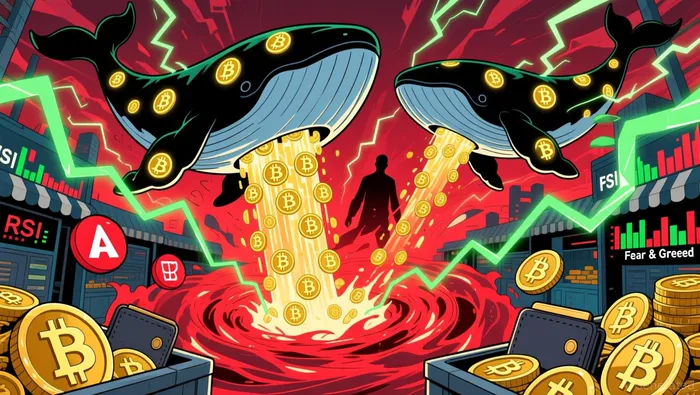
The recent downturn follows a period of extreme oversold conditions on the relative strength index (RSI), a key technical indicator that historically precedes short-term recoveries. Bitcoin's RSI dipped below 30 in late November, a level often associated with exhausted selling. Over $206 million in liquidations during the weekend of Nov. 23 further suggested a potential turning point, as thin liquidity and exhausted short-term sellers began to ease downward momentum. However, broader market sentiment remains bearish, with the Crypto Fear & Greed Index hovering near "extreme fear" levels and short-term holder profit-loss ratios signaling widespread capitulation.
Market participants are closely watching the interplay between institutional and retail behavior. Large holders-wallets with over 1,000 BTC-have shown signs of accumulation since late October, with their count rising to 1,384 from 1,354 three weeks prior, per Glassnode data. This contrasts with smaller wallets, which have dwindled as retail investors exit the market. Analysts suggest this divergence reflects a redistribution of control, with whales strategically acquiring dips while leveraged funds and retail traders face margin calls. Historically, such phases have preceded multi-month base formations, but confirmation requires sustained spot demand above $84,000 and stabilization of ETF outflows.
The market's broader context includes regulatory and structural shifts. The proposed exclusion of crypto treasury companies from major stock indexes by MSCI, set for January 2026, has sparked backlash from Bitcoin advocates and firms like StrategyMSTR--. The policy could trigger automatic sell-offs from index-linked funds, further pressuring crypto prices. Strategy founder Michael Saylor criticized the move, arguing that his company's model as a "Bitcoin-backed structured finance entity" defies traditional fund or holding company classifications. Concurrently, institutional investors are exploring Bitcoin-native financial instruments, with projects like Bitcoin Munari gaining traction. The project's presale, priced at $0.10 per token, has drawn interest as it prepares for a Solana deployment in early 2026, offering programmable smart contracts and EVM compatibility while maintaining Bitcoin's capped supply.
Looking ahead, analysts remain divided on Bitcoin's trajectory. Derivatives positioning shows selective optimism, with a $1.76 billion "call condor" trade targeting a $100K–$112K rally by December 2025. This structure profits if Bitcoin stays within that range, reflecting cautious bullishness rather than bets on new highs. Meanwhile, data center and AI infrastructure projects like Galaxy Digital's Helios campus in West Texas highlight a parallel narrative. Galaxy's $1.4 billion non-recourse financing and 15-year lease with CoreWeave underscore its pivot to AI infrastructure, with valuation models suggesting potential equity values of $48–$72 per share as the campus reaches full capacity by 2028.
As Bitcoin navigates a liquidity reset amid ETF outflows and macroeconomic uncertainty, the coming months will test whether strategic accumulation by whales and institutional innovation can offset bearish pressures. For now, the market remains in a transitional phase, with outcomes hinging on regulatory clarity, capital flows, and the execution of long-term infrastructure projects.

Stay ahead of the market.
Get curated U.S. market news, insights and key dates delivered to your inbox.
AInvest
PRO
AInvest
PRO



Comments
No comments yet