
Bitcoin News Today: Weekend Gap Exposes Critical Risks in Tokenized Asset Markets


 Aime Summary
The cryptocurrency landscape is evolving rapidly as companies and institutions prioritize 24/7 accessibility for BitcoinBTC-- transactions, driven by regulatory adjustments, infrastructure innovations, and growing institutional adoption. From enhanced compliance measures to blockchain-powered payment systems, the industry is navigating a complex but promising trajectory.
Bitcoin Depot, a key player in the Bitcoin ATM sector, highlighted its Q3 recovery amid tightening regulations. The company implemented stringent KYC (Know Your Customer) protocols, requiring customer identification for all transactions-a move that positions it as one of the most compliant operators in the industry. CEO Brandon Mintz emphasized that these efforts not only align with regulatory demands but also create competitive advantages, as smaller, non-compliant operators face increasing pressure to exit the market. However, the company acknowledged rising SG&A costs due to expanded compliance staffing and legal support, a common challenge as regulatory frameworks become more complex.
Meanwhile, BitForex, a global digital asset platform, reported progress in restoring user withdrawals after a year of operational disruptions. As of November 2025, the exchange stated it had processed over 50% of user withdrawals and reiterated a December 2025 deadline for KYC completion. Accounts that fail to meet the requirement will incur monthly management fees, underscoring the platform's focus on transparency and regulatory alignment.
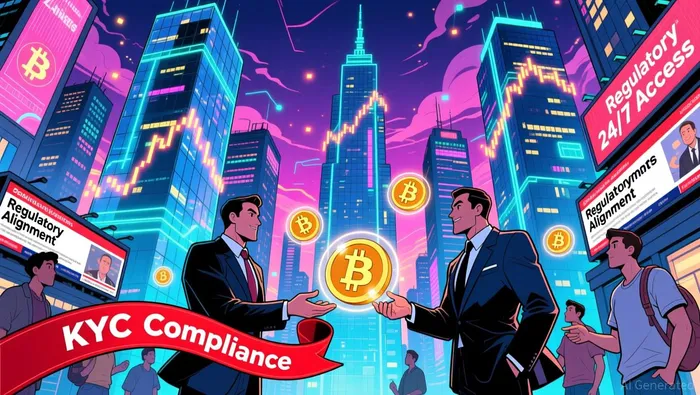
On the institutional front, Block Inc. launched its "Bitcoin is Everyday Money" campaign, advocating for De Minimis tax reform to simplify small-value crypto transactions. The initiative aligns with the company's broader ecosystem, including Square Bitcoin-a service enabling businesses to accept and manage Bitcoin payments seamlessly according to reports. This push reflects growing efforts to integrate Bitcoin into daily commerce, a trend echoed by major banks adopting blockchain for 24/7 settlement systems.
Legacy financial institutions are increasingly leveraging blockchain to eliminate traditional banking hour constraints. Deutsche Bank and JPMorgan, for instance, have advanced blockchain-based payment solutions, with the latter processing over $2 billion daily through its Kinexys network. SWIFT's development of a shared digital ledger further signals a shift toward real-time, round-the-clock operations. Such systems reduce cross-border transaction costs by up to 80%, positioning blockchain as a cost-effective alternative to traditional correspondent banking.
Regulatory clarity is also shaping the landscape. The Office of the Comptroller of the Currency recently permitted national banks to hold crypto assets as principal for paying blockchain network fees, a move that streamlines on-chain operations. This guidance removes a critical barrier for banks seeking to custody tokens or manage stablecoins on public chains, enabling them to settle transactions without relying on third-party intermediaries.
However, challenges persist. The tokenization of real-world assets (RWAs) has introduced risks tied to the "weekend gap" between 24/7 crypto markets and traditional markets closed on weekends. Oracle providers' frozen price feeds during this period could lead to price dislocations, as highlighted by RedStoneRED-- co-founder Marcin Kaźmierczak. For example, a tokenized Tesla stock trading on a decentralized exchange could misprice during a weekend crisis, creating arbitrage opportunities or under-collateralized lending risks.
Despite these hurdles, the industry's momentum is undeniable. Bitcoin's recent price action, while volatile, has drawn comparisons to historical extremes, with on-chain indicators showing patterns akin to the 2022 FTX collapse. Yet, market positioning suggests potential short-term bottoms, and institutional adoption continues to rise.
As the lines between traditional finance and crypto blurBLUR--, the focus remains on scalability, compliance, and user accessibility. With companies like Block, BitForex, and Bitcoin DepotBTM-- leading the charge, and regulators gradually adapting, Bitcoin's role as a 24/7 global currency appears increasingly entrenched.

Stay ahead of the market.
Get curated U.S. market news, insights and key dates delivered to your inbox.
AInvest
PRO
AInvest
PRO



Comments
No comments yet