
Bitcoin News Today: Trump Tariff Hikes Trigger 3-6% Crypto Selloff in 24 Hours
 Aime Summary
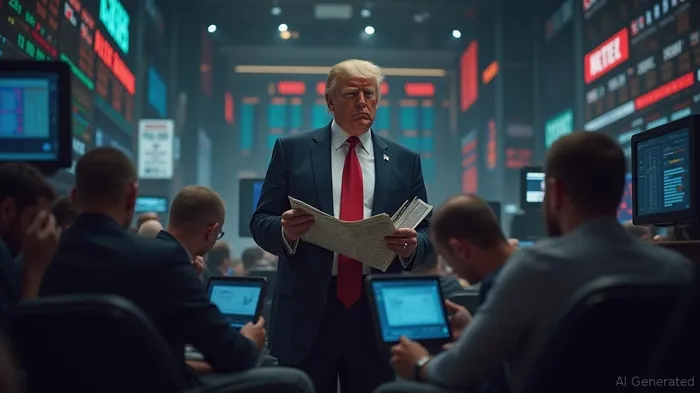
Trump’s tariff announcements last week sent shockwaves through the global financial system, with cryptocurrencies bearing the brunt of the selloff. Bitcoin fell 3% to $113,231, and Ethereum dropped 6% as investors retreated to safer assets. The market witnessed $490 million in crypto liquidations within 24 hours, with Coinbase shares plunging 16% following already weak Q2 earnings. Other crypto-linked stocks like CircleCRCL-- and Galaxy DigitalGLXY-- also fell significantly [1].
The impact was not confined to digital assets alone. Trump’s reciprocal tariffs—ranging from 10% to 41% on imports from multiple countries—created a broad risk-off environment. In times of global uncertainty, cryptocurrencies often face the sharpest sell-offs due to their perceived volatility and speculative nature [1].
The timing of the selloff was particularly concerning. August has historically seen reduced trading volumes and increased volatility in crypto markets. The combination of geopolitical uncertainty and traditional market jitters created a perfect storm, exacerbating the decline [1].
The crypto market’s vulnerability to trade tensions stems from its global supply chain and its growing correlation with traditional risk assets. Bitcoin mining hardware, for example, is largely sourced from China, and higher import costs due to tariffs directly affect mining profitability [1]. Additionally, as investors react to inflation risks and geopolitical instability, all speculative assets—including crypto—tend to be liquidated first.
However, some analysts argue that the long-term narrative for Bitcoin could benefit from rising inflation driven by the trade war. In past periods of economic uncertainty, such as the 2018–2020 trade conflict, Bitcoin saw significant price surges as a hedge against inflation and currency devaluation [1]. If the current tariff policies lead to sustained inflation, Bitcoin’s role as a digital store of value may gain renewed traction.
There is also a broader macroeconomic shift to consider. Grayscale’s research team has suggested that escalating tariffs could weaken the US dollar’s dominance, opening the door for alternative assets like Bitcoin. As central banks around the world diversify their reserves and reduce exposure to the dollar, digital assets may gain appeal as borderless, censorship-resistant stores of value [1].
For the remainder of August, several key events could shape the market’s direction. High-level trade talks between the US and China on August 12 could signal a potential easing of tensions. Additionally, Federal Reserve policy signals later in the month may provide insight into whether rate cuts—potentially boosting liquidity—will be on the horizon [1].
Technically, Bitcoin faces a critical juncture. A recovery above $122,000 could reestablish an uptrend, while a break below $112,000 may indicate a deeper correction is underway. Market participants are closely watching these levels as well as broader macroeconomic developments.
Despite the short-term pain, some market observers see opportunity in the selloff. Historical patterns suggest that geopolitical instability and currency debasement ultimately favor Bitcoin. For investors, the key is to manage near-term volatility while maintaining a long-term perspective. The 2025 tariff environment may prove to be the catalyst that reshapes the perception of Bitcoin as a global reserve asset [1].
Source: [1] Trump’s Tariff Storm Rocks Crypto Markets: What August 2025 Holds for Digital Assets (https://coinmarketcap.com/community/articles/6891b1c41e32735fbce6136d/)

Stay ahead of the market.
Get curated U.S. market news, insights and key dates delivered to your inbox.
AInvest
PRO
AInvest
PRO



Comments
No comments yet