
Bitcoin News Today: Trump Executive Order Lets 401(k)s Include Bitcoin Unlocking $12 Trillion
 Aime Summary
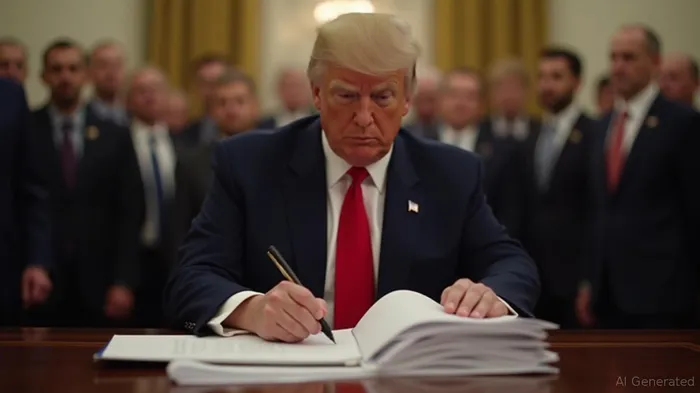
On August 7, 2025, U.S. President Donald Trump signed an executive order enabling 401(k) investors to include BitcoinBTC-- as an investment option, marking a pivotal shift in the regulatory treatment of digital assets [1]. The directive, issued alongside other related orders between July and August 2025, instructs the U.S. Department of Labor to revise existing rules that previously restricted the inclusion of alternative assets, such as private equity and cryptocurrencies, in employer-sponsored retirement accounts [2]. This regulatory change could unlock over $12 trillion in retirement funds for potential investment in Bitcoin and similar digital assets [2].
The first of these orders was signed on July 16, 2025, and was immediately followed by a sharp rise in Bitcoin’s price, which surged above $116,000 amid growing investor optimismOP-- [3]. A subsequent order on July 25, 2025, provided further clarity, allowing for a broader inclusion of cryptocurrencies in retirement portfolios [4]. The directive also extends to alternative assets beyond crypto, including private equity, although these carry higher risk profiles [5].
The move reflects a broader regulatory shift that aims to integrate digital assets into traditional financial systems. The executive order not only allows for the inclusion of Bitcoin in retirement accounts but also signals increased recognition of its legitimacy as an asset class. Institutional participation in the crypto market has been rising, and this action is expected to further accelerate adoption, particularly as firms begin to offer crypto investment options within 401(k) platforms [6]. Analysts suggest that this development may drive increased demand for Bitcoin as more Americans consider digital assets as part of their long-term financial strategies [7].
The regulatory development aligns with broader trends toward institutional backing and regulatory clarity in the crypto space, which have been instrumental in stabilizing and legitimizing the industry [9]. While the details of implementation—such as custodial requirements and tax implications—are still being finalized, the immediate market reaction has been clear: Bitcoin’s price has continued to rise following the announcements [3]. The move also mirrors historic financial reforms, such as the Dodd-Frank Act, and is seen as a key step toward regulatory clarity in crypto trading and investments [4].
While the initiative has been widely praised for its potential to diversify investment portfolios, it has also sparked debate. Critics caution that including highly volatile assets like Bitcoin in retirement accounts could expose investors—particularly those nearing retirement age—to significant risk. However, proponents argue that the move is a necessary evolution in the financial landscape and provides more options for long-term diversification [8].
The directive also includes instructions for the U.S. Department of Labor to reexamine fiduciary duties under the Employee Retirement Income Security Act (ERISA) for 401(k) and other defined-contribution plans, ensuring that alternative assets, including digital assets, are considered within the framework of fiduciary responsibilities [2]. Additionally, the Securities and Exchange Commission (SEC) and Commodity Futures Trading Commission (CFTC) have been directed to facilitate smoother trading and regulatory oversight of digital assets [2].
The regulatory green light for Bitcoin in retirement accounts is expected to reshape the traditional investment landscape, encouraging institutional interest and potentially altering asset allocation strategies. As the U.S. government moves forward with implementation, the broader financial market will be watching for how this policy impacts capital flows, investor behavior, and the overall integration of digital assets into mainstream finance [6].
---
Sources:
[1] https://www.aol.com/know-trumps-push-open-401-220841711.html
[2] https://www.blockhead.co/2025/08/08/trump-executive-order-ushe-bitcoin-and-alternative-assets-in-401-k-plans/
[3] https://sherwood.news/crypto/bitcoin-continues-to-rally-following-trumps-executive-orders/
[4] https://www.bitget.com/news/detail/12560604901244
[6] https://www.ainvest.com/news/bitcoin-news-today-institutional-backing-regulatory-clarity-drive-crypto-market-optimism-2025-2508/

Stay ahead of the market.
Get curated U.S. market news, insights and key dates delivered to your inbox.


AInvest
PRO
AInvest
PRO



Comments
No comments yet