
Bitcoin News Today: Trump's $2B Bitcoin Investment Spur $78B Market Surge as GENIUS Act Takes Effect
 Aime Summary
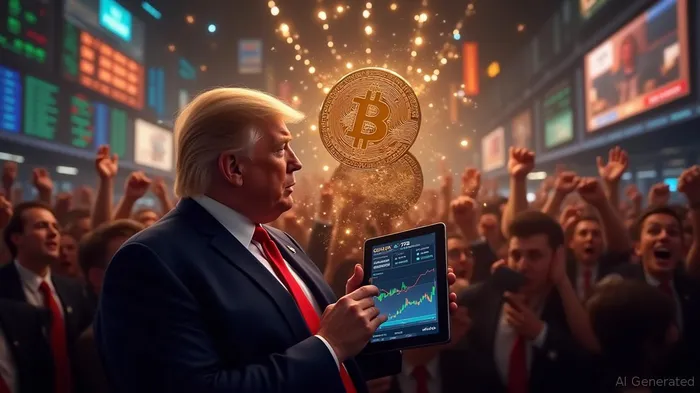
President Donald Trump has reinforced his public endorsement of Bitcoin, framing the cryptocurrency as a pivotal tool for reshaping U.S. economic strategy and countering global financial competition. At a recent press event, Trump highlighted Bitcoin’s role in job creation and strengthening the U.S. dollar’s global stature, revealing his personal pre-presidential investments in the asset and noting his children’s participation. He credited his administration with establishing a foundation for the crypto industry in the U.S., arguing that proactive measures prevented China from dominating the sector [1].
Trump’s influence extends beyond rhetoric. Trump MediaDJT-- & Technology Group has allocated $2 billion to Bitcoin and related securities, positioning itself as one of the largest corporate holders of the asset. The company has also invested hundreds of millions in crypto derivatives tied to ETFs and blockchain equities, reflecting a broader strategy to cement U.S. leadership in digital finance. These moves align with regulatory advancements, including the July 16, 2025, enactment of the Guiding and Establishing National Innovation for U.S. Stablecoins (GENIUS) Act, which established a federal framework for stablecoins and digital assets [4]. The law, designed to address regulatory gaps, coincided with a $78 billion surge in crypto markets, linked to the U.S.-EU trade deal and the act’s passage [6].
The Trump family’s crypto initiatives also encompass decentralized finance (DeFi). World Liberty Financial, a Trump-backed DeFi venture, generated $500 million in revenue since its launch, leveraging microloans and real-world utility to attract investors [3]. Despite concerns about conflicts of interest, supporters argue the projects aim to modernize U.S. financial systems rather than prioritize personal gains. Meanwhile, regulatory scrutiny remains a hurdle: The SEC delayed its decision on Truth Social’s Bitcoin ETF proposal until September 18, 2025, fueling uncertainty in the market [2].
Trump’s strategic emphasis on crypto underscores a broader geopolitical objective. By promoting Bitcoin as a decentralized alternative to traditional banking, the administration seeks to counter de-dollarization efforts and enhance U.S. economic resilience. The $2 billion Bitcoin acquisition by Trump Media, coupled with the GENIUS Act’s focus on innovation, reflects a calculated push to attract institutional investors while mitigating risks associated with stablecoins. However, the SEC’s cautious stance on ETFs highlights the challenges of balancing innovation with oversight, as market participants await clarity on regulatory pathways [7].
Market dynamics further illustrate the impact of Trump’s agenda. Bitcoin’s price approached $120,000 as institutional adoption expanded, while Trump’s endorsement of DeFi projects like microloans demonstrated confidence in decentralized systems. Analysts, including Michael Saylor, have forecasted dramatic gains for Bitcoin—such as a 17,400% surge—though such projections remain speculative and contingent on macroeconomic factors like trade agreements [9]. The interplay of regulatory developments, institutional interest, and geopolitical strategies suggests that the crypto sector’s trajectory will remain intertwined with U.S. policy decisions.
Trump’s multifaceted approach—spanning investments, legislation, and DeFi ventures—positions the U.S. as a leader in the digital asset era. Yet the long-term success of this strategy hinges on resolving regulatory ambiguities and addressing technical challenges in DeFi scalability and security. As the administration continues to shape the crypto landscape, its actions will likely influence global adoption patterns, reinforcing the U.S.’s role in defining the future of finance.
Sources: [1] https://coinmarketcap.com/community/articles/68884f48ee68857097c3532c/ [2] https://www.mitrade.com/insights/news/live-news/article-3-992758-20250729 [3] https://bravenewcoin.com/sponsored/presale/microloans-make-a-comeback-under-trump-3-new-crypto-projects-set-to-benefit [4] https://www.aol.com/finance/trump-media-stock-tests-limits-100056994.html [6] https://www.hoganlovells.com/en/publications/the-payments-newsletter-including-digital-assets-blockchain-july-2025 [7] https://medium.com/@dominalt/brics-currency-is-over-trump-stopped-de-dollarization-plans-fe405c6c430e [9] http://www.msn.com/en-us/money/savingandinvesting/1-top-cryptocurrency-to-buy-before-it-soars-17-400-according-to-michael-saylor/ar-AA1JkU3P

Stay ahead of the market.
Get curated U.S. market news, insights and key dates delivered to your inbox.
AInvest
PRO
AInvest
PRO



Comments
No comments yet