
Bitcoin News Today: Texas Sees Bitcoin as Inflation Hedge, Creates First State Reserve


 Aime Summary
Texas Becomes First U.S. State to Establish Strategic BitcoinBTC-- Reserve
The Texas state government has become the first U.S. state to allocate funds for a formal Bitcoin reserve, marking a historic shift in public-sector finance. On November 20, Texas invested $10 million in Bitcoin, with $5 million initially purchased through BlackRock's IBITIBIT-- ETF and an additional $5 million earmarked for direct, self-custodied Bitcoin holdings. The move, announced by Lee Bratcher, president of the Texas Blockchain Council, reflects a broader strategy to integrate digital assets into long-term treasury planning.
The initial $5 million allocation via the ETF was executed at a price point of roughly $87,000 per Bitcoin, capitalizing on a market pullback from earlier highs above $120,000. Bratcher emphasized that the state aims to eventually transition to self-custody of Bitcoin, though the process is still being finalized. The remaining $5 million will be acquired directly once the state completes its custodianship framework according to reports.
Legislation passed earlier this year authorized the creation of the Texas Strategic Bitcoin Reserve, allocating $10 million from general revenue for the initiative. The state's comptroller's office has also issued a request for information (RFI) to crypto industry leaders to develop best practices for managing the reserve according to analysis. 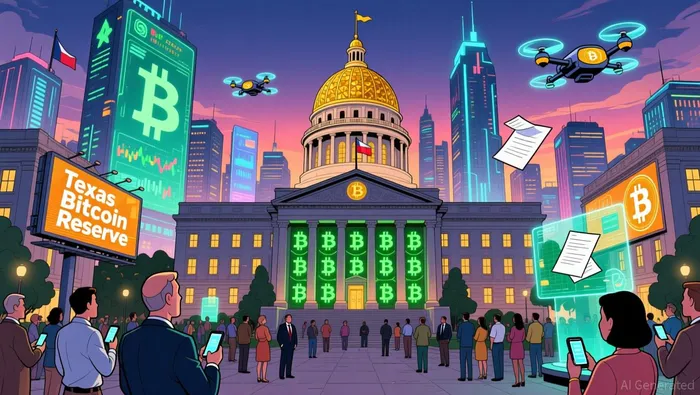 This effort positions Texas as a pioneer in state-level cryptocurrency adoption, with officials citing Bitcoin's potential as a hedge against inflation and a long-term store of value.
The move has drawn comparisons to other states exploring similar strategies. Michigan has invested in Bitcoin ETFs through public pension funds, while Wisconsin sold its $350 million stake in the BlackRockBLK-- ETF earlier this year according to reports. New Hampshire and Arizona are also advancing plans to establish crypto reserves, with Arizona proposing to use unclaimed crypto properties for its stockpile according to market analysis. Texas's action, however, is the first to result in an actual purchase of Bitcoin.
Critics have noted that the ETF route is an indirect investment, as IBIT holds Bitcoin rather than the state holding the asset directly. Nevertheless, the state's treasury team defended the approach as a compliant and secure mechanism for entering the market. The purchase also coincided with broader market volatility, as BlackRock's IBIT ETF saw $355 million in net outflows on the same day.
The initiative aligns with growing global interest in Bitcoin as a reserve asset. Cryptocurrency entrepreneur Mike Alfred predicted that the U.S. will eventually follow suit, but only after other countries begin accumulating Bitcoin. Meanwhile, Texas officials remain focused on finalizing custodianship agreements and expanding the reserve's scope. State Senator Charles Schwertner, a key architect of the bill, hinted that Ethereum could be added to the reserve if its market cap sustains above $500 billion.
Texas's move underscores a broader trend of institutional adoption, with governments and universities increasingly viewing Bitcoin as a strategic asset. The state's approach may serve as a model for other jurisdictions, accelerating the integration of cryptocurrencies into traditional financial systems.

Stay ahead of the market.
Get curated U.S. market news, insights and key dates delivered to your inbox.
AInvest
PRO
AInvest
PRO



Comments
No comments yet