
Bitcoin News Today: Tether's Risky Reserves: Volatility Threatens Stablecoin's Stability


 Aime Summary
Arthur Hayes, co-founder of BitMEX, has sounded an alarm over Tether's growing exposure to BitcoinBTC-- and gold, warning that a sharp decline in these assets could threaten the stablecoin issuer's solvency. TetherUSDT--, which backs its $184 billion market-cap USDTUSDT-- with a mix of cash, short-term Treasuries, and high-risk assets like Bitcoin and gold, has drawn scrutiny for its recent strategic shifts. Hayes argues the firm is positioning itself for a Fed rate-cut cycle by reallocating reserves into assets that could surge in a low-interest-rate environment but carry significant downside risk. "If their gold and Bitcoin holdings drop by about 30%, their equity will vanish, and USDT will theoretically go bankrupt," he wrote on X according to Hayes' analysis.
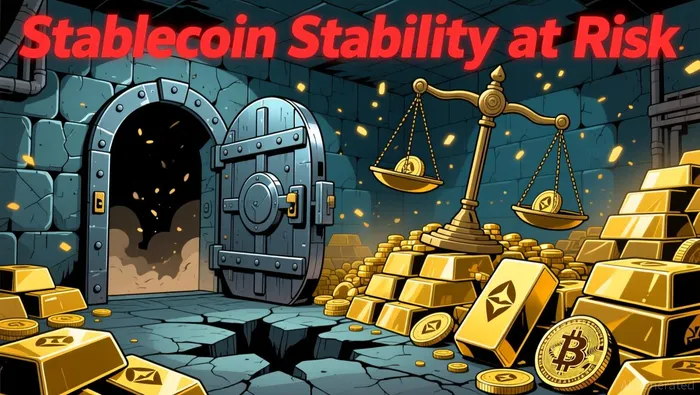
The warning comes amid growing transparency demands from major holders and exchanges, who are pushing for real-time access to Tether's balance sheets to assess solvency risks. This follows a recent S&P Global Ratings downgrade of USDT's peg stability to a "weak five," citing Tether's increased allocation to high-risk assets. S&P noted that Bitcoin now accounts for 5.6% of USDT's reserves, surpassing the 3.9% overcollateralization threshold, and warned that a drop in BTC's value could leave the stablecoin undercollateralized.
Tether's gold strategy has also drawn attention, with the firm's reserves now rivaling those of central banks. According to Jefferies, Tether holds 116 tons of physical gold, equivalent to the holdings of South Korea and Hungary. The stablecoin issuer has aggressively accumulated gold, acquiring $12.9 billion worth in nine months, and has deepened its involvement in the gold industry through investments in mining and royalty companies. While this diversification aims to enhance USDT's stability, it also introduces volatility risks. Gold's price swings up 50% in 2025-could erode Tether's equity cushion if the metal's value reverses.
The debate over Tether's strategy highlights broader tensions in the stablecoin sector. Critics argue that its reliance on opaque reserves undermines confidence, while proponents see gold and Bitcoin as hedges against fiat devaluation and inflation. Tether CEO Paolo Ardoino has defended the approach, calling the stablecoin "the first overcapitalized firm" in the financial industry and denying that its reserves include "toxic" assets. However, regulatory challenges loom, particularly in the U.S., where the GENIUS Act classifies gold as a non-compliant asset for stablecoin reserves.
Hayes' warnings underscore the precarious balance Tether must strike between growth and stability. While Bitcoin and gold could benefit from a Fed rate-cut cycle, their volatility poses a direct threat to USDT's peg. For now, Tether remains the largest stablecoin, but the pressure to provide greater transparency-and the potential for regulatory intervention-could reshape its strategy in the coming months. As Hayes noted, the market is watching closely: Some large holders and exchanges will demand to see their balance sheets in real time to assess Tether's solvency risk.

Stay ahead of the market.
Get curated U.S. market news, insights and key dates delivered to your inbox.


AInvest
PRO
AInvest
PRO



Comments
No comments yet