
Bitcoin News Today: Tether's Gold Gambit: Market Power vs. Stability Concerns


 Aime Summary
Tether, the issuer of the world's largest stablecoin, has emerged as the largest private holder of gold globally, surpassing central banks such as those of South Korea, Hungary, and Greece. According to Bloomberg and Jefferies analyses, Tether's gold reserves now exceed 116 tons, valued at over $12.9 billion as of September 2025, marking a dramatic shift in its reserve strategy and reshaping perceptions of stablecoin stability. This surge, driven by aggressive acquisitions in Q3 2025 - adding 26 tons alone - positions TetherUSDT-- as a significant player in the gold market, rivaling mid-sized national reserves.
The company's pivot to gold reflects a broader diversification of its asset backing, which now includes 7% gold in its total reserves, alongside BitcoinBTC-- and secured loans. This move, initially aimed at hedging against macroeconomic instability and inflation, has accelerated in 2025 as gold prices surged over 50% year-to-date. Jefferies analysts note that Tether's gold purchases accounted for 2% of global demand in the third quarter, tightening supply and influencing market sentiment. 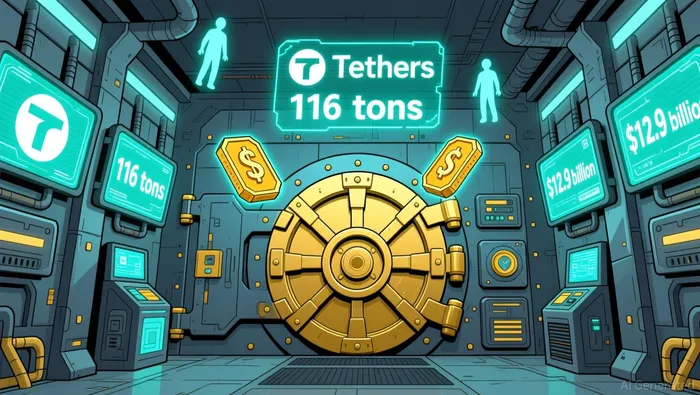 The firm's strategy also involves vertical integration into the gold supply chain, including a 37.8% stake in Canadian gold royalty firm Elemental Altus Royalties, and plans to acquire up to 51.8%.
However, this expansion has drawn scrutiny. S&P Global Ratings downgraded Tether's USDT stability rating to "weak" from "constrained," citing heightened exposure to high-risk assets like Bitcoin (5.6% of reserves) and gold. The agency warned that a decline in Bitcoin's value or other risky holdings could reduce reserve coverage, potentially leaving USDT undercollateralized according to S&P Global Ratings. Tether's reserves now include 7.13% in gold and 5.44% in Bitcoin, with cash-equivalent assets at 77.23%, reflecting a shift away from its traditional reliance on Treasuries and cash according to financial reports.
The implications extend beyond Tether. By becoming a major gold buyer, the firm has influenced both crypto and traditional markets. Gold's role as a safe-haven asset is now intertwined with digital finance, as tokenized gold (XAU₮) gains traction. Jefferies estimates Tether could acquire another 100 tons in 2025, leveraging its $15 billion annual profit projections. Meanwhile, regulators face challenges in reconciling Tether's gold-backed reserves with frameworks like the U.S. GENIUS Act, which mandates stablecoins be 100% backed by "high-quality liquid assets".
Looking ahead, Tether's dual-track strategy - expanding gold and Bitcoin reserves while launching a U.S.-compliant stablecoin (USAT) backed by Treasuries - aims to navigate regulatory pressures and preserve market dominance. Competitors may follow suit, but Tether's scale and infrastructure give it a first-mover advantage. For investors, the move underscores a maturing crypto ecosystem where physical assets anchor digital value, yet risks like market concentration and regulatory uncertainty remain.

Stay ahead of the market.
Get curated U.S. market news, insights and key dates delivered to your inbox.


AInvest
PRO
AInvest
PRO



Comments
No comments yet