
Bitcoin News Today: Tether CEO Defies S&P Downgrade: A Clash Between Innovation and Traditional Finance


 Aime Summary
Tether CEO Paolo Ardoino has launched a sharp rebuttal to S&P Global Ratings' recent downgrade of the stablecoin USDTUSDT--, accusing the agency of misunderstanding the company's financial model and traditional finance of harboring "loathing" toward innovative structures. The downgrade, which lowered USDT's stability score to "weak" on a five-point scale, cited increased exposure to high-risk assets like BitcoinBTC-- and gold, as well as insufficient transparency in reserve management. S&P noted that Bitcoin now accounts for 5.6% of USDT's circulating supply, exceeding the 3.9% overcollateralization buffer, and warned that a sharp decline in BTCBTC-- or other volatile assets could leave the token undercollateralized.
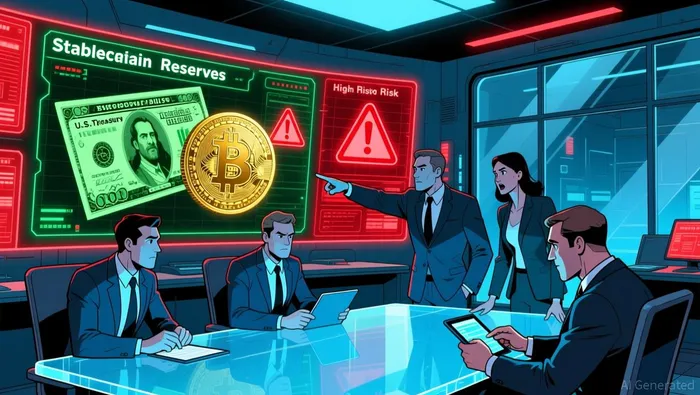 Ardoino dismissed the critique as part of a broader resistance from traditional finance institutions, which he accused of clinging to a "broken" system. "Tether is living proof that the traditional financial system is so broken that it's becoming feared by the emperors with no clothes," he wrote on X, emphasizing the company's status as an overcapitalized entity with no "toxic" assets in its reserves. TetherUSDT--, which maintains $181.2 billion in reserves backing its $184.4 billion in liabilities, has published quarterly independent attestations since 2021 and claims to have never refused a redemption request according to independent audits.
The downgrade has intensified scrutiny over Tether's reserve strategy, particularly its shift toward Bitcoin and gold. BitMEX co-founder Arthur Hayes highlighted risks in a November 30 post, warning that a 30% drawdown in these assets could wipe out Tether's equity and render USDT technically insolvent. Tether's third-quarter 2025 attestation revealed $12.9 billion in gold and $9.9 billion in Bitcoin holdings, part of a deliberate "interest rate trade" to hedge against potential Federal Reserve rate cuts according to the latest report. While Tether holds $112.4 billion in U.S. Treasury bills and $21 billion in repo agreements, Hayes argued that the firm's thin equity cushion-estimated at $3.7% of assets-exposes it to asymmetric risks during market downturns according to industry analysis.
Industry stakeholders have pushed back against these warnings. Tran Hung, CEO of UQUID Card, noted that Tether's reserves remain heavily weighted toward liquid, low-risk instruments, with over $140 billion in cash equivalents sufficient to cover redemption demands even in a crisis. Former Citi analyst Joseph emphasized Tether's profitability, with $10 billion in annual interest income from Treasuries and a corporate equity buffer potentially exceeding $50 billion ("Tether's structure is more conservative than banks, which operate with 5-15% liquidity," he argued, noting the firm's ability to recapitalize if needed).
The downgrade has also sparked mixed reactions in China, where USDT dominates underground crypto trading. Over 20 million participants rely on the token to access digital assets despite the 2021 ban, with traders expressing both skepticism and panic over the S&P assessment according to market analysts. Some dismissed the downgrade as another false alarm, citing USDT's resilience during past crises, while others feared systemic instability if the peg were to break according to Chinese traders.
Looking ahead, Tether faces mounting pressure to improve transparency, particularly around custodians and counterparties. S&P called for reduced exposure to high-risk assets and clearer disclosures, while regulators globally have signaled increased oversight of stablecoin reserves according to financial reports. Ardoino, however, remains defiant, arguing that traditional rating models have repeatedly failed to predict financial collapses and that Tether's model is "the first overcapitalized firm in the financial industry" according to CEO statements.

Stay ahead of the market.
Get curated U.S. market news, insights and key dates delivered to your inbox.


AInvest
PRO
AInvest
PRO



Comments
No comments yet