
Bitcoin News Today: Solana Defies Crypto's 'Extreme Fear' as ETFs Lose $420M


 Aime Summary
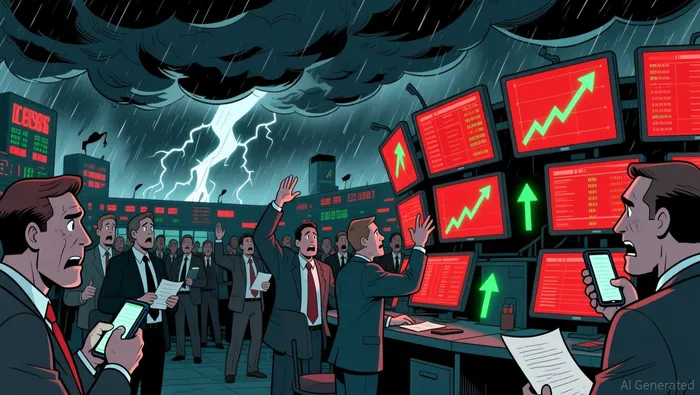
The Cryptocurrency Fear and Greed Index, a key barometer of market sentiment, climbed to 19 on November 19, 2025, marking the longest continuous stretch in "Extreme Fear" territory in over three years, according to data from CoinMarketCap. Despite this slight upward tick, the index remains entrenched in a bearish psychological state, reflecting persistent uncertainty among investors amid regulatory scrutiny, volatile price swings, and institutional caution. The benchmark has now spent eight consecutive days in "Extreme Fear," underscoring a market grappling with systemic risks and a lack of clear catalysts for recovery.
The broader crypto ecosystem continues to face headwinds, with U.S. spot ETFs experiencing significant outflows. Bitcoin and Ethereum ETFs saw combined net outflows of $420.8 million in the latest reporting period, with BitcoinBTC-- ETFs alone hemorrhaging $372.8 million. Meanwhile, SolanaSOL-- (SOL) has emerged as a relative bright spot, maintaining positive inflows and outperforming its peers. Analysts attribute this resilience to Solana's growing institutional adoption and its role as a hub for decentralized finance (DeFi) innovation. "Solana's infrastructure is attracting capital that's fleeing less scalable networks," said one market analyst cited in a CoinMarketCap report.
Institutional players are also recalibrating their strategies. Strategy, the largest corporate holder of Bitcoin, reported third-quarter earnings of $8.42 per share, driven by mark-to-market gains as the price of Bitcoin rose nearly 7% during the period. The firm's Bitcoin holdings expanded to 640,031 BTC by September 30, reflecting its aggressive accumulation strategy. However, broader market volatility has eroded confidence. Coinbase Global recently raised $216 million through a public token sale for Monad's MON tokens but saw its shares drop 30% amid a broader tech selloff. The exchange's struggles highlight the fragility of investor sentiment in a sector still reeling from regulatory crackdowns and high-profile failures.
Regulatory pressures are intensifying, with crypto ATM operator Crypto Dispensers exploring a potential $100 million sale amid federal money laundering charges against its CEO. The company, which shifted to a software-driven model in 2020, faces scrutiny over its role in facilitating illicit transactions through its network. The U.S. Department of Justice alleges the firm processed $10 million in proceeds from narcotics trafficking and wire fraud, a claim both the CEO and company have denied. This case underscores a wider regulatory crackdown on crypto infrastructure, with cities like New York and Los Angeles imposing restrictions on ATM operations.
Meanwhile, geopolitical tensions are complicating the landscape. South African authorities have launched an investigation into Jacob Zuma's daughter, Duduzile Zuma, over her alleged role in recruiting South African men to fight for Russian forces in Ukraine. While tangential to crypto markets, the case highlights the intersection of global politics and digital assets, where state actors and private entities increasingly blur lines. The incident adds to a backdrop of geopolitical instability that has historically amplified crypto market volatility.
Despite these challenges, some firms are pushing forward with expansion. WhiteBIT celebrated its seventh anniversary by launching a global fintech brand, W Group, and expanding into markets like Australia and Brazil. The company's security-first approach, including a top-tier Cryptocurrency Security Standard certification, positions it to attract risk-averse investors. Similarly, Bitget's collaboration with LALIGA and Atlético de Madrid's star Julián Alvarez aims to bridge sports and crypto through a new video campaign, leveraging the athlete's strategic mindset to promote "smart trading".
The market's "Extreme Fear" state may persist until macroeconomic clarity emerges. With Bitcoin down roughly one-third from its peak and the S&P 500 Index exhibiting heightened volatility, investors remain cautious. However, long-term proponents argue that periods of fear often precede innovation. According to a strategist from HashStaking, "History shows that the most transformative crypto projects emerge during bear markets," which recently launched an AI-powered staking index to guide regional participation. As the sector navigates this challenging phase, the interplay between institutional resilience, regulatory evolution, and technological innovation will likely shape the next chapter for digital assets.

Stay ahead of the market.
Get curated U.S. market news, insights and key dates delivered to your inbox.


AInvest
PRO
AInvest
PRO



Comments
No comments yet