
Bitcoin News Today: Screven County Uses Bitcoin Blockchain to Secure Election Results with Immutable Timestamps
 Aime Summary
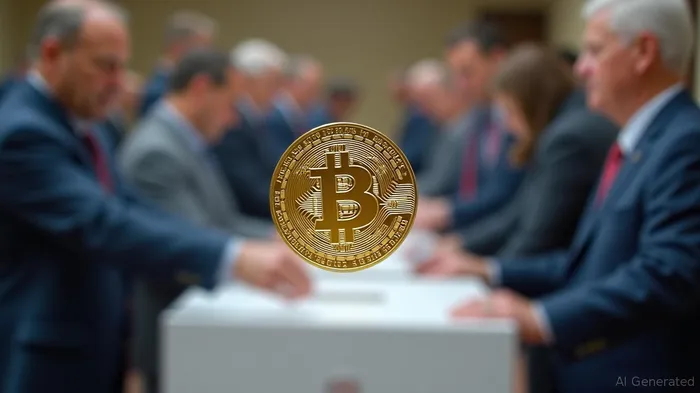
Screven County in Georgia, U.S., has become the first U.S. county to use Bitcoin-based blockchain technology to secure election results, deploying Simple Proof’s OpenTimestamps system in November 2024. The method involves generating a cryptographic hash—essentially a digital fingerprint—of official election data and embedding it into a BitcoinBTC-- transaction. This creates an immutable, time-stamped record that can be independently verified without exposing sensitive voter information. By anchoring this hash to Bitcoin’s decentralized ledger, the county established a tamper-evident audit trail, ensuring that any post-election alterations would be detectable by anyone with access to the original documents [1].
The system operates by leveraging cryptographic structures such as Merkle trees, which allow a single blockchain entry to verify the existence of multiple documents simultaneously. This approach enabled Screven County to timestamp all relevant election materials with one blockchain entry, offering a scalable solution for securing large datasets. Crucially, the process does not require election officials to have technical expertise in blockchain, minimizing operational disruption while maintaining high security standards [1].
The benefits of this system lie in its dual emphasis on transparency and confidentiality. While the hash allows anyone to confirm the existence of a document at a specific time, it does not reveal the document’s contents, such as individual voter details or vote counts. This ensures that sensitive data remains private while providing a verifiable, tamper-proof record. Because the Bitcoin blockchain is maintained by thousands of independent nodes globally, no single authority can alter or erase the timestamp, reducing the risk of centralized system manipulation or failure [1].
Screven County’s initiative draws on a proven precedent in Guatemala, where Simple Proof’s system was deployed in the 2023 presidential election. The country faced deep-seated distrust in its electoral infrastructure, particularly after the 2019 election night collapse of the official results system. In 2023, over 150,000 digital tally sheets were hashed and anchored to the Bitcoin blockchain, ensuring that any post-election tampering would be detectable. This implementation played a key role during a politically tense period when the Attorney General’s office controversially seized physical tally sheets, raising fears of manipulation. The immutability of the blockchain-anchored records allowed independent observers and citizen groups to confirm the authenticity of the official results, reinforcing democratic resilience [1].
The impact of such systems extends beyond securing election data. By offering a decentralized, permissionless network for verifying public records, Bitcoin-based timestamping could inspire broader reforms in governance. Applications may include securing legal rulings, legislative records, public spending, and historical archives. This could create a durable audit trail that enhances accountability across various sectors of government, particularly in regions with weak rule of law or high levels of political interference [1].
However, the success of these technologies hinges on the political will of authorities to embrace transparency. While Screven County’s model demonstrates the technical feasibility and operational simplicity of blockchain-based election security, its global adoption will depend on whether governments and institutions choose to implement and support such systems. The Guatemalan experience underscores this point: even with robust technological safeguards in place, the credibility of election results can only be maintained if institutions permit and protect the verification process [1].
Source: [1] Can Bitcoin Improve Election Integrity? - Bitfinex blog (https://blog.bitfinex.com/freedom/can-bitcoin-improve-election-integrity/)

Stay ahead of the market.
Get curated U.S. market news, insights and key dates delivered to your inbox.


AInvest
PRO
AInvest
PRO



Comments
No comments yet