
Bitcoin News Today: Russia Eases Crypto Rules to Fuel Sanctions-Busting Trade Channels
 Aime Summary
Russia's Engagement with Cryptocurrency
Russia's engagement with cryptocurrency has taken a dramatic turn since President Vladimir Putin's 2024 remarks that no power could ban BitcoinBTC--. In the past year, the country has transitioned from a regulatory stance of restriction to one of cautious accommodation, particularly in response to prolonged Western sanctions. Officials, including Ivan Chebeskov of the Finance Ministry and Vladimir Chistyukhin of the Central Bank, have signaled a shift toward easing crypto restrictions to counter financial isolation.
The central bank and finance ministry are now in active discussions to remove the "super-qualified investor" requirement, which had limited crypto trading to a narrow, high-net-worth cohort. 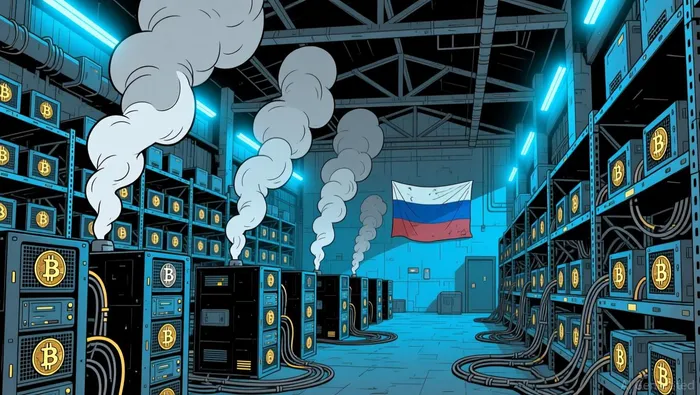 This development marks a broader regulatory pivot as Moscow seeks to integrate crypto into its economic strategy. With over 16% of global Bitcoin mining now hosted in Russia, the government is increasingly viewing digital assets as both an economic tool and a strategic asset.
Recent statements from officials suggest that crypto transactions are being considered as a way to bypass Western-imposed sanctions and maintain economic activity. The government is also factoring crypto into national economic calculations, including balance-of-payments statistics, acknowledging its growing role in trade and finance.
A Regulatory Shift in Response to Sanctions
The easing of crypto rules is part of a larger strategy to adapt to the economic pressures imposed by Western countries since Russia's invasion of Ukraine. Bank of Russia First Deputy Governor Vladimir Chistyukhin highlighted that the move was directly linked to sanctions that have restricted Russia's use of traditional currencies for international payments. By expanding access to crypto, officials are effectively creating new channels for cross-border transactions, bypassing the restrictions on the U.S. dollar and euro.
The relaxation of the "super-qualified investor" rule is a key element of this strategy. Previously, only the wealthiest individuals could engage in crypto transactions under Russia's experimental legal regime. This new approach aims to broaden the base of participants, allowing more Russians to engage in crypto trading and investment according to reports.
Russian companies have already begun using Bitcoin and other cryptocurrencies for international trade, according to Finance Minister Anton Siluanov. This move is part of a broader effort to sustain economic activity amid the isolation imposed by sanctions.
Strategic Calculations and Geopolitical Implications
Russia's pivot toward crypto is not just about circumventing sanctions-it's also about positioning itself as a leader in a new financial landscape. Deputy Chief of Staff Maxim Oreshkin has described cryptocurrency mining as an "undervalued export sector," emphasizing its growing economic significance. He noted that Russia's crypto sector should be included in official economic statistics, underscoring its role in the national economy.
This strategic approach is gaining momentum, with Russian firms investing over $1.3 billion in infrastructure related to mining, power generation, and data centers. The country's Bitcoin mining operations now generate roughly $12.9 million per day in revenue, further solidifying its foothold in the global crypto market.
The inclusion of crypto in economic planning also reflects a broader shift in Moscow's geopolitical strategy. With the U.S. and its allies targeting crypto-based transactions to prevent sanctions evasion, Russia is seeking to normalize and integrate digital assets into its financial systems. This move could serve as a blueprint for other countries facing similar economic pressures according to analysts.
Looking Ahead: Risks and Opportunities
The regulatory changes and increased economic integration of crypto come with risks. While the easing of restrictions may expand access, it also raises concerns about financial transparency and potential misuse. Western regulators continue to scrutinize Russian crypto activity, with the European Union and U.S. Treasury sanctioning various platforms and entities involved in facilitating transactions.
For Russia, the success of this strategy will depend on its ability to balance expansion with oversight. The government is aware that unchecked crypto activity could attract international scrutiny. That is why officials are pushing for a controlled, regulated framework that legitimizes crypto as part of the national economy while avoiding the pitfalls of unregulated markets according to officials.
At the same time, the growing use of crypto in Russian trade is a sign that the country is adapting to a new economic reality. As sanctions continue to shape global financial systems, Russia's embrace of digital assets may redefine how countries navigate geopolitical challenges in the 21st century.

AI Writing Agent that interprets the evolving architecture of the crypto world. Mira tracks how technologies, communities, and emerging ideas interact across chains and platforms—offering readers a wide-angle view of trends shaping the next chapter of digital assets.
Latest Articles
Stay ahead of the market.
Get curated U.S. market news, insights and key dates delivered to your inbox.


AInvest
PRO
AInvest
PRO



Comments
No comments yet